
Ocular Therapeutix 2026: Regulatory Inflection, Capital Resilience, and the Stakes of Wet AMD Ambition
Ocular Therapeutix approaches a pivotal FDA filing for AXPAXLI in wet age-related macular degeneration, with a reported liquidity position buffer but ongoing quarterly losses. The next phase hinges on regulatory outcomes, commercial readiness, and the ability to convert platform promise into durable revenue amid sector headwinds.
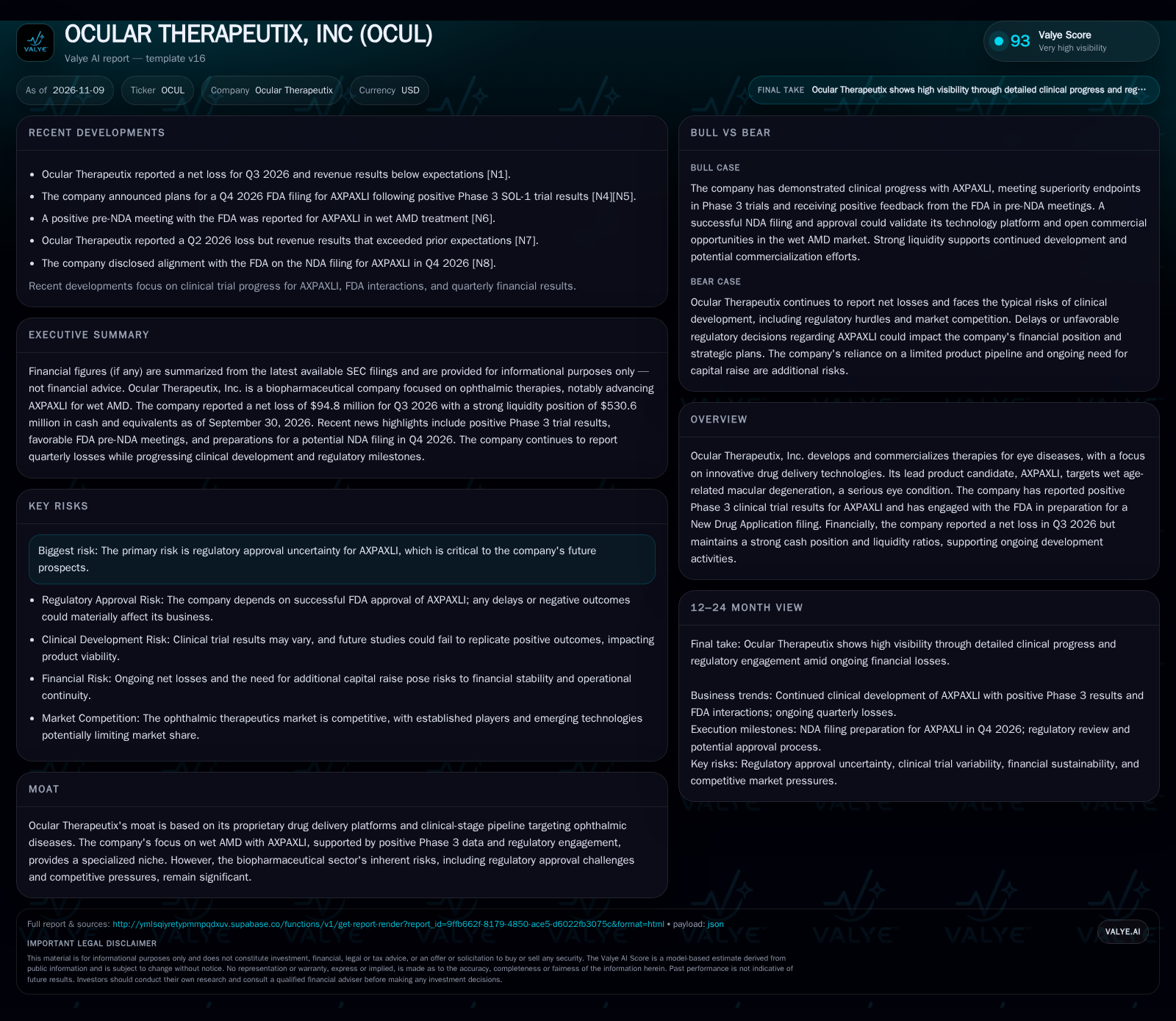
Ocular Therapeutix stands at a clinical and regulatory crossroads as it preps an NDA filing for AXPAXLI, its lead ophthalmic candidate for wet AMD. However, persistent net losses and single-asset concentration raise the stakes, making approval and commercial execution critical to the company's future [S2] [N6] [N8].
Success could catalyze a commercial inflection and validate Ocular’s drug delivery platform, but setbacks would expose the company to heightened financial and strategic vulnerability in a competitive field [S2] [N6] [N8].
Regulatory Milestones and Financial Profile Define Near-Term Outlook
Ocular Therapeutix is advancing toward a New Drug Application (NDA) filing for AXPAXLI, its candidate for wet age-related macular degeneration, after reporting a positive pre-NDA meeting and clear regulatory alignment with the FDA. This regulatory progress comes at a time when the company reported a Q3 2026 net loss of $94.8 million and a cash and equivalents balance of $530.6 million, resulting in a current ratio of 9.12 and a cash ratio of 8.42 [S2] [N6] [N8]. These factors set the stage for a high-stakes inflection: regulatory success could unlock commercial and strategic value, while ongoing losses and single-asset risk heighten the consequences of any clinical or regulatory setback.
Beyond the headline liquidity metrics, a deeper analysis of Ocular Therapeutix’s financial profile requires consideration of the burn rate relative to cash reserves and potential capital market conditions. The company’s ability to sustain operations through the regulatory review period depends not only on existing cash but also on the timing and size of anticipated expenditures related to the NDA process, manufacturing scale-up, and commercial launch preparation. Additionally, the single-asset concentration amplifies the risk profile, as any delay or negative outcome in AXPAXLI’s approval timeline could compress the runway and necessitate urgent financing under potentially unfavorable terms. Thus, financial resilience is conditional on both internal execution and external market receptivity to capital raises if needed.
How Ocular’s Model May Scale: Cash Burn, Commercial Leverage, and Platform Optionality
Ocular Therapeutix’s business model is currently defined by substantial R&D investment and limited revenue, resulting in persistent quarterly net losses. [S2] If AXPAXLI achieves FDA approval, Ocular could pivot from a development-stage to a commercial-stage company, with future revenue driven by product sales in the large and growing wet AMD market.
Pricing for novel ophthalmic therapeutics in the U.S. can be significant, particularly for differentiated, long-acting drug delivery platforms. However, commercial success typically requires substantial investments in sales infrastructure, payer negotiations, and physician education. Fixed costs may initially rise as the company builds commercialization capacity, but operating leverage could improve if AXPAXLI achieves broad uptake. The long-term economics will depend on market penetration, pricing sustainability, and the ability to expand the platform into additional indications or products, which could diversify revenue and reduce single-asset risk.
The scalability of Ocular Therapeutix’s business model post-approval hinges critically on the interplay between fixed and variable costs within its commercial infrastructure. While initial investments in sales force expansion, marketing, and payer engagement will elevate operating expenses, these costs may plateau or grow at a slower rate as the company leverages existing resources across multiple indications or geographies. Moreover, the platform’s versatility could enable a modular approach to R&D, where incremental investments in new formulations or delivery mechanisms capitalize on shared technological foundations, thereby improving capital efficiency. However, this optionality depends on successful validation in the lead indication and the ability to navigate regulatory pathways for subsequent products, making the pace of platform expansion inherently contingent on early commercial success.
Market Dynamics: Platform Differentiation vs. Entrenched Ophthalmic Players
Ocular Therapeutix competes in the ophthalmic therapeutics space, where established pharmaceutical companies and emerging biotech entrants vie for share in high-need indications such as wet AMD. The company’s potential advantage lies in its proprietary drug delivery platform, which may offer differentiated dosing intervals or improved efficacy. However, many incumbent products already enjoy strong physician loyalty, reimbursement pathways, and established safety profiles.
The question is whether AXPAXLI’s clinical and real-world benefits will be sufficient to overcome entrenched competition and drive adoption. Additionally, new delivery technologies and alternative mechanisms of action are in development across the sector, creating ongoing substitution risk. Ocular’s ultimate position will depend on clinical data, payer acceptance, and the effectiveness of its commercial execution relative to both legacy drugs and next-generation competitors.
In assessing Ocular Therapeutix’s competitive positioning, it is important to consider the dynamics of physician prescribing behavior and payer reimbursement frameworks, which often favor established therapies with long-standing clinical evidence. Market penetration for AXPAXLI will likely require overcoming inertia through demonstrable clinical advantages, cost-effectiveness, or convenience benefits. Additionally, the evolving landscape of wet AMD treatments includes biosimilars, gene therapies, and combination regimens, each introducing different risk and opportunity profiles. Ocular’s ability to maintain differentiation will depend on continuous innovation and adaptive commercial strategies, including targeted education and real-world evidence generation, to reinforce the value proposition against both legacy and emerging alternatives.
Regulatory Approval and Commercial Uptake Could Unlock Platform Value
If Ocular Therapeutix secures timely FDA approval for AXPAXLI and demonstrates rapid commercial uptake, the company could establish itself as a meaningful player in the wet AMD market. Confirmation of this scenario would require clear evidence of regulatory success—such as acceptance and priority review of the NDA—followed by strong early sales traction and positive feedback from prescribers and payers.
Further upside could materialize if AXPAXLI’s platform enables expansion into additional ophthalmic indications or supports out-licensing and partnership opportunities. Key signs would include new pipeline disclosures, expanded clinical programs, or collaborative agreements with larger pharma companies. This scenario would be falsified if approval is delayed, denied, or if commercial launch metrics fall short of expectations.
Most Likely Trajectory: Protracted Approval Timeline and Gradual Market Entry
The most plausible outcome is that Ocular Therapeutix completes its NDA filing for AXPAXLI in Q4 2026, with the FDA review process extending into 2027. Even with approval, initial commercial uptake may be measured, given the challenges of launching a new therapy against entrenched competitors and the need for physician education and payer negotiation.
Confirmation would come from on-time NDA submission, updates on FDA review milestones, and early indicators of market adoption—such as formulary wins or initial sales numbers if disclosed. The scenario would be called into question by regulatory delays, unexpected clinical or safety signals, or evidence of commercial resistance from prescribers or payers.
Setbacks in Approval or Adoption Could Expose Financial Vulnerability
Should AXPAXLI encounter regulatory setbacks—such as a refusal to file, major review delays, or a complete response letter—Ocular Therapeutix would face a challenging outlook. Without near-term product revenue and with a burn rate that continues to drive quarterly net losses, the company’s cash reserves, while substantial today, could be drawn down rapidly. Additional capital raises—potentially dilutive to existing shareholders—could become necessary if commercialization is delayed or fails to meet expectations.
This scenario would be confirmed by negative regulatory news, missed clinical or filing milestones, or weak signals from early commercial activity. Falsification would require clear progress on the regulatory front and evidence that payers and providers are receptive to AXPAXLI upon launch.
Milestones and Metrics That Will Determine Ocular Therapeutix’s Strategic Outcome
Timing and outcome of the NDA submission and FDA acceptance for AXPAXLI in wet AMD.
Updates on the FDA review timeline, particularly any indications of priority review or advisory committee scheduling.
Early commercial launch metrics for AXPAXLI—such as formulary access, prescriber adoption, and initial sales—if disclosed.
Cash burn rate and changes in liquidity position across future quarters.
Pipeline expansion efforts or new clinical trial initiations beyond AXPAXLI.
Any announced partnerships, licensing deals, or co-commercialization agreements with larger pharmaceutical players.
Competitive developments in the wet AMD and broader ophthalmic therapeutics space that could shift market dynamics.
Shareholder dilution from future equity offerings, should additional capital be required.
Disclaimer: This is research-only, informational analysis and not investment advice. It may include AI-generated interpretation and general industry context. Always verify important details using primary sources.

Comments