
MainStreet Bancshares 2026: Real Estate Lending Concentration, Credit Exposure, and the Stakes for Community Banking Resilience
MainStreet Bancshares’ profitability and dividend continuity underscore operational discipline, but its concentrated real estate loan book and exposure to small business borrowers heighten sensitivity to credit cycles, liquidity conditions, and external shocks. The next phase will test the adequacy of its credit risk buffers and the adaptability of its funding model.
The company’s risk management centers on credit loss allowances and quarterly stress testing, but the true resilience of these buffers may only be evident under adverse scenarios. Key inflections will hinge on credit performance, funding costs, and the durability of small business demand in a shifting rate environment. [S1] [S2] [N3] [N4]
MainStreet Bancshares, Inc. stands at a crossroads typical of community banks with a strong lending franchise but concentrated exposures. The cited source reports dividend-related activity; that disclosure alone does not establish dividend-policy continuity, management confidence, or a material constraint on capital flexibility. The next several quarters will be pivotal in revealing whether MainStreet’s risk mitigation strategies are robust enough for a more volatile environment. [S1] [S2] [N3] [N4]
Loan Concentration, Unfunded Commitments, and Recent Profitability: What’s Most Material Now
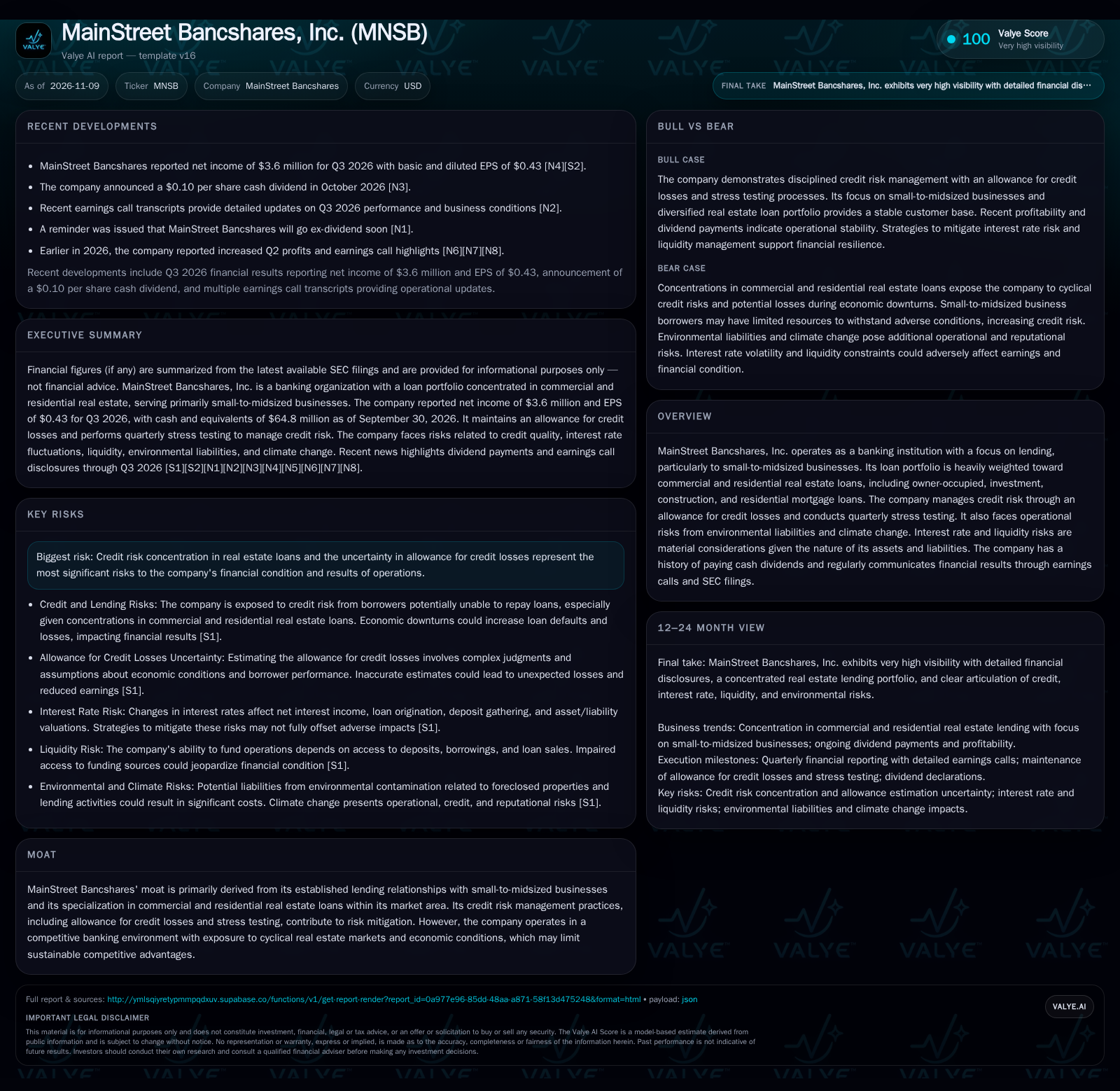
As of September 30, 2026, MainStreet Bancshares reported net income of $3.6 million and basic and diluted EPS of $0.43 for the third quarter, with $64.8 million in cash and cash equivalents [S2] [N4]. While these numbers reflect operational stability, the company’s balance sheet is defined by a heavily concentrated loan portfolio: as of December 31, 2025, $448.5 million in owner-occupied commercial real estate, $566.4 million in investment CRE, $300.7 million in construction loans, and $441.6 million in residential real estate [S1].
A further $202.6 million in unfunded credit commitments potentially extends the company’s liquidity obligations if borrowers draw on these lines [S1]. The primary customer base—small-to-midsized businesses—is typically more sensitive to economic stress, making the credit profile and risk management approach especially consequential. The continued payment of dividends, including a $0.10 per share payout announced in October 2026, highlights current profitability but cannot by itself guarantee future resilience [N3].
How MainStreet Bancshares Earns: Lending Margins, Cost of Funds, and the Leverage of Scale
The core economics of MainStreet Bancshares are driven by the spread between interest earned on loans (primarily commercial and residential real estate) and the cost of funding, which is largely deposit-based. The concentration in real estate lending means average yields may be above those of plain-vanilla consumer or government-backed loans, but this also heightens exposure to cyclical downturns and asset-quality swings.
Interest income is sensitive to both loan growth and the pricing power the bank can exert in its local markets, while interest expense will reflect the competitive landscape for deposits and the broader rate environment. In rising rate cycles, funding costs may increase faster than asset yields, compressing net interest margins unless the loan book can be repriced or expanded profitably. Fixed costs—including regulatory compliance, technology, and branch infrastructure—create operating leverage, meaning loan growth can improve efficiency ratios if credit quality is maintained.
Unfunded commitments represent a contingent capital need: if drawn during a downturn, they could pressure both liquidity and capital ratios. The allowance for credit losses acts as a first line of defense but is inherently subjective and backward-looking. The capital base must be sufficient to absorb unexpected losses, especially given the chunky exposures typical of CRE and construction loans.
Competitive Dynamics: Specialization, Relationship Banking, and the Limits of Differentiation
MainStreet Bancshares’ competitive position is rooted in its local relationships and specialization in real estate lending to small and midsized business clients. In community banking, proximity and relationship depth can provide some insulation from larger, more transactional national lenders, as local knowledge and service can attract clients seeking flexibility or speed.
However, these advantages are not absolute. Competing banks—regional, super-regional, and credit unions—may offer more diversified loan products, larger balance sheets, or digital capabilities that appeal to certain segments. Non-bank lenders and fintechs are increasingly targeting small business and real estate borrowers, sometimes with streamlined underwriting or alternative data models that could erode share.
MainStreet’s focus on CRE and construction lending is a double-edged sword: it may command premium pricing and foster loyalty, but it also exposes the bank to greater earnings volatility, especially if property values decline or refinancing becomes difficult. The company’s risk management practices (allowance, stress testing) are necessary but not unique, and the absence of distinctive technology or funding advantages may constrain the moat in a crowded market.
When Credit Holds and Funding Is Stable: Pathways to Sustainable Profitability
The bull case for MainStreet Bancshares rests on the assumption that credit quality remains sound, loan demand from small and midsized businesses is steady or growing, and funding costs are managed effectively. In this scenario, the company can continue to earn attractive spreads on its concentrated real estate loan book, benefit from operating leverage as fixed costs are spread over a larger asset base, and maintain or grow its dividend payout.
Evidence that would confirm this scenario includes stable or improving non-performing loan ratios (if disclosed), low net charge-offs, and continued growth in both loan balances and deposits without a material rise in funding costs. Maintenance or expansion of the allowance for credit losses without significant drawdown could further support confidence. A growing pipeline of new business from small enterprise clients, and the ability to retain existing relationships despite competition, would signal franchise durability.
If MainStreet can demonstrate resilience during periods of mild economic turbulence—by containing credit losses, supporting capital ratios, and defending its net interest margin—investors may view it as a reliable income and growth play, justifying a premium to book value.
Navigating Normal Cyclicality: Moderate Growth, Margin Compression, and Credit Vigilance
The most plausible outcome is that MainStreet Bancshares experiences moderate loan and deposit growth, with net interest margins facing some compression as funding costs rise in a competitive deposit environment. Credit quality is likely to be tested in pockets, especially among small business and construction borrowers, but significant deterioration is avoided through active risk management and selective lending.
Allowance for credit losses may need periodic adjustment, and non-performing asset levels could fluctuate modestly without threatening overall profitability. The company’s quarterly stress testing and risk oversight processes help anticipate emerging problems, but do not fully insulate against broader market shocks.
Confirmation of this scenario would include stable but unspectacular financial results, periodic tweaks to loan underwriting or deposit pricing, and continued but cautious investor communication around credit and liquidity risks. Falsification would require a sustained spike in credit losses, a rapid outflow of deposits, or a breakdown in access to wholesale funding.
When Real Estate Credit Cycles Turn: Liquidity Strain, Rising Losses, and Dividend Risk
In an adverse scenario, a regional or national downturn in commercial and residential real estate markets triggers higher defaults among MainStreet Bancshares’ borrowers, especially in construction and small business segments. Drawdowns on the $202.6 million in unfunded credit commitments accelerate as stressed borrowers seek liquidity, putting pressure on both the company’s funding base and its capital ratios [S1].
As non-performing loans rise, the allowance for credit losses may prove inadequate and require rapid replenishment, hitting earnings and potentially forcing a cut or suspension of the dividend. Liquidity risk intensifies if deposit outflows coincide with limited access to wholesale funding or if the bank is forced to sell loans at a discount. Environmental or climate-related losses on foreclosed properties could add to the stress, amplifying reputational and operational risks.
Falsification would require credit metrics to remain benign even as broader markets deteriorate, or for the company to demonstrate access to stable, low-cost funding under stress.
What Will Test MainStreet Bancshares’ Resilience in the Next Phase
Quarterly trends in non-performing assets and net charge-offs, if disclosed, to gauge emerging credit stress and adequacy of the allowance for credit losses.
Deposit growth or attrition rates, especially in the context of rising funding costs and competition from higher-yield alternatives.
Draw rates on unfunded credit commitments—a sustained uptick could signal borrower stress and looming liquidity needs.
Changes in the allowance for credit losses and management commentary on credit outlook, particularly in relation to commercial real estate exposures.
Capital ratios and any regulatory disclosures regarding capital adequacy or stress testing outcomes.
Evidence of successful new business development or retention among small-to-midsized business clients, supporting the core franchise.
Material developments in environmental or climate-related liabilities, including any significant write-downs or cost accruals tied to foreclosed property exposures.
Disclaimer: This is research-only, informational analysis and not investment advice. It may include AI-generated interpretation and general industry context. Always verify important details using primary sources.

Comments