
Brookfield Asset Management 2026: Fee-Bearing Capital Scale, Asset Mix, and the Stakes of Alternative Manager Diversification
Brookfield Asset Management’s $682 billion in Fee-Bearing Capital and multi-asset strategy define its position as a global alternative asset manager. With Q3 2026 revenues of $2.15 billion and net income of $3.0 billion, BAM’s performance now hinges on sustaining capital inflows, navigating market volatility, and managing the complexity of fair value accounting and regulatory risks.
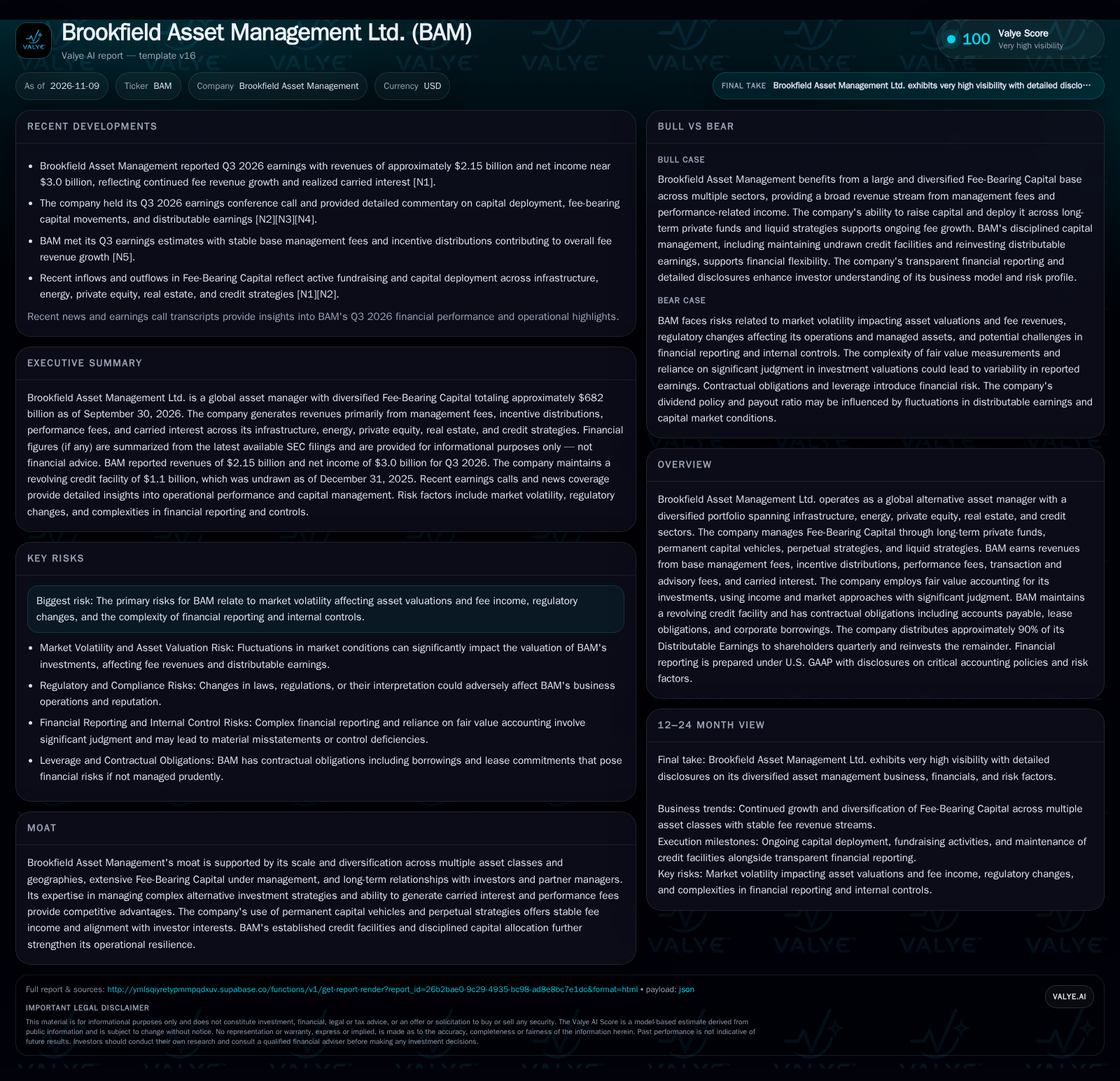
Brookfield Asset Management reported $2.15 billion in revenue and $3.0 billion in net income for Q3 2026, managing a diversified $682 billion Fee-Bearing Capital base spanning infrastructure, energy, private equity, real estate, and credit. Fee revenue growth was stable, supported by base management and incentive fees, while recent inflows and outflows reflect active capital deployment and fundraising. The company’s scale and breadth provide resilience, but ongoing volatility, regulatory exposure, and the complexity of fair value accounting remain central risks to watch. [S2] [N1] [N2] [N5]
Brookfield Asset Management’s Q3 2026 results reinforce its profile as one of the world’s largest and most diversified alternative asset managers, with $682 billion in Fee-Bearing Capital deployed across infrastructure, energy, private equity, real estate, and credit. The company’s quarter was defined by stable base management and incentive fee generation, ongoing capital inflows and outflows, and the operational flexibility afforded by a substantial undrawn credit facility. Yet, the complexity of fair value accounting, regulatory scrutiny, and exposure to market volatility pose persistent challenges. The central question for investors is whether BAM’s scale, diversification, and capital-raising engine can continue to offset these structural risks and support durable fee growth in an uncertain macro environment.
How Recent Capital Flows and Fee Stability Define BAM’s 2026 Operating Landscape
Brookfield Asset Management managed approximately $682 billion in Fee-Bearing Capital as of September 30, 2026, spread across infrastructure ($113 billion), energy ($71 billion), private equity ($53 billion), real estate ($104 billion), and credit ($341 billion) [S2]. This scale and diversification underpin the company’s ability to weather asset-specific shocks and cyclical downturns. In Q3 2026, BAM reported $2.15 billion in revenue and $3.0 billion in net income, with stable contributions from base management fees and incentive distributions [S2] [N1] [N5]. Recent quarters saw both inflows and outflows in Fee-Bearing Capital, reflecting fundraising momentum and capital deployment across strategies [N1] [N2]. These facts highlight a business model currently defined by scale, diversity of capital sources, and an ability to generate consistent fee revenue even amid market turbulence.
Dissecting BAM’s Revenue Streams and the Levers of Fee Growth
Brookfield Asset Management’s economics are anchored in its ability to charge management fees on Fee-Bearing Capital, with additional upside from incentive distributions, performance fees, transaction/advisory fees, and carried interest. The recurring base management fees provide predictable revenue, while performance and incentive fees are more volatile and tied to fund returns and capital deployment cycles. The mix between private funds, permanent capital vehicles, perpetual strategies, and liquid strategies affects both revenue stability and margin profile—perpetual and permanent capital vehicles tend to deliver steadier fee streams, while private funds and opportunistic mandates introduce higher variability.
Operating leverage can be substantial in this model: incremental Fee-Bearing Capital typically generates high-margin fee income once platform infrastructure is in place. However, the cost base is not purely fixed—fundraising, investment diligence, compliance, and risk management introduce variable costs, especially as asset complexity and regulatory requirements rise. Fair value accounting adds earnings volatility, as investment marks can swing with market sentiment, potentially distorting period-to-period net income.
Why Scale, Diversification, and Structure Matter in the Alternative Asset Manager Arena
In the global alternative asset manager landscape, BAM’s $682 billion Fee-Bearing Capital base is a substantial competitive asset, enabling it to compete for large mandates and offer clients access to a broad spectrum of strategies. Scale allows for better access to deal flow, co-investment opportunities, and operational synergies across asset classes. Diversification across infrastructure, energy, private equity, real estate, and credit reduces dependency on any single asset class or economic cycle, potentially smoothing earnings over time.
However, this scale and breadth also introduce complexity—managing disparate asset types and geographies increases operational risk and regulatory exposure. While BAM’s permanent capital vehicles and perpetual strategies may offer more stable fee income than traditional closed-end funds, the competitive environment is intensifying as institutional investors demand lower fees, more transparency, and greater alignment of interests. Competitor categories include global alternatives platforms, private equity specialists, real estate investment managers, and credit-focused firms. The moat is reinforced by investor relationships and track record, but could be eroded by fee compression, underperformance, or regulatory action.
When Capital Formation and Deployment Outpace Market Headwinds
The favorable scenario for BAM hinges on continued success in capital raising, effective deployment into high-returning assets, and benign market conditions supporting asset valuations. If institutional allocators continue to shift toward alternatives for yield and diversification, BAM could see Fee-Bearing Capital growth accelerate, particularly in infrastructure and credit where secular demand is strong. Stable or rising asset values would boost both performance fees and carried interest, while perpetual vehicles could anchor recurring revenue.
Upside would be confirmed by rising net inflows into Fee-Bearing Capital, significant new fund launches or mandate wins, and a visible increase in performance-related fee income. Signs of robust fundraising in challenging markets, or above-peer performance in flagship funds, would further support the upside thesis.
Sustained Fee Streams Amid Market Cycles and Operational Complexity
The most plausible outcome is that BAM continues to generate steady base management fees from its diversified capital base, with performance and incentive fees fluctuating in line with broader market cycles. Capital inflows may moderate as institutional investors become more selective, but BAM’s breadth and track record should allow it to maintain or modestly grow Fee-Bearing Capital, especially in less cyclical segments like infrastructure and credit.
Confirmation would come from quarterly results showing stable or slightly rising Fee-Bearing Capital, consistent base management fee growth, and manageable swings in performance fees. Evidence against this scenario would include sharp declines in inflows, fee compression across strategies, or meaningful underperformance in key flagship funds.
How Market Stress and Regulatory Shocks Could Disrupt the Fee Engine
A negative scenario could materialize if market volatility severely impacts asset values, leading to lower performance fees, reduced carried interest, and even base fee erosion if outflows or fund liquidations accelerate. Regulatory changes targeting alternative asset managers—such as new disclosure requirements, fee limitations, or restrictions on leverage—could increase compliance costs and limit investment flexibility. The complexity of BAM’s fair value accounting could also result in material misstatements or control deficiencies, undermining investor confidence.
Downside would be confirmed by net outflows from Fee-Bearing Capital, falling base management fees, or a marked increase in compliance and legal costs. Signs of dividend cuts or a sharply higher payout ratio would suggest cash flow pressure. Persistent negative marks on key assets, restatements of financials, or regulatory investigations would further validate the bear case.
What Could Shift the Brookfield Thesis in the Next 12–24 Months
Quarterly net inflows or outflows in Fee-Bearing Capital by asset class—if disclosed—would help assess fundraising momentum and investor appetite.
Base management fee and incentive fee trends, including the mix of recurring versus performance-based revenue, are critical for evaluating earnings stability.
The pace and scale of new fund launches or permanent capital vehicle formation would indicate BAM’s ability to expand its platform and attract new mandates.
Dividend growth rate and payout ratio—if disclosed—would provide insight into the sustainability of shareholder returns relative to distributable earnings.
Material changes in fair value marks for key assets, especially in volatile markets, could signal underlying risk or resilience.
Compliance costs and legal expenses as a percentage of revenue—if disclosed—would help test the impact of regulatory complexity.
Any restatements of financial statements or material weaknesses in internal controls would be a red flag for reporting reliability.
Shifts in the competitive landscape, such as new regulatory regimes or major fee compression events, could reshape the economics of BAM’s business model.
Disclaimer: This is research-only, informational analysis and not investment advice. It may include AI-generated interpretation and general industry context. Always verify important details using primary sources.

Comments