
Universal Corp: Tobacco Supply Cycles, Ingredients Transformation, and the Stakes of Customer Concentration
Universal Corp faces the dual challenge of tobacco market oversupply and the ongoing transformation of its plant-based ingredients segment. With operating income down sharply amid shipment delays and Ingredients headwinds, the company’s ability to adapt its commercial model and mitigate customer concentration risk will shape its next phase.
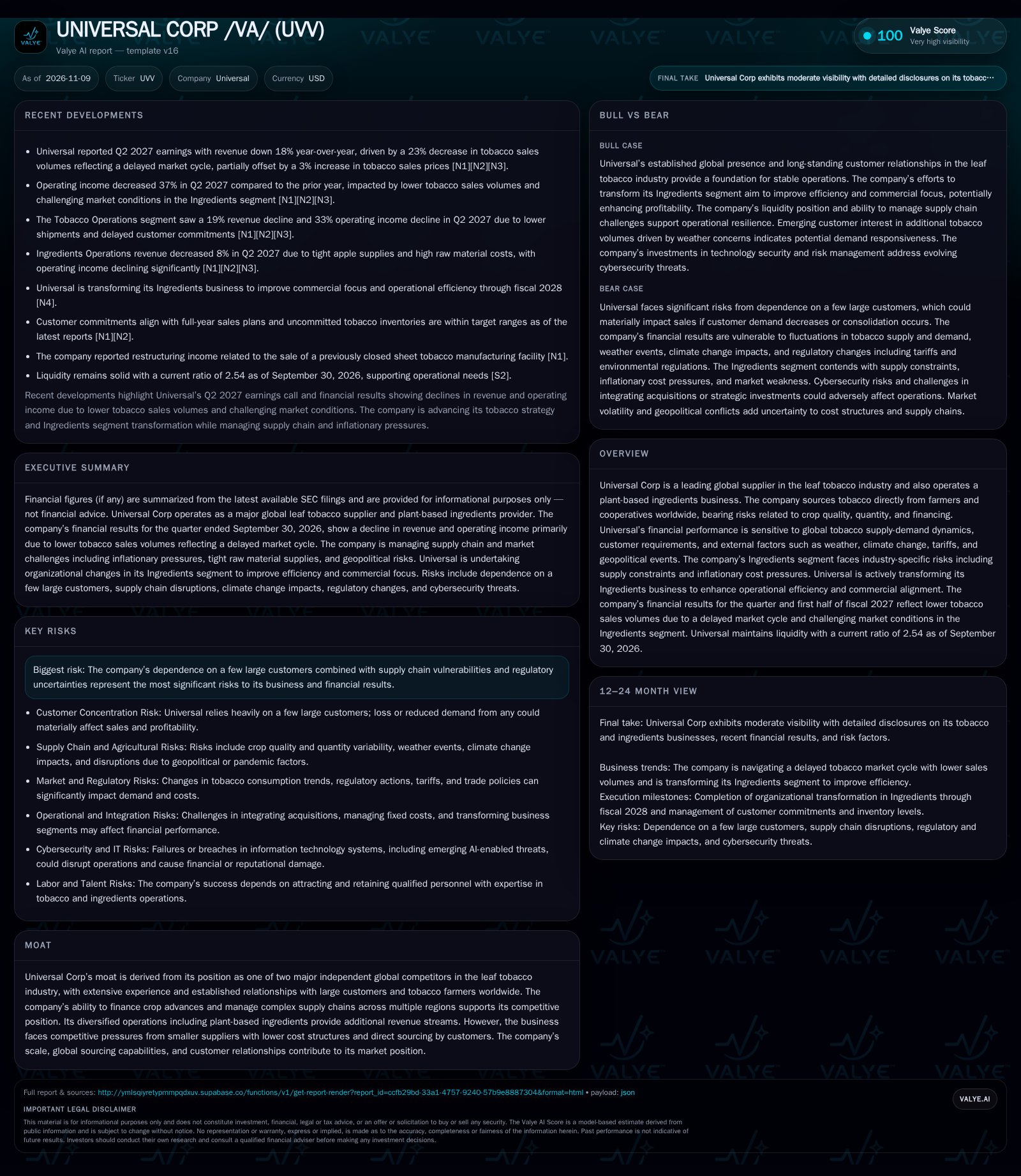
Universal Corp’s operating income fell 37% year-over-year in Q2 2027, reflecting delayed tobacco shipments and a weak Ingredients segment. The company is restructuring Ingredients for efficiency through 2028. With customer commitments reportedly in line with full-year plans and ample current assets, Universal’s resilience will depend on execution in both legacy tobacco and its evolving food ingredients business. Customer concentration and supply chain volatility remain the core risks to future earnings [N1] [N2] [N3] [N4] [S2].
Universal Corp stands at an inflection point shaped by external tobacco market pressures and internal restructuring in its Ingredients segment. The company’s Q2 2027 results reflect a steep drop in operating income, driven by delayed tobacco shipments and persistent challenges in food ingredients. While management points to customer commitments and inventory discipline as offsetting risks, the company’s heavy reliance on a few large buyers and exposure to supply chain shocks underscore the fragility of its earnings base. Universal’s near-term trajectory will hinge on its ability to restore tobacco volumes, execute Ingredients transformation, and navigate evolving industry headwinds.
Recent Financial Results Highlight Pressure Points in Tobacco and Ingredients
Universal Corp’s Q2 2027 operating income fell 37% compared to the prior year, primarily due to lower tobacco sales volumes and persistent headwinds in the Ingredients segment [N1] [N2] [N3]. This contraction is notable given the company’s historical stability in leaf tobacco and underscores the cyclical and external risks in its core market. Management attributes part of the revenue timing to an oversupply cycle, with shipments expected to be weighted toward the second half of the fiscal year—suggesting some potential for near-term recovery if customer commitments materialize as planned [N1] [N2].
The company reported cash and liquidity metrics for the period; these figures do not by themselves establish operating runway, investment capacity, financial flexibility, or financing capacity. [S2]
The company is actively restructuring its Ingredients segment, aiming for improved commercial focus and operational efficiency through fiscal 2028 [N4]. This transformation is a response to challenging market conditions and is expected to influence cost structure and utilization rates in the coming quarters.
How Universal’s Earnings Are Shaped by Tobacco Cycles and Ingredients Utilization
Universal’s core economic engine remains the global leaf tobacco business, where the company purchases crops directly from farmers and cooperatives, processes them, and supplies a handful of large multinational customers. Revenue is highly sensitive to the timing and volume of customer shipments, which can be lumpy due to the nature of tobacco procurement cycles and global demand variability. The company bears significant working capital risk, financing crop advances and holding large inventories to ensure supply reliability—a structure that creates both operating leverage and exposure to supply chain shocks.
Margins in tobacco are shaped by procurement costs, customer pricing power, and the efficiency of logistics and processing operations. When supply is tight or disrupted (by weather, regulation, or geopolitics), Universal may benefit from price or volume surges, but in oversupply periods as seen in 2027, pricing and volumes can drop sharply, compressing margins.
The Ingredients segment introduces distinct economics: it is exposed to shorter product cycles, spoilage, regulatory requirements, and intense competition from larger food ingredient suppliers. While the company is seeking to improve utilization and efficiency through restructuring, profitability in Ingredients may depend on the ability to scale volumes and differentiate on quality or specialty applications. Fixed costs in manufacturing and R&D can be significant, so underutilization (as experienced recently) erodes margins quickly. Conversely, successful transformation could yield operating leverage if higher volumes are achieved with a more efficient cost base.
Universal’s Moat: Scale, Relationships, and the Limits of Customer Concentration
Universal’s position as one of two major independent global leaf tobacco suppliers gives it scale advantages in procurement, processing, and logistics. Its long-standing relationships with both farmers and large tobacco manufacturers could increase switching friction for customers who rely on consistent quality and timely delivery. The company’s ability to finance crop advances and manage global sourcing adds to its value proposition for both suppliers and buyers.
However, the moat is not unassailable. Customer concentration is a structural risk: with a few large buyers accounting for most revenue, Universal’s bargaining power is limited. If any major customer reduces volumes, seeks alternative sourcing, or faces its own regulatory or demand shocks, Universal’s earnings could be materially impacted. Direct sourcing by customers or the emergence of lower-cost regional suppliers could erode margins over time. In Ingredients, competition is even more intense, with large multinational ingredient companies and agile niche players exerting pricing and innovation pressure.
Substitution risk is also present: declining tobacco consumption trends, regulatory crackdowns, or accelerated customer moves toward non-tobacco alternatives could reduce addressable market size. Universal’s ability to reposition its Ingredients business may partially offset this, but the transition will require successful execution and differentiation in a crowded field.
Unlocking Value: Ingredients Transformation and a Rebound in Tobacco Demand
In a favorable scenario, Universal successfully executes its Ingredients restructuring, driving improved facility utilization, cost discipline, and commercial focus. This could enable the segment to grow share in specialty food and beverage applications, supporting higher margins and diversifying the company’s earnings base away from tobacco cyclicality.
Simultaneously, if the current tobacco oversupply cycle normalizes and global demand recovers in the second half of fiscal 2027, Universal could benefit from a release of delayed shipments, improved inventory turnover, and better pricing. Early signs of renewed customer interest—such as increased order volumes or favorable contract renewals—would confirm this scenario.
Evidence supporting this upside would include: sustained improvement in Ingredients segment margins, higher volumes or new customer wins, and a rebound in tobacco shipment volumes in H2 2027, as well as clear commentary from management on improved customer demand and inventory management.
Managing Through Cyclicality: Stabilization but No Quick Fix
The most plausible outcome is that Universal experiences a gradual normalization in tobacco shipments as the oversupply cycle abates, but the recovery is muted by ongoing demand pressures and regulatory headwinds in core markets. Ingredients restructuring yields incremental efficiency gains, but the segment remains challenged by competition and lower-than-expected volume growth.
Earnings stabilize but remain below prior peaks, with some operating leverage returning as volumes improve and cost actions take hold. The company continues to manage customer relationships closely, keeping uncommitted inventories within target ranges, but customer concentration and supply chain risks persist.
Evidence supporting this scenario would include modest sequential improvement in operating income, steady current ratios, and commentary indicating that customer commitments are holding but not expanding. Conversely, persistent underperformance in Ingredients or further shipment delays would falsify even this moderate stabilization.
Prolonged Oversupply and Customer Attrition Drive Margin Compression
In an adverse scenario, the tobacco oversupply persists longer than expected, leading to continued shipment delays, inventory build, and downward pressure on prices. One or more of Universal’s large customers could reduce volumes, renegotiate terms unfavorably, or shift sourcing to competitors, exacerbating margin compression.
If Ingredients restructuring fails to deliver volume or cost improvements, the segment could become a persistent drag on profitability, with underutilized facilities and rising fixed costs. Supply chain disruptions, regulatory shocks, or adverse weather events could further erode both segments’ performance.
This scenario would be confirmed by ongoing declines in operating income, rising inventories, deteriorating current or cash ratios, and any disclosures of reduced customer commitments or contract losses. Negative surprises in regulatory or supply chain domains would further validate the downside.
Milestones and Metrics That Will Shape Universal’s Next Chapter
Sequential and year-over-year changes in tobacco shipment volumes—especially in the second half of fiscal 2027—will be critical to testing recovery expectations.
Ingredients segment gross margins and facility utilization rates (if disclosed) will indicate whether restructuring efforts are translating into better economics.
Customer concentration metrics: any disclosure of changes in the share of revenue from top customers would help assess risk exposure.
Inventory levels and turnover rates: rising inventories could signal ongoing shipment or demand issues.
Commentary or evidence of new customer wins, contract renewals, or lost accounts in both segments would clarify demand trends.
Updates on regulatory developments, tariffs, or climate-related supply chain disruptions affecting procurement or costs.
Progress reports or milestones on the Ingredients transformation program, including cost savings or commercial wins.
Disclaimer: This is research-only, informational analysis and not investment advice. It may include AI-generated interpretation and general industry context. Always verify important details using primary sources.

Comments