
Arrow Financial’s Expansion Through Adirondack Bancorp: Integration Complexity and Regional Banking Economics
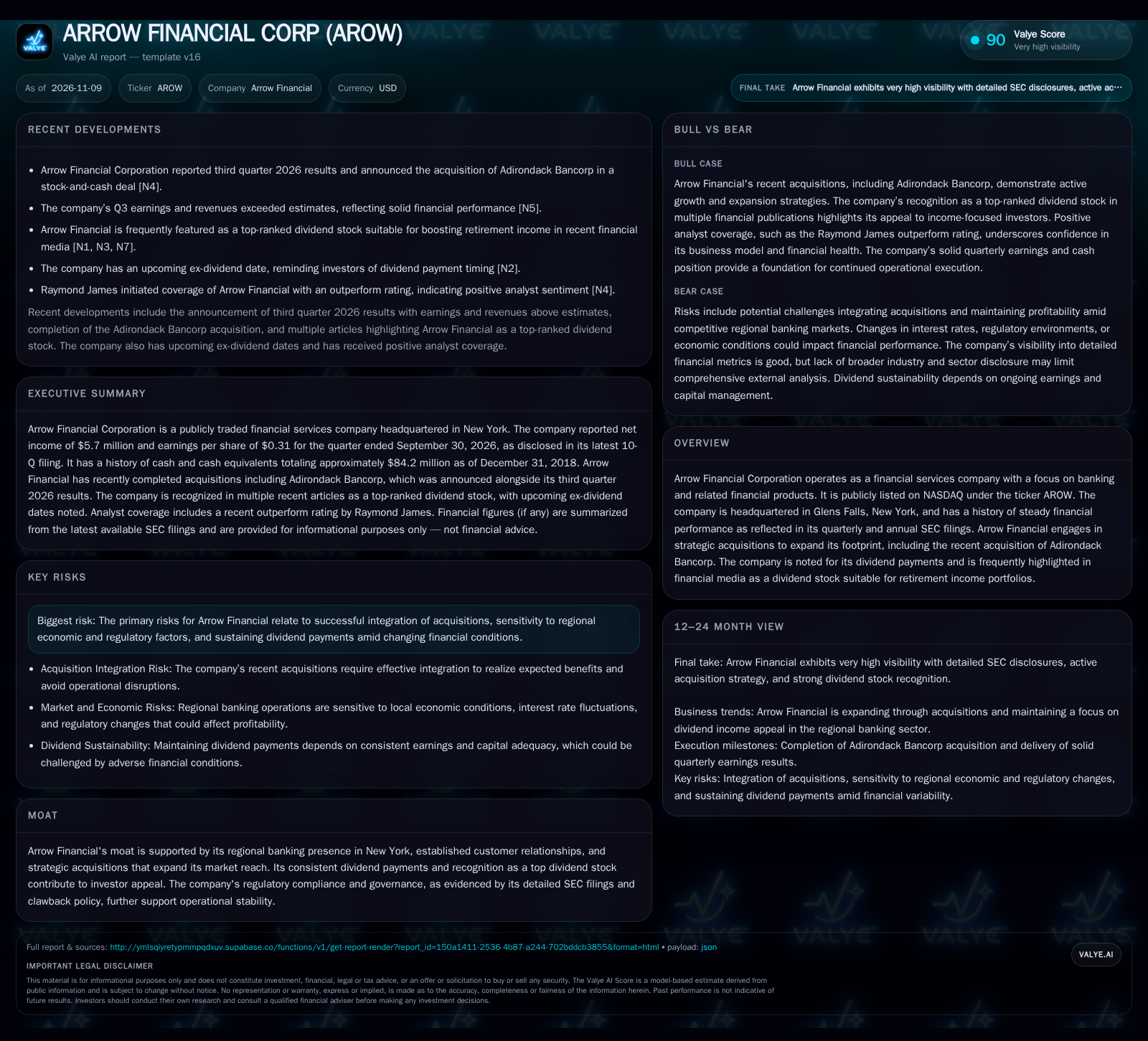
Arrow Financial’s acquisition of Adirondack Bancorp materially expands its asset base and deposit franchise, but introduces integration risk and heightens exposure to regional market and interest rate dynamics. The company’s Q3 2026 outperformance and positive analyst sentiment set a constructive tone, yet the true test will be sustaining profitability and capital management through the acquisition’s transition period.
Arrow Financial’s acquisition of Adirondack Bancorp has significantly increased its size and market reach, with Q3 2026 results exceeding expectations. The transaction brings new deposit and loan volumes but creates integration and credit risk. The cited source reports dividend-related activity; that disclosure alone does not establish dividend-policy continuity, management confidence, or a material constraint on capital flexibility. [S2] [N4] [N5]
Arrow Financial Corporation’s acquisition of Adirondack Bancorp marks a pivotal strategic shift, rapidly expanding its regional footprint, asset base, and deposit franchise. The Q3 2026 results—delivered above market expectations—reflect the initial financial impact of the acquisition, but the true value of the deal will hinge on Arrow’s ability to integrate Adirondack’s operations, realize cost and revenue synergies, and manage elevated credit and operational risks. In a consolidating and highly competitive regional banking landscape, Arrow’s next phase will test its ability to sustain earnings and preserve shareholder returns amid shifting interest rate and regulatory conditions.
Recent Acquisition and Financial Outperformance Set the Stage
Arrow Financial completed the acquisition of Adirondack Bancorp in October 2026, adding approximately $1.01 billion in identifiable assets and $925 million in deposits to its balance sheet. The transaction was completed through a stock and cash deal, with Arrow issuing 1.98 million new shares—representing 9.65% of the post-deal share count—and recognizing $44.7 million in goodwill. [S2]
For the quarter ended September 30, 2026, Arrow reported net income of $5.7 million, or $0.31 per share, surpassing consensus expectations on both earnings and revenue. [S2] [N5]
The cited source reports dividend-related activity; that disclosure alone does not establish dividend-policy continuity, management confidence, or a material constraint on capital flexibility. [N2]
Raymond James initiated coverage with an outperform rating in September 2026, reflecting rising analyst confidence in Arrow’s growth trajectory post-acquisition. [N4]
How Arrow’s Revenue and Cost Structure May Shift With Scale
Arrow Financial’s core revenue streams include net interest income from lending and investment activities, as well as fee-based income from banking services. The acquisition of Adirondack Bancorp brings substantial new loan and deposit volumes—Adirondack’s net loans at acquisition were $581 million, and core deposit intangible was valued at $16.4 million—potentially enhancing Arrow’s net interest margin and fee income base. [S2]
Regional banks like Arrow typically operate on thin net interest margins, with profitability highly sensitive to interest rate movements and local credit conditions. The increased scale from the acquisition could provide operating leverage through shared back-office functions, branch network consolidation, and unified digital platforms—if integration is executed efficiently.
However, integration costs, possible loan book impairments, and merger-related expenses may temporarily compress margins. Arrow’s issuance of nearly 2 million new shares introduces dilution, so incremental earnings growth must outpace the expanded share base to deliver per-share value.
The cited source reports dividend-related activity; that disclosure alone does not establish dividend-policy continuity, management confidence, or a material constraint on capital flexibility. If Arrow realizes meaningful cost synergies and successful credit risk management, the larger franchise could deliver improved returns on equity over time.
Regional Banking Scale: Advantages and Vulnerabilities After Adirondack
Arrow’s expanded footprint across upstate New York deepens its customer reach and deposit base, reinforcing local relationships that can be sticky due to inertia and service familiarity. In fragmented regional banking, size can confer modest advantages in pricing power, cross-selling, and digital investment.
However, Arrow’s competitive moat remains limited by the relatively commoditized nature of core banking products. Larger regional and national banks, as well as fintech entrants, pose ongoing threats, especially as digital adoption accelerates and customer expectations shift.
The integration of Adirondack’s operations presents both an opportunity and a risk: if Arrow can retain acquired customers and realize cost synergies, it may improve its efficiency ratio relative to smaller peers. But failure to harmonize systems, cultures, or risk controls could lead to customer attrition or credit issues.
The regional banking sector’s vulnerability to macroeconomic downturns and interest rate volatility remains an overarching competitive constraint, as does the ever-present risk of regulatory tightening or shifts in deposit behavior.
Integration Delivers Synergies and Earnings Acceleration
If Arrow successfully integrates Adirondack Bancorp, several favorable mechanisms could drive outperformance: realization of cost synergies from branch and back-office consolidation, improved pricing power with an enlarged deposit base, and cross-selling of loan and fee-based products to new customers.
A confirming signal would be a declining efficiency ratio (costs as a percentage of revenue), stable or improving net interest margin, and sustained low credit losses on the expanded loan book. Accelerated earnings per share growth—outpacing the dilution from new share issuance—would reinforce the case that scale is translating into real shareholder value.
Additional evidence would include positive trends in core deposit retention, growth in non-interest income, and continued analyst upgrades or positive revisions to consensus estimates. If Arrow can maintain or increase its dividend payout while growing regulatory capital, the upside scenario would be further validated.
Post-Acquisition Stabilization With Moderate Growth
The most plausible path is that Arrow experiences a transition period where integration costs and merger-related expenses partially offset the immediate benefits of scale. Net income and per-share earnings may grow modestly as cost synergies are gradually realized, but headline profitability could remain constrained by integration risk and regional economic variability.
Deposit and loan growth may be steady but not dramatic, with customer attrition and system harmonization presenting ongoing challenges. The dividend is likely maintained, but payout growth could be limited until operational and capital stability is demonstrated.
Evidence supporting this scenario would include stable or slightly improved return on equity, a flat to mildly declining efficiency ratio, and absence of material credit losses or regulatory issues. If Arrow’s core profitability metrics hold steady and the company continues to meet or slightly exceed consensus estimates, the investment case remains intact but not transformational.
Integration Missteps and Credit Deterioration Pressure Earnings
A negative outcome could emerge if Arrow encounters significant challenges integrating Adirondack’s operations, leading to elevated costs, customer attrition, or cultural misalignment. If credit quality in the acquired loan book deteriorates—whether due to legacy Adirondack exposures or regional economic stress—Arrow could face higher loan loss provisions, eroding net income.
Additional risks include unexpected deposit outflows, regulatory findings, or failure to achieve projected cost synergies. Dilution from the share issuance would exacerbate per-share earnings pressure if underlying profitability stalls or declines.
Downside evidence would include a rising efficiency ratio, increasing non-performing assets, missed earnings estimates, or a dividend cut. Negative analyst revisions or a declining stock price relative to peers would further signal that the acquisition is not delivering intended value.
Milestones and Metrics That Will Define Arrow’s Post-Acquisition Trajectory
Reported efficiency ratio trends—declines would suggest successful cost integration; increases could indicate operational challenges.
Net interest margin movement, especially as deposit and loan portfolios are integrated and repriced.
Credit quality indicators, such as non-performing loan ratios and loan loss provisions, particularly within the acquired Adirondack portfolio.
Core deposit retention and growth rates, which would demonstrate Arrow’s ability to maintain customer loyalty post-merger.
Earnings per share progression relative to pre-acquisition levels, testing whether scale offsets dilution.
Dividend payout continuity and coverage by core earnings, signaling capital discipline and earnings resilience.
If disclosed, realized cost synergies and merger-related expense run-off rates, to assess integration execution.
Analyst estimate revisions and market reaction following quarterly results, as external validation of the integration thesis.
Disclaimer: This is research-only, informational analysis and not investment advice. It may include AI-generated interpretation and general industry context. Always verify important details using primary sources.

Comments