
Target Hospitality: Modular Lodging at the Crossroads of Infrastructure Cycles and Potential Financial Flexibility
Target Hospitality’s vertically integrated, modular hospitality platform serves critical infrastructure, natural resource, and government projects across North America.
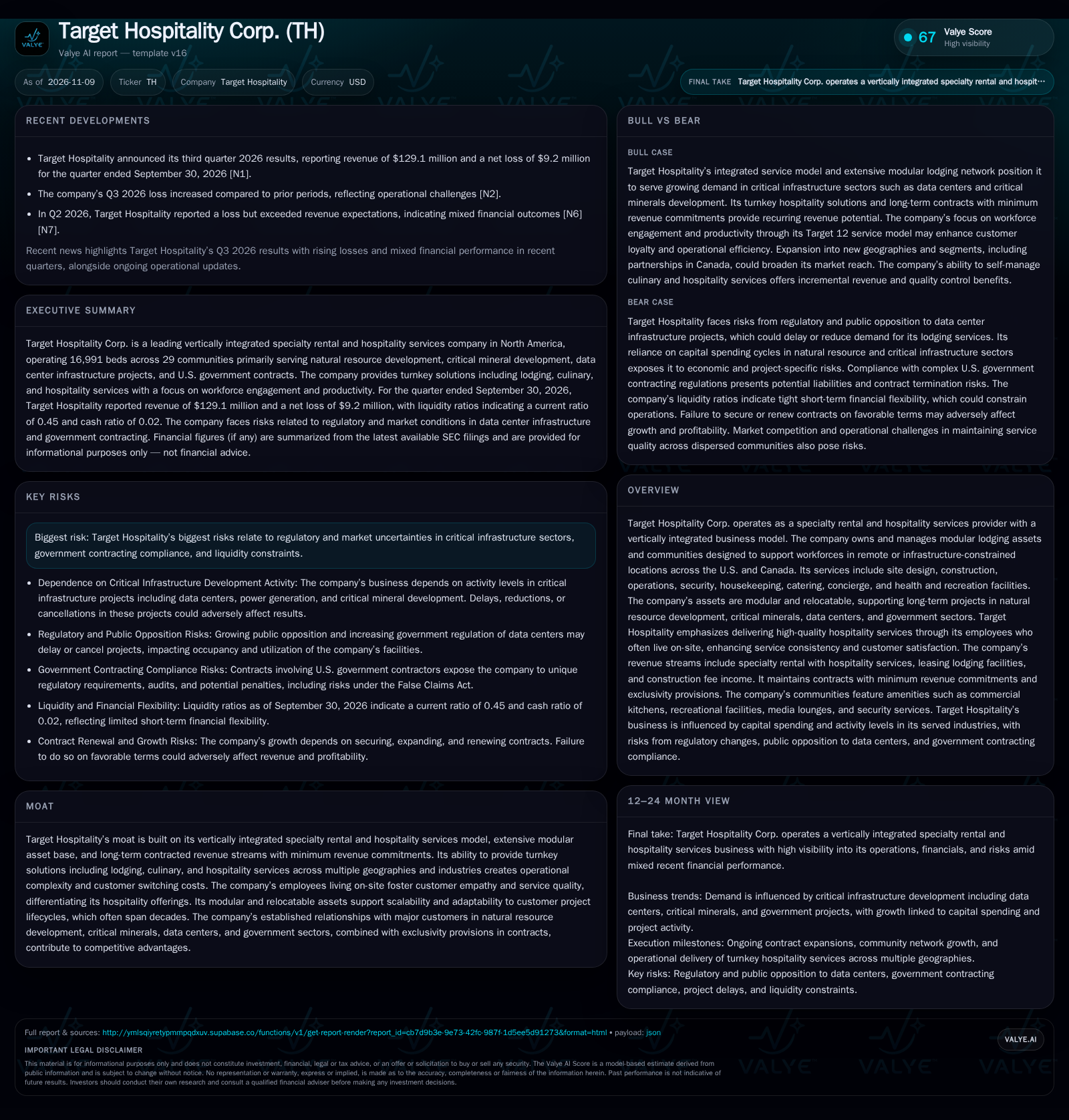
Target Hospitality delivers turnkey modular lodging and hospitality services to remote workforce projects in sectors like data centers, critical minerals, and government contracts. Its long-term contracts with minimum revenue commitments and integrated service model support recurring revenue and customer retention. [S2] [N2] [N6] [N7]
Target Hospitality Corp. sits at the intersection of North America’s critical infrastructure build-out and the operational realities of modular lodging for remote workforces. With nearly 17,000 beds across 29 communities and a vertically integrated model that manages everything from site design to culinary services, the company has carved out a niche serving sectors with demanding project requirements and long timelines. However, as of late 2026, persistent quarterly losses and constrained liquidity ratios point to mounting operational and financial pressures. The company’s future will likely turn on its ability to secure stable contract flows in volatile industries, manage regulatory headwinds, and adapt its capital-intensive model to evolving customer and market demands. [S2] [N2] [N6] [N7]
Recent Losses and Liquidity Constraints Shape the Near-Term Outlook
Target Hospitality reported an increased loss in Q3 2026 compared to prior periods, continuing a trend of operational challenges. While the company exceeded revenue expectations in Q2 2026, it still posted a loss, highlighting a disconnect between top-line performance and bottom-line profitability. These facts spotlight the immediate tension between the capital requirements of its modular asset base and the volatility of the end markets it serves. [S2] [N2] [N6] [N7]
The company’s contract structure, featuring minimum revenue commitments and exclusivity provisions, provides some revenue visibility and may help mitigate near-term occupancy risk. However, this does not fully insulate Target Hospitality from broader sectoral cycles or from the operational drag of underutilized assets. The quality and duration of these contracts, as well as the company’s ability to renew or expand them, will be central to its trajectory in the coming quarters. [S2]
Integrated Service Model Drives Revenue, But Financial Leverage Remains a Double-Edged Sword
Target Hospitality’s modular lodging communities generate revenue through a blend of specialty rental with hospitality services, leasing, and construction fees. The vertically integrated model—including site design, construction, operations, and culinary services—enables the company to capture a larger share of customer spend, increase control over service quality, and potentially drive higher margins compared to pure asset-rental models. However, this integration also brings significant fixed costs, with labor, maintenance, and asset depreciation forming a substantial portion of the cost base.
The prevalence of long-term contracts with minimum revenue commitments and exclusivity provisions provides some insulation from short-term market volatility and supports higher utilization rates. This structure may create switching frictions for customers, as relocating entire workforce communities is costly and disruptive. Nevertheless, the capital intensity of owning and maintaining modular assets means that occupancy risk and project delays can rapidly translate into margin compression and cash flow stress if not offset by new wins or contract renewals.
Operating leverage is both a strength and a vulnerability: high fixed costs mean that incremental revenue from contract expansions or increased occupancy can drive substantial profit improvement, but underutilization or project cancellations can quickly erode margins. [S2]
How Scale, Integration, and Switching Costs Shape the Competitive Battleground
Target Hospitality’s moat rests on its vertically integrated approach, modular asset network, and contract structures that embed customer exclusivity and minimum spend commitments. These factors can create meaningful switching costs for customers with large, long-duration projects in remote or infrastructure-constrained locations. The company’s ability to provide turnkey solutions—from site development to on-site hospitality—differentiates it from less integrated specialty rental or pure hospitality providers.
However, the competitive landscape includes national and regional specialty accommodation firms, traditional hotels, and even mobile lodging startups targeting niche infrastructure or resource extraction markets. Substitute solutions may become more attractive if project cycles slow, regulatory hurdles increase, or if customers seek greater flexibility through less capital-intensive, on-demand models. The company’s operational complexity—managing dispersed, self-sustaining communities—can be a barrier to entry but also raises the bar for consistent service delivery and cost control.
Target Hospitality’s established relationships in resource development, critical minerals, and government sectors provide some revenue stability, but these same customers are exposed to regulatory and market cycles that could drive abrupt shifts in demand. The ability to renew exclusive contracts, expand into new geographies, and adapt offerings for emerging sectors (such as data center build-outs) will be critical to sustaining its competitive edge.
Contract Wins and Project Activity Could Unlock Margin Recovery
If Target Hospitality successfully capitalizes on increased capital spending in data centers, critical minerals, and government infrastructure—sectors where it has established customer relationships and operational expertise—incremental contract wins could rapidly absorb existing capacity, drive higher occupancy, and improve operating leverage. Expanding into new geographies or securing multi-year contract renewals with minimum revenue commitments would enhance revenue visibility and reduce exposure to project-by-project volatility.
Upside would be confirmed by a sustained improvement in occupancy rates, new contract announcements in high-growth sectors, and evidence of margin expansion as incremental revenue outpaces fixed cost growth. Conversely, a lack of contract momentum or continued margin compression would challenge this scenario.
Navigating Industry Cycles with Mixed Performance and Cautious Expansion
The most plausible outcome is that Target Hospitality continues to experience a mix of contract renewals, incremental expansions, and modest new business wins, but remains constrained by sectoral cycles and tight liquidity. Revenue may remain relatively stable due to minimum contract commitments and exclusivity provisions, but persistent fixed costs and operational complexity limit margin improvement unless demand meaningfully accelerates.
In this scenario, the company’s performance would be characterized by ongoing efforts to optimize occupancy, manage costs, and selectively pursue growth opportunities in sectors with favorable project pipelines. Evidence would include steady occupancy rates, renewal of major contracts, gradual improvement (or stabilization) of liquidity ratios, and continued focus on operational delivery. Deterioration in contract win rates, further margin erosion, or a worsening liquidity position would tilt the base case toward a downside trajectory.
Project Delays, Regulatory Headwinds, and Liquidity Erosion Threaten Stability
A negative scenario could unfold if regulatory or public opposition further delays or cancels data center and infrastructure projects, reducing occupancy and utilization of the company’s modular assets. If key contracts are not renewed or are renegotiated on less favorable terms, revenue could fall below the fixed cost base, compounding losses and straining already reported liquidity position. Additional risks include government contracting compliance issues or penalties, which could result in contract terminations or financial liabilities.
This scenario would be confirmed by declining occupancy rates, loss of major contracts, worsening liquidity ratios, or disclosures of regulatory setbacks. An inability to access external capital or refinance debt under these conditions would further jeopardize operational continuity. Conversely, evidence of contract resilience, regulatory clarity, or new project wins would help disprove this downside outcome.
Milestones That Will Define Target Hospitality’s Trajectory in Infrastructure Lodging
Occupancy rate trends across the modular lodging portfolio—particularly in key sectors such as data centers, critical minerals, and government contracts.
Renewal, expansion, or loss of major contracts, especially those with minimum revenue commitments and exclusivity provisions.
Evolution of current and cash ratios—any signs of improvement or further deterioration in short-term liquidity.
New contract wins or geographic expansions in high-growth or underpenetrated sectors.
Disclosures related to regulatory or public opposition impacting project timelines or customer activity.
Operational cost management and evidence of margin stabilization or improvement, if disclosed.
Resolution of any government contracting compliance matters or regulatory investigations, if reported.
Disclaimer: This is research-only, informational analysis and not investment advice. It may include AI-generated interpretation and general industry context. Always verify important details using primary sources.

Comments