
Teucrium Commodity Trust: Navigating Commodity Volatility and ETF Structure in a Shifting Agricultural Landscape
The interplay between commodity cycles, fund structure, and market access will shape future outcomes.
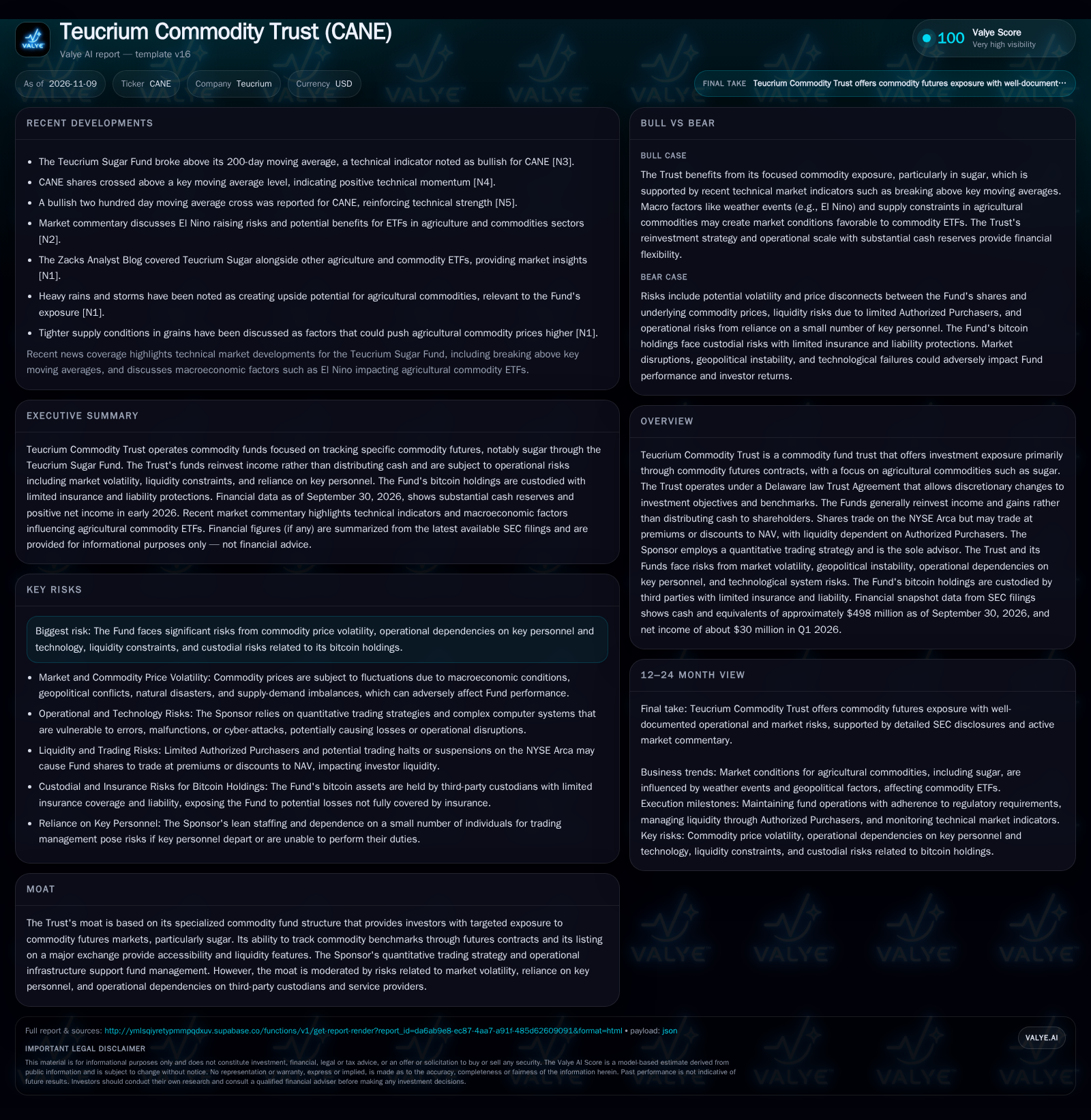
Teucrium Commodity Trust, through products like the Sugar Fund (CANE), offers investors exposure to agricultural commodity futures. Recent technical signals in CANE suggest increased market interest, while macro factors such as weather events and supply constraints could influence returns. [S2] [N1] [N3] [N4] [N5]
Teucrium Commodity Trust provides investors with targeted access to agricultural commodity futures, most prominently through its Sugar Fund (CANE). Recent technical signals and macro commentary have put CANE in the spotlight, as sugar prices respond to weather events and global supply shifts. Teucrium’s future will be defined not only by commodity cycles but also by how effectively it manages these structural and operational complexities.
Recent Technical Momentum and Financial Position: Where Teucrium Stands Now
Teucrium’s Sugar Fund (CANE) has recently broken above key technical thresholds, including the 200-day moving average, a development often interpreted by market participants as a bullish signal for commodity ETFs. This technical strength coincides with increased commentary around agricultural supply constraints and weather volatility, factors that can drive both commodity prices and investor flows. On the financial front, Teucrium Commodity Trust reported cash and equivalents of roughly $498 million as of September 30, 2026, and net income of about $30 million in Q1 2026. The company reported cash and liquidity metrics for the period; these figures do not by themselves establish operating runway, investment capacity, financial flexibility, or financing capacity. [S2] [N3] [N4] [N5]
How Teucrium’s Funds Monetize Commodity Exposure
Teucrium’s core economic engine is its commodity ETF structure: the Trust earns management and operating fees from assets invested in its funds, which are designed to track commodity futures such as sugar. Returns to investors are driven by changes in the value of the underlying futures contracts, less fund expenses. Unlike traditional mutual funds, Teucrium’s funds reinvest income and realized gains, rather than distributing cash, which can compound returns in favorable cycles but may not appeal to yield-seeking investors. The cost structure is largely variable with fund size, but certain fixed overheads—such as regulatory compliance, systems, and sponsor staffing—must be covered regardless of AUM. Operating leverage can be positive in periods of asset growth, but fee pressure and market volatility may compress margins. The Trust relies on third-party brokers and custodians for execution and safekeeping, introducing counterparty and operational cost elements. The presence of bitcoin assets adds a layer of custodial and insurance complexity, as these holdings are not covered by traditional SIPC or FDIC protection.
The reinvestment of income and realized gains within Teucrium’s funds introduces a compounding effect that can amplify returns during sustained commodity price uptrends. However, this mechanism also means that in periods of commodity price declines or volatility, investors may experience amplified drawdowns without the mitigating effect of periodic cash distributions. This dynamic can influence investor composition over time, potentially skewing the shareholder base toward those with longer-term investment horizons and tolerance for price fluctuations. Furthermore, the fee structure tied to assets under management creates an inherent sensitivity to market cycles; during downturns, shrinking AUM can compress revenues and challenge fixed cost coverage, underscoring the importance of maintaining both asset growth and operational efficiency.
Commodity ETF Differentiation: Accessibility, Liquidity, and Structural Trade-offs
Teucrium’s value proposition centers on targeted commodity exposure—particularly in underrepresented agricultural segments like sugar—offered through a liquid, exchange-traded format. This differentiates the Trust from traditional commodity pools or direct futures trading, which require margining and specialized accounts. However, the ETF structure introduces its own frictions: only Authorized Purchasers can create or redeem shares at NAV, and their limited number can lead to significant NAV premiums or discounts, especially during market stress. Competitors include broader commodity ETF providers, mutual funds with commodity sleeves, and direct commodity futures traders. The absence of cash distributions may be a disadvantage versus income-oriented vehicles, while the Trust’s quantitative trading strategy and regulatory flexibility could be a source of agility if managed well. Still, reliance on a small sponsor team and third-party infrastructure may limit scalability and resilience compared to larger, more diversified ETF operators.
The limited pool of Authorized Purchasers, while a common feature in commodity ETFs, can create liquidity bottlenecks during periods of heightened volatility or market stress. This structural characteristic means that secondary market prices may deviate significantly from NAV, posing valuation and trading risks for investors. Competitively, this can be a double-edged sword: while the ETF format provides accessibility and intraday liquidity absent in direct futures trading, the potential for persistent premiums or discounts may deter more risk-averse investors or institutions seeking tight tracking and liquidity. Additionally, the Trust’s reliance on a lean sponsor team may limit its capacity to innovate or scale rapidly in response to evolving investor demands or competitive pressures, highlighting a trade-off between operational agility and resource depth.
Weather-Driven Supply Shocks and Technical Flows Could Turbocharge Asset Growth
A favorable scenario for Teucrium would unfold if persistent weather disruptions—such as El Nino or major storms—trigger sustained volatility and price appreciation in agricultural commodities like sugar. This could attract speculative and hedging flows into CANE, compounded by technical traders responding to bullish chart patterns and moving-average crossovers. Asset growth would increase management fees and operating leverage, while reinvested gains could enhance NAV performance. Confirmation would come from continued fund inflows, expanding assets under management, and the persistence of NAV premiums, as well as market commentary highlighting CANE as a preferred vehicle for sugar exposure. Evidence falsifying this scenario would include a rapid reversal in commodity prices, outflows from the fund, or a breakdown in technical momentum despite favorable fundamentals. [N1] [N3] [N4] [N5]
Commodity Cycles, ETF Mechanics, and Operational Frictions Shape a Mixed Outlook
The most plausible outcome is a continued ebb and flow of investor interest tied to agricultural commodity cycles, with fund performance and assets under management fluctuating accordingly. The ETF structure will periodically result in NAV premiums or discounts, especially during volatility, as the limited pool of Authorized Purchasers constrains liquidity. Operational risks—such as key personnel departures, trading errors, or technology failures—will remain latent but manageable if the sponsor maintains systems and staffing. Bitcoin custodial risks are likely to persist as a tail risk rather than an everyday concern. Evidence supporting this scenario would include stable or gradually shifting AUM, intermittent NAV dislocations, and operational continuity with few major incidents. Evidence against would be persistent or severe liquidity issues, high-profile operational failures, or regulatory intervention affecting fund structure or sponsor discretion.
The interplay between commodity price cycles and ETF structural mechanics suggests that Teucrium’s funds will likely continue to experience episodic fluctuations in investor interest and fund performance. While the reinvestment policy can enhance compounding during favorable periods, it may also exacerbate volatility in less supportive environments. Moreover, the constrained Authorized Purchaser network could intermittently amplify NAV dislocations, particularly during sharp commodity price moves or broader market stress. Operational risks, though latent, require ongoing vigilance; small sponsor teams must maintain robust systems and contingency plans to mitigate disruptions. This scenario implies a steady-state environment where Teucrium’s funds perform adequately but face recurring challenges related to liquidity, investor behavior, and operational resilience.
Liquidity Crunch or Operational Failure Could Trigger Severe NAV Dislocation and Investor Losses
In an adverse scenario, a sudden market event—such as a commodity price collapse, major geopolitical shock, or systemic trading system failure—could cause CANE shares to trade at a deep and persistent discount to NAV. If Authorized Purchasers are unwilling or unable to create/redeem shares, secondary market liquidity could evaporate, trapping retail holders at unfavorable prices. Compounding this, an operational failure or key personnel loss could disrupt fund management or trigger forced liquidation, especially if net assets fall below prudent thresholds relative to expenses. Bitcoin custody issues, such as a loss event not covered by insurance, could further erode trust and capital. Confirmation would be a sharp, sustained NAV discount, trading halts, sponsor turnover, or publicized custodial losses. Falsification would require continued orderly trading, sponsor stability, and no material operational incidents even during stress periods.
Testing Teucrium’s Resilience: What Will Determine If the Thesis Holds
Net asset value (NAV) premium/discount to share price: Persistent or widening discounts may indicate liquidity or structure stress.
Assets under management (AUM) trends: Ongoing inflows, outflows, or sharp reversals would signal changing investor appetite and fee base.
Sponsor staffing and key personnel continuity: Announcements of leadership changes or team departures would highlight operational risk.
Operational incident disclosures: System failures, trading errors, or custodial events (especially involving bitcoin) would test process robustness.
Authorized Purchaser activity, if disclosed: Concentration or withdrawal of key liquidity providers may foreshadow trading frictions.
Commodity price volatility and underlying futures curve: Structural contango or backwardation and weather-driven price swings will impact fund performance.
Fund expense ratio and fee waivers, if disclosed: Changes in sponsor fee policy or expense absorption could signal stress or margin pressure.
Regulatory or legal developments affecting ETF structure or commodity trading: New rules or enforcement actions could alter fund operations or investor protections.
Disclaimer: This is research-only, informational analysis and not investment advice. It may include AI-generated interpretation and general industry context. Always verify important details using primary sources.

Comments