
Electronic Servitor Publication Network: Proprietary Tech Ambitions Collide with Acute Solvency Risk
Electronic Servitor Publication Network, Inc. (XESP) touts a proprietary digital engagement platform and recent IP-driven mergers, but zero revenue, no cash, and mounting liabilities leave the company's commercial future in immediate jeopardy.
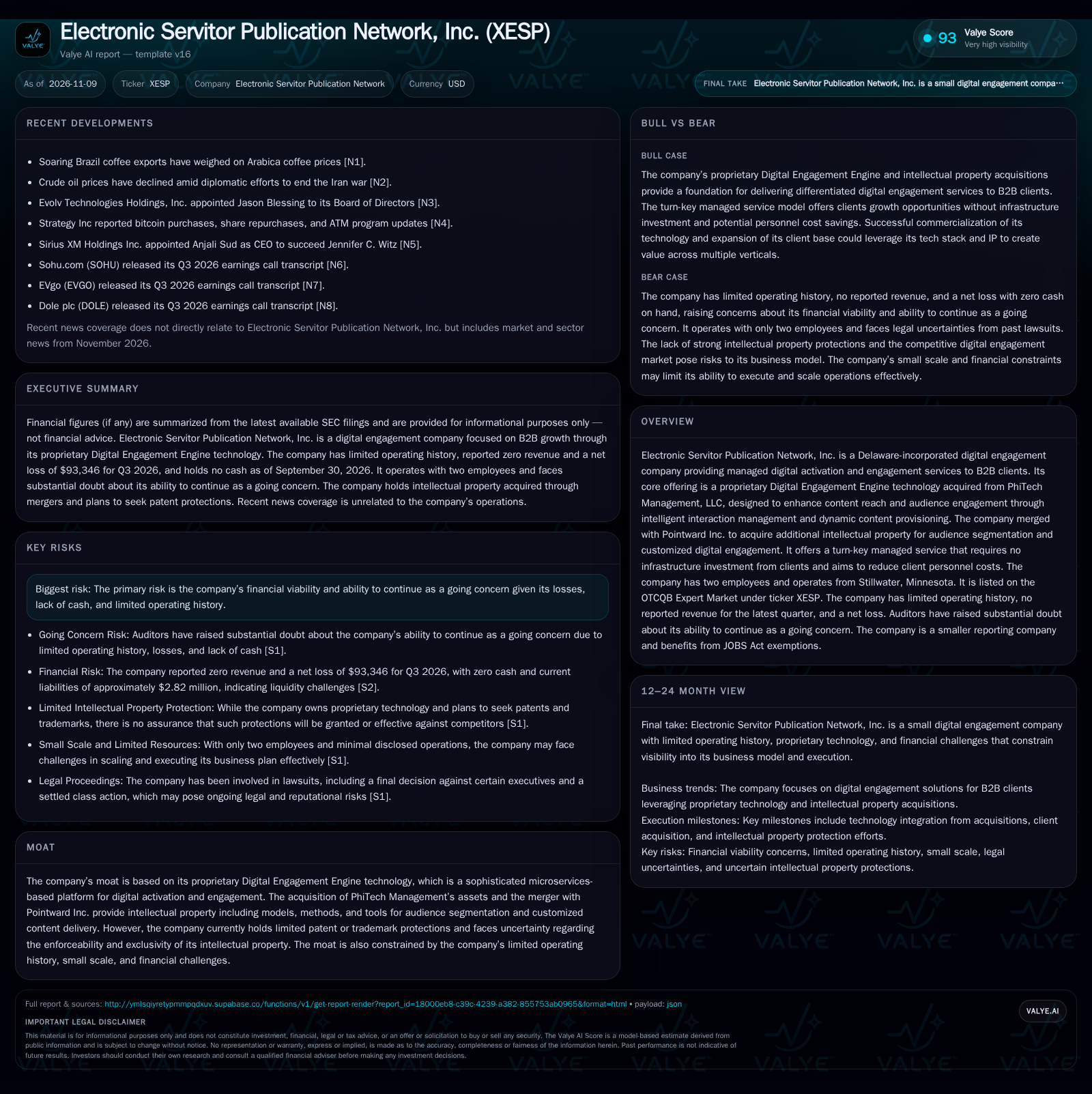
XESP markets a managed B2B digital engagement service powered by proprietary technology and recent IP acquisitions. However, as of September 30, 2026, it reported zero revenue, a net loss, no cash, and $2.8 million in current liabilities. Auditors have raised substantial doubt about its ability to continue as a going concern, making financial stabilization and customer traction existential priorities. The business model's scalability and defensibility remain unproven in a crowded market.
Electronic Servitor Publication Network, Inc. (XESP) aspires to disrupt B2B digital engagement with proprietary technology and a turnkey managed service model. Yet the company stands at a critical crossroads: despite recent intellectual property acquisitions and a tech-forward narrative, XESP reported zero revenue, no cash, and escalating liabilities in its latest quarter. With only two employees and substantial doubt cast by auditors on its ability to continue, the company’s future will be dictated as much by funding and commercial validation as by product differentiation.
Recent Acquisitions, Mounting Liabilities, and the Absence of Revenue Define the Stakes
The most material current facts for Electronic Servitor Publication Network, Inc. are: (1) its reported zero revenue and a net loss of $93,346 for the quarter ending September 30, 2026; (2) a cash balance of zero and current liabilities totaling $2.82 million at that date; (3) auditors’ expression of substantial doubt about the company’s ability to continue as a going concern; and (4) the company's recent acquisition of proprietary technology and intellectual property through asset and merger transactions with PhiTech Management, LLC and Pointward Inc. [S1] [S2].
These facts signal an immediate solvency risk and underline the company’s total dependence on external financing or rapid commercial traction. While the IP acquisitions provide a narrative of differentiation, the absence of revenue and cash means even short-term operational continuity is in question. The very viability of the business model and the company’s ability to deliver on its managed service promises depend on resolving this acute funding crisis.
Managed Service Economics: Inherent Leverage but Unproven Commercialization
XESP’s business model revolves around providing fully managed digital engagement services for B2B clients, leveraging its proprietary Digital Engagement Engine. In theory, this approach should allow for high gross margins if the technology enables automation and scale, as digital engagement platforms typically carry low marginal costs once the infrastructure is built. The company’s turn-key offering aims to reduce or redeploy client personnel, suggesting a value proposition tied to cost savings and operational simplicity for clients.
However, the company’s current economics are entirely hypothetical: with zero reported revenue and no disclosed client contracts, there is no evidence yet of product-market fit, pricing power, or scalable customer acquisition. The fixed cost base appears minimal—only two employees—but the company faces ongoing general and administrative expenses, IP integration costs, and the need to service or restructure its $2.82 million in current liabilities [S2].
Capital needs are acute: the company has no cash and has publicly disclosed that it would require approximately $1.5 million over the next twelve months to continue as a going concern, aside from any capital needed to fund planned growth [S2]. Without revenue, every dollar must come from external financing, making dilution or debt restructuring likely prerequisites for survival.
IP-Driven Differentiation Meets a Crowded Digital Engagement Market
XESP’s claimed edge lies in its proprietary Digital Engagement Engine, developed via the PhiTech asset acquisition and Pointward merger, which together bring audience segmentation tools, workflow protocols, and a microservices-based architecture [S1]. In principle, these could enable more targeted, dynamic, and measurable B2B engagement than generic marketing automation platforms.
However, the moat is tenuous. The company lacks granted patents or trademarks and faces uncertainty about the enforceability of its intellectual property. In the broader market, digital engagement and marketing automation are fiercely competitive, with established software vendors, consulting firms, and new SaaS entrants all targeting B2B activation. Switching costs for clients may be low unless XESP can demonstrate unique outcomes or deep integration into client workflows.
Given the company’s tiny scale and resource constraints, it may struggle to achieve the brand credibility, channel access, or customer support levels needed to win against better-funded rivals. The most plausible competitive advantage would arise if the company’s technology delivers a step-change in engagement effectiveness or cost efficiency for niche B2B verticals, but this remains unproven.
A Successful Pilot Customer Validates the Platform, Unlocking Funding and Growth
The most favorable scenario for XESP involves landing one or more anchor B2B clients who publicly validate the Digital Engagement Engine’s impact—measured by improved content reach, engagement metrics, or customer acquisition for those clients. Such a pilot would create tangible proof points, attract further client interest, and unlock the possibility of strategic funding or partnerships.
This outcome would likely require: (1) rapid integration of acquired IP into a seamless managed service; (2) clear demonstration of ROI for initial clients, possibly through case studies or reference accounts; and (3) the ability to secure bridge financing to maintain operations until revenue materializes.
Confirmation of this scenario would come from public announcements of customer wins, disclosed recurring revenue, or new capital infusions tied to commercial milestones. Falsification would be evident if the company continues to report zero revenue, fails to secure bridge funding, or if early clients churn rapidly or provide negative feedback.
Solvency-Driven Restructuring and Delayed Commercial Validation
The most plausible trajectory is one in which XESP is forced to prioritize short-term solvency through aggressive cost control, debt restructuring, or highly dilutive financing, while continuing to seek its first meaningful client engagement. The company may need to pivot its go-to-market approach, focus on a narrower vertical, or offer deep discounts to secure initial traction.
Progress will be measured by any evidence of operating revenue, successful cost reductions, or announcements regarding new financing. However, the base scenario assumes that commercial adoption will be slow due to credibility gaps, lack of brand presence, and the inherent inertia in B2B procurement cycles.
This middle path is confirmed by continued going-concern warnings, minimal revenue growth, and repeated references to funding needs in filings. It would be falsified if the company either secures a transformative client or funding partner, or if it is unable to secure new capital and enters bankruptcy or liquidation.
Acute Liquidity Crisis Forces Bankruptcy or Asset Sale
The most adverse scenario for XESP is a near-term liquidity event in which the company is unable to secure bridge financing or generate revenue, forcing it to cease operations, enter bankruptcy, or sell its technology assets at distressed prices. With zero cash and mounting liabilities, this scenario could materialize rapidly absent external intervention.
Confirmation would come from missed payroll or vendor payments, bankruptcy filings, or fire-sale announcements. Falsification would require a credible new financing round or unexpected revenue windfall sufficient to stabilize operations.
Milestones That Will Determine Whether XESP’s Model Can Survive and Scale
Disclosure of any material client contract, including pilot programs, recurring revenue, or referenceable customer outcomes, would help test the company’s product-market fit.
Evidence of secured bridge financing, debt restructuring, or equity issuance sufficient to cover at least 12 months of operating expenses is critical to address going-concern risk.
Updates on the status of patent applications, trademark grants, or other enforceable IP protections would clarify the defensibility of the company’s technology.
If disclosed, gross and net margin data for early service contracts would illuminate the scalability and profitability of the managed service model.
Progress on integration of PhiTech and Pointward technologies into a unified platform would demonstrate operational execution and readiness for client onboarding.
Public case studies or testimonials from initial clients would validate the technology’s effectiveness and strengthen go-to-market credibility.
Resolution or escalation of outstanding legal and regulatory matters, including the impact of prior litigation on management bandwidth or reputation, could influence risk perception.
Any changes in management, board composition, or strategic direction would signal shifts in execution capacity or risk appetite.
Disclaimer: This is research-only, informational analysis and not investment advice. It may include AI-generated interpretation and general industry context. Always verify important details using primary sources.

Comments