
Vaxcyte’s Vaccine Ambition: Clinical Milestones, Capital Scale, and the Stakes of Transitioning to Commercialization
Vaxcyte has met key Phase 3 endpoints for its lead pneumococcal vaccine candidate, VAX-31, fueling investor optimism and large-scale capital raises.
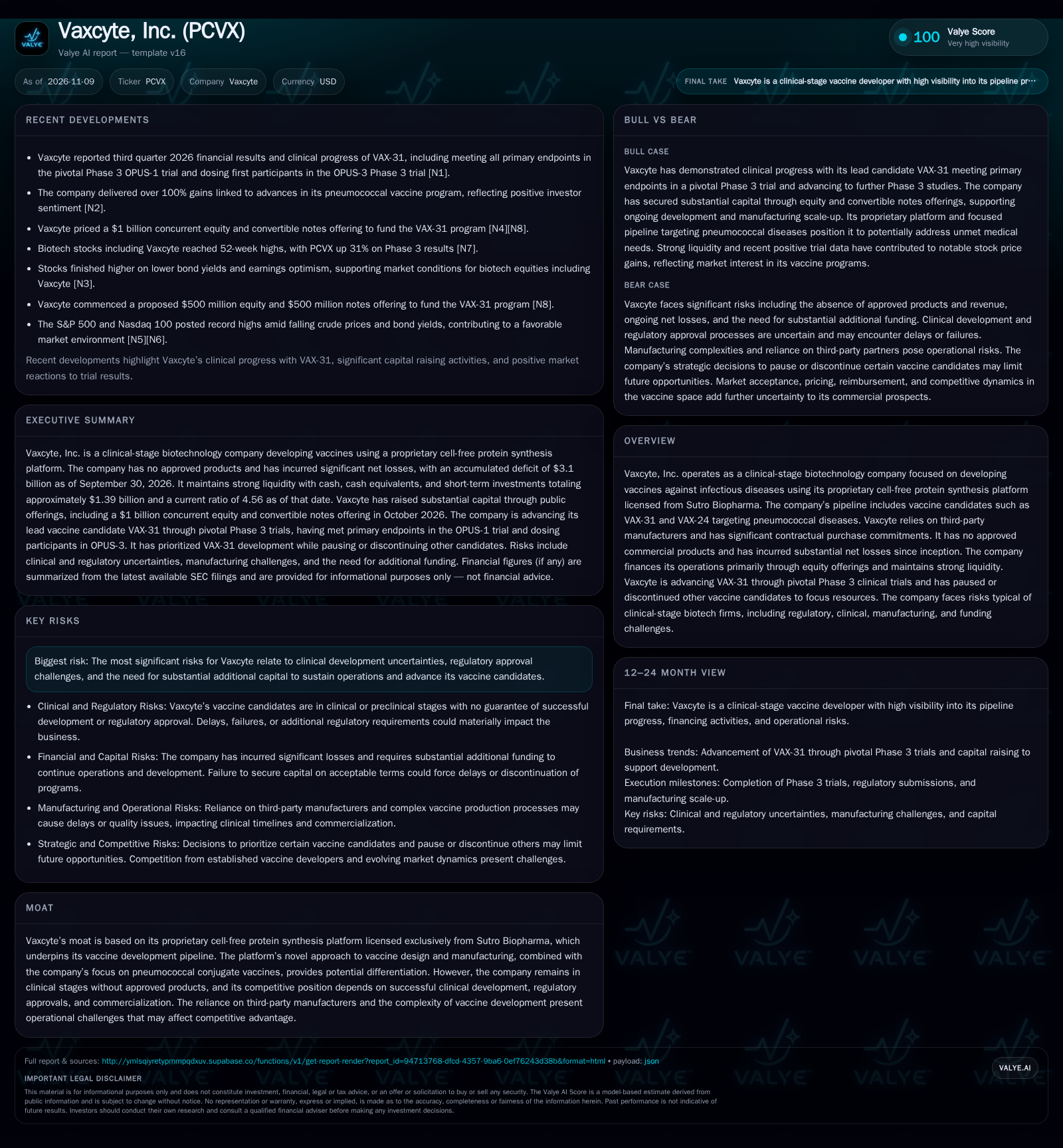
Vaxcyte has met key Phase 3 endpoints for its lead pneumococcal vaccine candidate, VAX-31, fueling investor optimism and large-scale capital raises. With no approved products and ongoing losses, the company’s fate hinges on successful regulatory approval and the ability to scale manufacturing and commercial operations. Prioritization of VAX-31 and substantial purchase commitments signal a high-conviction, high-risk bet on a single asset’s success. Clinical, regulatory, and operational execution over the next 12–24 months will determine whether Vaxcyte can transition from a promising biotech to a commercial vaccine player.
Vaxcyte, Inc. sits at a pivotal crossroads: flush with $1.39 billion in cash, buoyed by positive Phase 3 data for its lead vaccine candidate VAX-31, and freshly capitalized after a $1 billion equity and convertible notes raise. The company’s high-profile advances have driven notable stock gains and heightened expectations for a breakthrough in pneumococcal vaccination. Yet, with no approved products, persistent heavy losses, and a pipeline now concentrated around a single asset, Vaxcyte’s ability to convert clinical progress into sustainable commercial success will be tested by regulatory, operational, and market hurdles in the coming quarters.
Phase 3 Success and Capital Infusion Define Vaxcyte’s Moment of Truth
The most material recent development for Vaxcyte is the achievement of all primary endpoints in the pivotal Phase 3 OPUS-1 trial for its lead pneumococcal conjugate vaccine candidate, VAX-31. This milestone has triggered further Phase 3 studies and sets the stage for regulatory submissions, specifically Biologics License Application (BLA) filings, for adult and infant indications [N1] [N7]. The positive clinical news has driven a 31% stock price increase and 100%+ gains over recent periods, reflecting a surge in investor confidence [N2] [N7].
Financially, Vaxcyte is well-resourced for this critical period, holding $1.39 billion in cash, cash equivalents, and short-term investments as of September 30, 2026, following a $1 billion concurrent equity and convertible notes offering in October 2026 [S2] [N4] [N8]. However, the company remains without approved products or product revenue, and has incurred $3.1 billion in accumulated deficit, with a net loss of $297.1 million in the most recent quarter [S2].
Operationally, Vaxcyte has made a strategic decision to focus resources on VAX-31, pausing or discontinuing other vaccine candidates. This focus is reinforced by $585 million in non-cancelable purchase commitments through 2029, representing preparations for manufacturing scale-up ahead of potential commercialization [S1].
How Vaxcyte’s Model Could Transition from R&D Burn to Commercial Cash Flow
Vaxcyte’s economics to date are entirely pre-commercial: the company has generated no product revenue and relies on external funding to support operations and R&D [S2]. The core business model, if VAX-31 is approved, would likely depend on capturing a share of the global pneumococcal vaccine market through a differentiated conjugate vaccine. Commercial mechanics in this segment typically involve large-volume, periodic vaccine purchases by governments, health systems, and potentially private payers, with pricing driven by efficacy, breadth of serotype coverage, and health-economic evidence.
The company’s fixed cost base is significant, as seen in its consistent net losses and large purchase commitments, with variable costs likely to rise sharply in the manufacturing and launch phase. Vaxcyte relies on third-party manufacturers, which may limit margin upside but also reduces the need for heavy internal capital investment in facilities [S1]. The proprietary cell-free protein synthesis platform could, in theory, enable faster or more flexible vaccine production, but the impact on gross margin will depend on scale, tech transfer success, and supply chain reliability.
If VAX-31 is approved and reimbursed at a premium to current standards of care, Vaxcyte could see rapid revenue ramp and operating leverage, as initial sales scale against a high fixed cost base. However, initial commercialization will require substantial investment in market access, post-approval studies, and potentially sales infrastructure, depending on whether Vaxcyte partners or commercializes independently. The $585 million in purchase commitments through 2029 suggest a bet on scaling quickly but also lock in cost exposure even if uptake is slower than hoped.
Differentiation, Imitation, and Incumbent Defenses in the Pneumococcal Vaccine Arena
Vaxcyte’s potential advantage lies in its proprietary cell-free protein synthesis platform and the design of VAX-31, which targets a broader range of pneumococcal serotypes than many legacy vaccines [S1]. If clinical and real-world data confirm superior efficacy, especially against strains not well-covered by competitors, Vaxcyte could disrupt a market long dominated by large incumbents in the vaccine space.
However, incumbent vaccine producers possess entrenched customer relationships, established global supply chains, and strong regulatory expertise. Barriers to entry include not only technology, but also the need for regulatory trust, large-scale manufacturing reliability, and the ability to navigate complex government procurement processes.
Switching frictions are meaningful in vaccines: health systems are slow to change protocols, and new entrants must demonstrate clear advantages in efficacy, safety, and cost-effectiveness. The proprietary nature of Vaxcyte’s platform could provide a temporary moat, but success will attract both rapid competitive responses and scrutiny over manufacturing robustness.
Potential substitutes include next-generation conjugate vaccines or alternative approaches (such as mRNA or protein subunit vaccines) if they offer broader or more durable protection. The commercial landscape is also shaped by payer willingness to reimburse for incremental serotype coverage and by the competitive pricing strategies of established players.
What It Would Take for Vaxcyte to Become a Breakout Vaccine Leader
A favorable scenario for Vaxcyte hinges on VAX-31 receiving regulatory approval based on its positive Phase 3 efficacy and safety data, followed by rapid adoption by healthcare systems in major markets. If health authorities and payers recognize the value of broader serotype coverage—translating into premium pricing or inclusion in government vaccination programs—Vaxcyte could rapidly scale revenue and achieve operating leverage.
Confirmation would come from: (1) timely and favorable regulatory decisions, (2) public statements or procurement contracts from major buyers (e.g., CDC, GAVI, EU), (3) evidence of manufacturing and supply chain readiness for large-scale launch, and (4) early sales traction or market share gains versus incumbent vaccines.
Additional upside could materialize if the cell-free platform enables faster development of pipeline candidates or new indications, allowing Vaxcyte to leverage its infrastructure for future launches.
Commercialization Is Hard: The Most Likely Middle Outcome for Vaxcyte
The most probable scenario is one of gradual transition: VAX-31 secures approval, but launch is met with operational, regulatory, or market-access hurdles that slow the revenue ramp. Manufacturing scale-up, payer negotiations, and integration into vaccination schedules often take longer than anticipated, especially for new entrants without established commercial infrastructure.
In this scenario, Vaxcyte’s large fixed commitments and R&D expenses continue to drive losses for several quarters post-approval, with cash burn only gradually offset by growing sales. The company may need to pursue partnerships or co-commercialization to achieve broad reach, which could temper margins but reduce execution risk.
Evidence supporting this scenario would include regulatory approval with post-marketing requirements, slow but steady initial sales, and announcements of distribution or commercialization partnerships. Falsification would occur if Vaxcyte secures rapid, blockbuster-level uptake or if regulatory or manufacturing setbacks delay launch beyond expectations.
If Clinical or Commercial Hurdles Derail the Vaxcyte Thesis
The primary risk is that VAX-31 fails to secure regulatory approval, or faces unexpected safety, efficacy, or manufacturing issues that delay or complicate launch. With the pipeline now concentrated almost entirely on VAX-31, a material setback would leave Vaxcyte with high fixed obligations, ongoing R&D expenses, and no path to near-term revenue.
Even with approval, commercial risks loom: payers may be slow to reimburse, health systems may not prioritize switching, or competitors may undercut pricing or launch improved alternatives. Manufacturing scale-up might reveal unforeseen cost overruns or supply chain bottlenecks, eroding gross margin and extending the period of negative cash flow.
Evidence for this scenario would include regulatory delays or rejections, publicized manufacturing quality issues, tepid initial uptake, or guidance revisions indicating slower-than-expected commercial traction. In this event, Vaxcyte may need to seek additional dilutive financing or restructure operations to preserve cash.
Milestones That Will Determine Whether Vaxcyte Delivers on Its Vaccine Promise
Timing and outcome of VAX-31 Biologics License Application (BLA) submissions and regulatory reviews in the U.S. and abroad.
Updates on manufacturing readiness, tech transfer progress, and the ability to meet $585 million in purchase commitments—would help test operational scalability.
Announcements of commercial or government procurement agreements, which would signal early market acceptance and revenue visibility.
Reported initial sales volumes and realized pricing for VAX-31, if disclosed, to gauge the pace and profitability of launch.
Cash burn rate and updates on remaining liquidity, especially as commercialization expenses ramp and purchase commitments come due.
Disclosure of any manufacturing or quality-control setbacks that could impact supply or regulatory standing.
Progress on pipeline expansion or reactivation of paused assets, which would indicate platform durability beyond VAX-31.
Evidence of payer coverage decisions and inclusion in national vaccination guidelines—a key adoption lever.
Disclaimer: This is research-only, informational analysis and not investment advice. It may include AI-generated interpretation and general industry context. Always verify important details using primary sources.

Comments