
Plains All American Refocuses on Core Crude Oil Infrastructure: Strategic Divestitures, Margin Dynamics, and the Stakes of Permian Volume Growth
A major midstream player, Plains All American is sharpening its focus on U.S. crude oil pipelines and storage by divesting its Canadian NGL business.
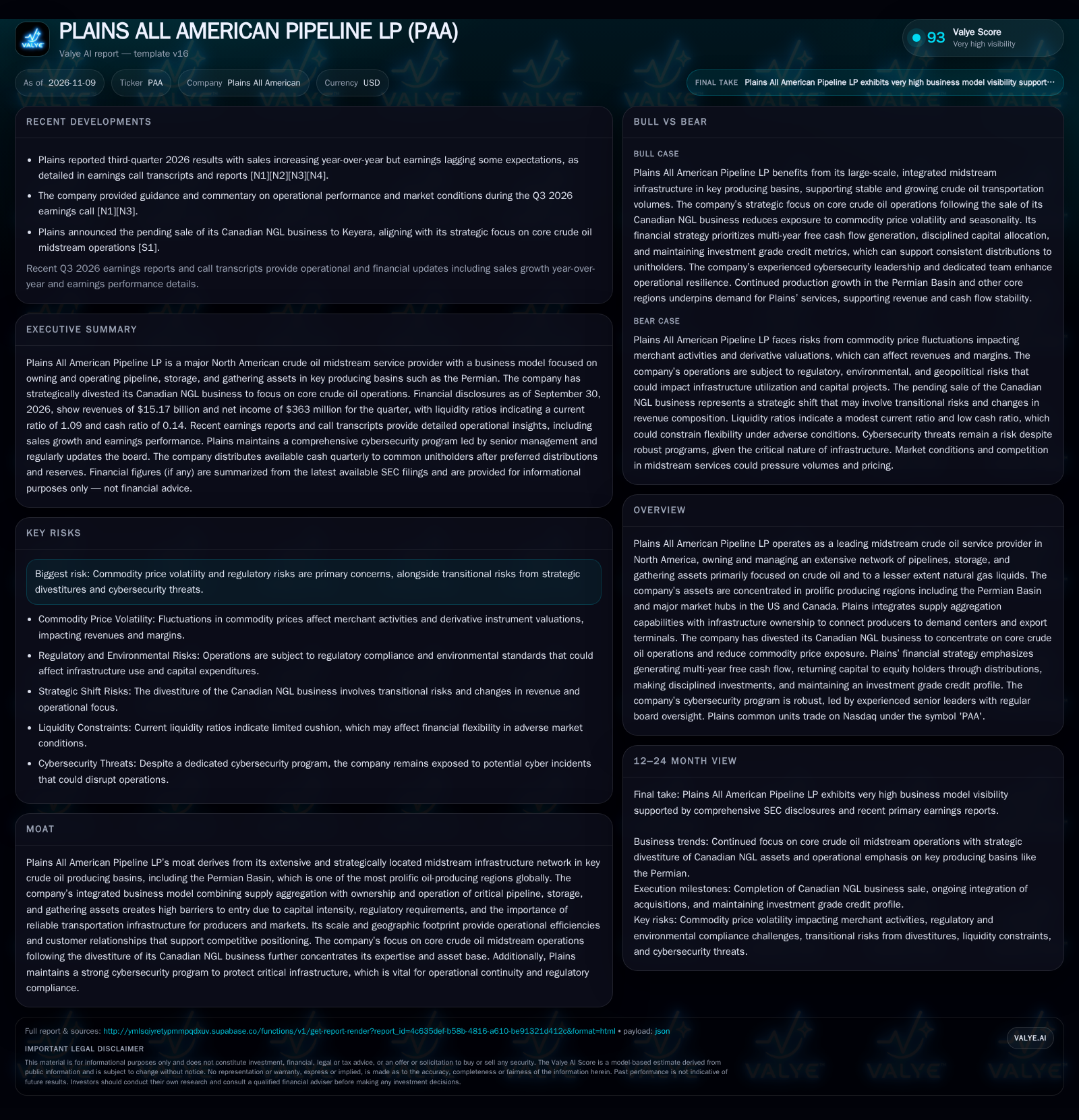
Plains All American Pipeline is concentrating on its core U.S. crude oil midstream business, selling its Canadian NGL assets and emphasizing free cash flow, capital returns, and investment grade credit. Q3 2026 results show solid revenue but earnings lagged some expectations, with liquidity ratios modest. The company’s prospects hinge on Permian Basin volume trends, tariff escalation, and its ability to manage commodity exposure and regulatory risk. Watch for execution on the Canadian NGL sale, margin evolution, and discipline in capital allocation.
Plains All American Pipeline LP, a leading North American midstream operator, is executing a strategic pivot by divesting its Canadian NGL assets to sharpen its focus on core U.S. crude oil infrastructure. This move aims to concentrate resources on high-barrier, high-volume crude oil corridors—especially the Permian Basin—while reducing exposure to commodity price swings. With Q3 2026 results showing robust top-line growth but softer-than-hoped earnings, the company’s ability to drive margin expansion, maintain disciplined capital allocation, and adapt to shifting regulatory and commodity environments will determine whether its renewed focus translates into durable value creation for unitholders.
Strategic Divestiture and Recent Results Set the Stage for a Refocused Plains
Plains All American is in the midst of a significant strategic transition, having entered a definitive agreement in June 2025 to sell its Canadian NGL business to Keyera. This transaction, expected to close by the end of Q1 2026, marks a deliberate move to concentrate on U.S. crude oil midstream operations and reduce direct exposure to commodity price volatility associated with NGLs [S1].
For the quarter ended September 30, 2026, Plains reported revenue of $15.17 billion and net income from continuing operations of $363 million. While sales increased year-over-year, earnings lagged some expectations, highlighting both operational resilience and cost/margin pressures [N1] [N2] [N3] [N4].
On the balance sheet, as of September 30, 2026, Plains held $879 million in cash and cash equivalents against current liabilities of $6.349 billion, yielding a current ratio of 1.09 and a cash ratio of 0.14. These figures indicate only a reported liquidity position cushion [S2].
The Permian Basin remains the core driver for Plains, underpinning volume and growth prospects as the company seeks to optimize its asset base and capital allocation.
How Plains Generates Cash: Tariffs, Volumes, and the Leverage of Scale
Plains’ business model centers on integrating supply aggregation with ownership and operation of pipelines, storage, and gathering assets. The company earns revenue through tariff-based fees for transporting and storing crude oil, as well as from buying and selling oil in its merchant activities. This model typically yields stable, volume-driven fee income, with some exposure to commodity price swings depending on the mix of fee-based versus merchant business.
The company’s large-scale, strategically located network—especially in the Permian—enables Plains to capture significant throughput, benefiting from operating leverage when volumes are high. However, a portion of revenue and margin is still influenced by commodity price changes and the results of derivative instruments, as evidenced by recent earnings volatility.
Plains’ divestiture of its Canadian NGL business is intended to increase the share of fee-based, less volatile income and reduce commodity-linked margin swings. The company’s stated financial strategy is to generate multi-year free cash flow, return capital to equity holders primarily through distributions, make disciplined accretive investments, and maintain an investment grade credit profile.
Fixed costs are substantial due to the capital intensity of pipeline infrastructure, but incremental throughput often carries high margin, making volume resilience and tariff escalation key to margin expansion. The company must also continually invest in maintenance, regulatory compliance, and selective growth projects, which can impact near-term free cash flow and capital allocation flexibility.
Barriers, Bottlenecks, and the Battle for Permian Volumes
Plains’ competitive edge is rooted in its ownership of extensive and strategically sited midstream infrastructure, particularly in the Permian Basin, one of the world’s most prolific oil-producing regions. This physical network creates high barriers to entry for new competitors due to capital requirements, regulatory hurdles, and the necessity of long-term customer relationships.
Operational integration—combining gathering, transportation, and storage—enables Plains to offer end-to-end solutions for producers, fostering stickiness and sometimes multi-year relationships. However, the company operates in a competitive field that includes other large midstream operators, integrated energy majors, and regionally focused pipeline companies.
A key structural advantage for Plains is the difficulty and cost of replicating its infrastructure, but counterforces include regulatory risk, environmental scrutiny, and potential overbuild in key corridors that could pressure tariffs or volumes. Rising competition for Permian volumes, shifts in basin-level production trends, and the risk of substitution (such as expanded rail or alternative pipeline routes) are ongoing threats.
While the divestiture of the Canadian NGL business sharpens focus, it also narrows diversification—Plains is now more exposed to U.S. crude oil dynamics and less to broader NGL markets. This could increase sensitivity to single-market disruptions but may also improve focus and efficiency.
Permian Growth and Tariff Escalation Unlock Margin Expansion
A favorable outcome for Plains would see robust production growth in the Permian Basin and other core regions drive higher pipeline and storage volumes, maximizing the utilization of existing assets. If Plains can secure long-term contracts or volume commitments with producers, this would underpin fee-based revenues and provide greater earnings visibility.
Tariff escalations—whether via inflation-linked adjustments or renegotiated contracts—could further boost margins, especially if operating costs are held in check. The sale of the Canadian NGL business, if executed cleanly, could result in a more streamlined, less volatile margin profile and allow management to redeploy proceeds into high-return U.S. crude oil opportunities or further capital returns.
Confirmation of this scenario would come from disclosed increases in contracted volumes, higher segment margins, and unit distribution growth, as well as evidence of rising Permian throughput and successful reinvestment of divestiture proceeds. On the financial side, improving free cash flow and a strengthening investment grade credit profile would also support the upside case.
Stable Fee Income, Disciplined Capital Return, and Measured Margin Progress
The most plausible near-term trajectory is for Plains to maintain relatively stable fee-based revenues, with modest growth in crude oil transportation volumes as Permian production trends remain healthy but not explosive. The company will likely continue returning capital to unitholders via quarterly distributions, while making selective, disciplined investments in maintenance and incremental capacity.
Margins may improve incrementally if the Canadian NGL divestiture reduces commodity-linked swings, but ongoing exposure to merchant activities and cost pressures could cap upside.
This scenario would be confirmed by steady reported throughput, consistent distribution coverage, and stable or gradually improving segment margins. Falsification would come from a sharp drop in Permian volumes, regulatory setbacks, or unexpected cost escalations undermining free cash flow.
Commodity Volatility, Regulatory Friction, or Liquidity Strain Erode Value
Adverse outcomes could arise if commodity price volatility sharply impacts Plains’ merchant margins or derivative valuations, leading to earnings and cash flow shortfalls. If Permian production growth stalls or volumes decline, the company’s operating leverage could work in reverse, amplifying the impact of lost throughput on margins and returns.
Regulatory or environmental headwinds—such as new pipeline restrictions, costly compliance mandates, or adverse permitting outcomes—could raise expenses or limit growth opportunities. Transitional risks from the Canadian NGL divestiture, including potential stranded costs or integration missteps, might also weigh on reported results.
Confirmation of a downside scenario would include declining volumes, negative free cash flow, distribution cuts, or credit downgrades.
Milestones and Metrics That Will Define Plains’ Strategic Refocus
Completion timing and financial terms of the Canadian NGL business sale to Keyera, and subsequent redeployment of proceeds.
Quarterly trends in Permian Basin and total system throughput volumes, as disclosed.
Segment margin evolution and the mix of fee-based versus commodity-exposed revenues (if disclosed).
Distribution coverage ratio and any changes to quarterly unitholder distributions.
Net debt/EBITDA ratio and updates to investment grade credit metrics.
New or renewed long-term transportation contracts or volume commitments with major producers (if disclosed).
Major regulatory, permitting, or environmental developments affecting Plains’ core pipeline and storage assets.
Reported free cash flow and management commentary on capital allocation priorities.
Disclaimer: This is research-only, informational analysis and not investment advice. It may include AI-generated interpretation and general industry context. Always verify important details using primary sources.

Comments