
EVgo’s Expansion Ambitions: Can Network Scale and Partnerships Offset Persistent Losses?
EVgo is aggressively scaling its EV fast-charging infrastructure through high-profile partnerships with Tesla, General Motors, and retail centers, aiming for 17,000 stalls by 2030. Yet, persistent net losses, missed revenue targets, and the capital intensity of growth raise questions about the business model’s path to profitability and its ability to capture long-term value in a rapidly evolving sector.
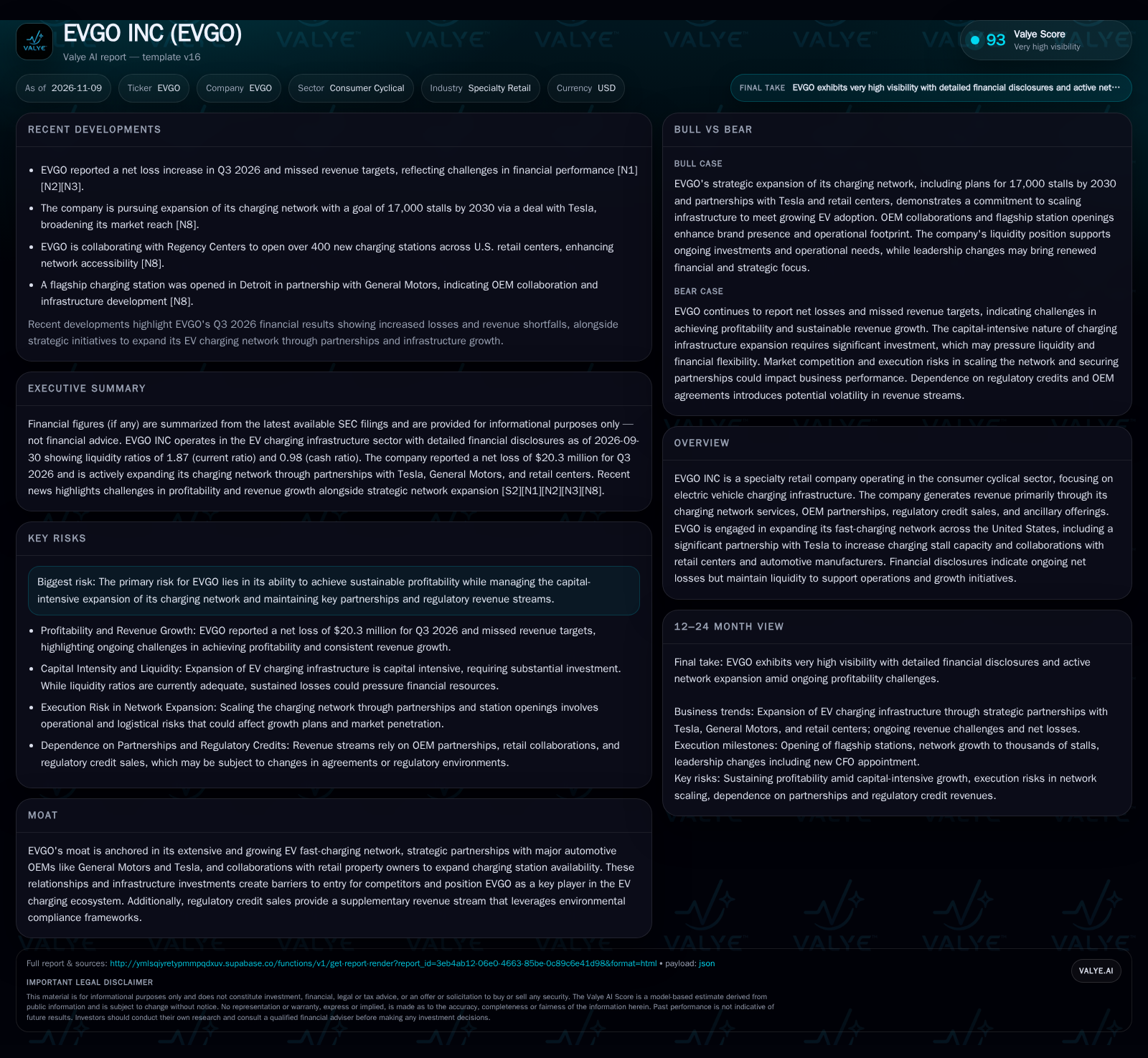
EVgo is deepening its US fast-charging network via partnerships with Tesla and retail centers, targeting 17,000 stalls by 2030. However, the company continues to post sizable net losses and recently missed revenue expectations, highlighting ongoing profitability challenges. The strategic expansion could cement EVgo’s role as a key infrastructure provider, but the capital requirements, execution risk, and reliance on partnerships make the path to sustainable returns uncertain. Watch for revenue growth, margin trends, and evidence that network scale translates into economic leverage. [S2] [N1] [N2] [N3] [N8]
EVgo is at a pivotal juncture as it races to expand its EV fast-charging network across the United States, targeting 17,000 stalls by 2030 through a landmark deal with Tesla. The company’s strategy is rooted in leveraging OEM collaborations and retail partnerships to broaden its reach, but this ambition comes with mounting losses and revenue shortfalls. As the competitive landscape intensifies and the capital demands of infrastructure buildout persist, the central question is whether EVgo’s expanding footprint and partner ecosystem can eventually deliver the scale, operating leverage, and sustainable profitability the market demands. [S2] [N1] [N2] [N3] [N8]
Recent Losses, Network Expansion, and Strategic Partnerships Shape the Current Landscape
EVgo reported a net loss of $20.3 million for Q3 2026, with basic and diluted EPS at -$0.14, and missed revenue targets—a signal of ongoing difficulty in converting network growth into near-term profitability. [S2] [N1] [N2] [N3] Despite these financial challenges, EVgo continues to expand aggressively: its deal with Tesla sets an ambitious goal of 17,000 charging stalls by 2030, and partnerships with retail centers (such as Regency Centers) and OEMs (notably General Motors) are broadening the company’s geographic and market reach. The company reported cash and liquidity metrics for the period; these figures do not by themselves establish operating runway, investment capacity, financial flexibility, or financing capacity. [N8] [S2]
How EVgo’s Business Model Seeks Profitable Scale—And Where Leverage Remains Elusive
EVgo’s revenue model is built on multiple streams: charging network usage (both retail and fleet), OEM partnerships, regulatory credit sales, and ancillary services. [S1] The core economic challenge is the capital intensity of building and maintaining fast-charging infrastructure—requiring large upfront investment, ongoing maintenance, and site acquisition costs. Revenue per stall is highly sensitive to utilization rates, which remain variable given the still-maturing US EV adoption curve. Margins are further pressured by competition on charging prices, potential profit-sharing with site hosts, and the need for continual hardware upgrades.
While regulatory credit sales and OEM partnerships can provide higher-margin or recurring revenue, these streams are susceptible to regulatory changes and contract renegotiation. The path to operating leverage depends on achieving high utilization at scale, controlling site-level costs, and maintaining a robust pipeline of value-added services. If EV adoption accelerates and EVgo’s network captures a meaningful share of charging sessions, fixed costs could be spread over a higher revenue base, improving margins. However, absent sustained volume growth and pricing power, breakeven remains challenging.
Assessing EVgo’s Defenses Amid Intensifying Competition and Technology Shifts
EVgo’s primary defensive assets are its expanding network footprint, high-visibility partnerships with Tesla and General Motors, and access to prime retail locations via deals like Regency Centers. These create localized network effects and some degree of switching friction for repeat users and fleets, especially in urban and high-traffic areas. The Tesla partnership is particularly notable, as it enables EVgo to tap into the largest installed EV base and potentially benefit from cross-network compatibility. [N8]
However, the competitive landscape is fierce: other charging networks (public and private), utilities, oil majors, and even automakers themselves are expanding their own infrastructure or forming alliances. Technology risk is also salient—shifts in charging standards, battery technology, or home/workplace charging adoption could reduce reliance on public fast-charging. Regulatory incentives and credits, while a near-term tailwind, are not guaranteed long-term, and customer loyalty is not yet entrenched in this nascent, price-sensitive market.
If Network Scale Unlocks Utilization and Partnerships Drive Volume
The most favorable scenario for EVgo is that the rapid expansion of its charging footprint, particularly in collaboration with Tesla and major retail centers, enables the company to achieve dominant coverage in key urban corridors and high-traffic retail sites. If US EV adoption accelerates and charging sessions per stall increase, the company could see a step-change in revenue and margin expansion as fixed costs are amortized over higher volumes. OEM partnerships—especially if they include direct integration into vehicle navigation and charging platforms—could drive recurring, high-margin traffic to EVgo’s network.
Confirmation of this scenario would come from sustained increases in same-station revenue, evidence of rising utilization rates, and visible margin improvement even as the network grows. Additional OEM deals, expanded regulatory credit sales, or new value-added services (such as fleet management or loyalty programs) would further support the case. The scenario would be falsified if network expansion fails to produce meaningful revenue/EBITDA inflection, utilization rates stagnate, or if partnerships do not translate into durable volume growth.
Incremental Network Growth, Intense Competition, and a Long Road to Breakeven
The most probable outcome is that EVgo continues to grow its network and partnerships, but faces persistent headwinds from capital intensity, competitive pricing, and slow improvements in station-level utilization. Revenue grows with the stall count, but margin expansion is slow due to ongoing cost inflation, customer incentives, and the need to secure premium locations. Regulatory credits and OEM partnerships provide some buffer, but are volatile and subject to external forces.
Signs this scenario is playing out would include steady but modest revenue growth, continued net losses, and periodic capital raises to fund expansion. Utilization gains may be incremental, with break-even economics elusive until EV adoption reaches critical mass. The scenario would be challenged if site-level profitability improves faster than expected, or if a major competitor’s exit or consolidation reduces price pressure.
When Capital Demands Outpace Revenue and Execution Falters
The adverse scenario for EVgo arises if network expansion consistently fails to deliver improved utilization and revenue per stall, while competition intensifies and regulatory credit revenues decline or become less reliable. Execution risk—such as delays in station rollouts, technical issues, or failed partnerships—could further undermine growth.
This scenario would be confirmed by a declining cash balance, deteriorating liquidity ratios, missed expansion milestones, or the loss/non-renewal of major OEM or retail partnerships. Worsening unit economics, such as falling revenue per charging session or rising maintenance costs, would also be red flags. The scenario could be avoided if cost discipline improves, utilization surprises to the upside, or if external funding remains accessible and non-dilutive.
Milestones and Data Points That Will Determine If EVgo’s Expansion Delivers Lasting Value
Quarterly revenue growth relative to stall count—does network expansion translate to higher revenue per stall, or is growth purely footprint-driven?
Utilization rates (charging sessions per station, if disclosed)—a direct measure of network productivity and a leading indicator of margin improvement.
Margin trends at both gross and EBITDA levels—evidence of operating leverage as the network scales.
OEM and retail partnership renewals or expansions—confirmation that strategic relationships are delivering durable, high-volume traffic.
Regulatory credit sales and their contribution to overall revenue—volatility or decline would pressure the business model.
Station rollout pace versus stated targets—delays or under-delivery could signal execution issues.
Competitive developments, such as major new entrants, price wars, or technological shifts that could reduce demand for public fast-charging.
Disclaimer: This is research-only, informational analysis and not investment advice. It may include AI-generated interpretation and general industry context. Always verify important details using primary sources.

Comments