
USCI’s Commodity Exposure: Managing Volatility, Regulatory Boundaries, and Investor Trends in a Changing Macro Landscape
United States Commodity Index Funds Trust (USCI) has delivered notable NAV gains and repeated 52-week highs, reflecting robust investor demand amid shifting commodity cycles. Yet the fund’s ability to deliver benchmark-tracking exposure depends on successfully balancing regulatory position limits, margin costs, and the unpredictable forces that drive commodity prices.
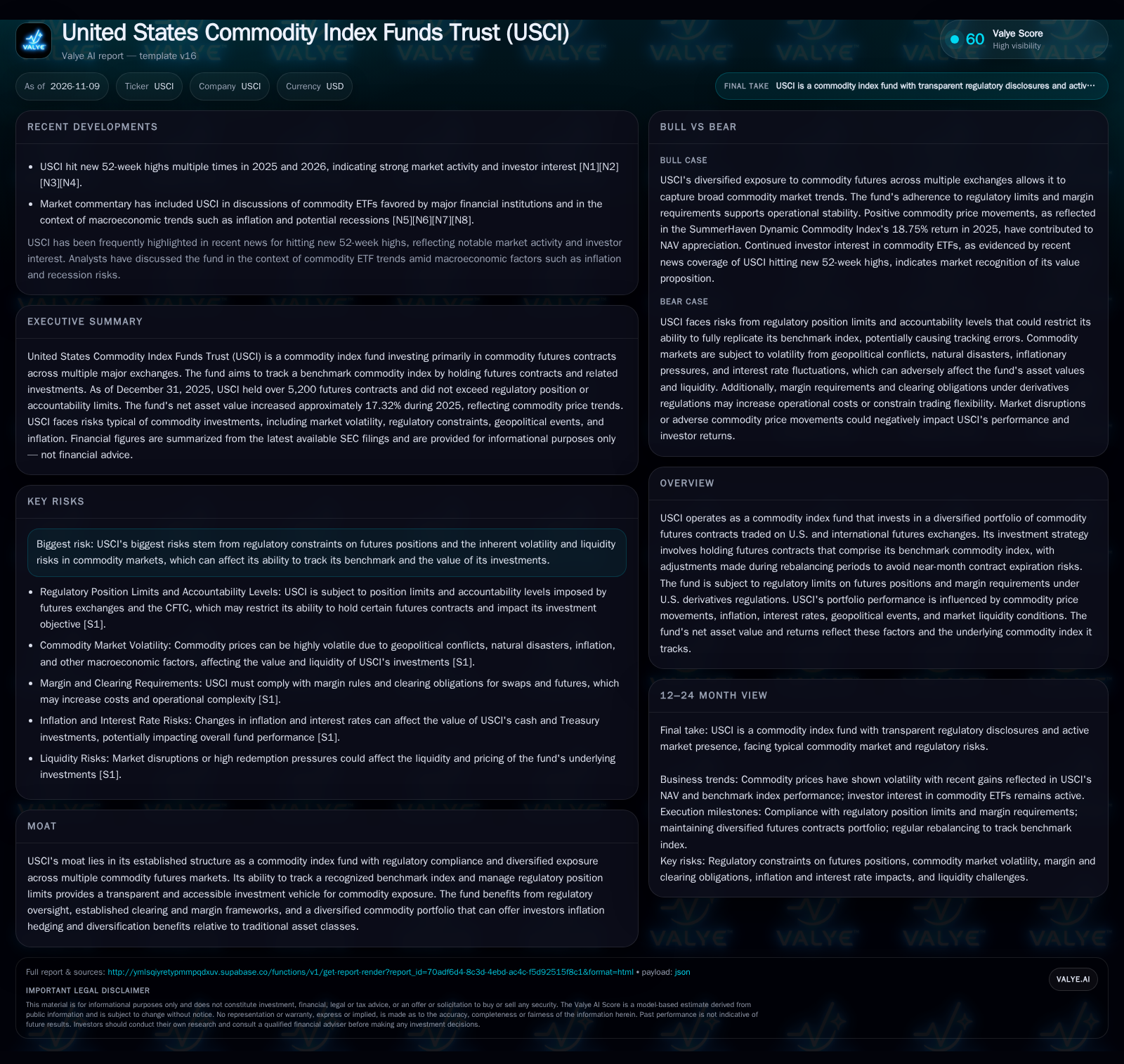
USCI’s NAV climbed over 17% in 2025, buoyed by broad commodity price strength and repeated 52-week highs that signal strong investor interest. The fund’s structure—tracking a diversified commodity index via rolling futures—offers inflation hedging and diversification, but exposes it to regulatory trading limits and the full force of commodity market volatility. [S1] [N1] [N2] [N3] [N4]
United States Commodity Index Funds Trust (USCI) stands out among commodity index funds for its diversified futures exposure and recent strong performance, with NAV gains of over 17% in 2025 and a series of new 52-week highs. These results underscore both the fund’s appeal as an inflation and diversification play and the cyclical nature of commodity markets. However, USCI’s ability to maintain this trajectory is not solely a function of commodity prices: it relies on navigating regulatory position limits, managing margin requirements, and responding to the volatility that characterizes the commodity complex. As macro conditions, regulatory frameworks, and investor flows evolve, the fund’s next phase will test its operational flexibility and its value as a portfolio hedge. [S1] [N1] [N2] [N3] [N4]
Recent NAV Expansion and Market Dynamics Shape USCI’s Current Position
USCI’s net asset value (NAV) increased approximately 17.32% during 2025, a result that mirrors the broader strength across commodity markets over the period. This upward move was supported by the SummerHaven Dynamic Commodity Index’s 18.75% return, the fund’s diversified futures positions, and a favorable macro backdrop for real assets. In tandem, USCI hit new 52-week highs multiple times in 2025 and 2026, signaling not only price appreciation but also heightened investor engagement and trading activity. These developments have placed USCI among the commodity ETFs spotlighted by institutions and media as vehicles for inflation protection and macro diversification. [S1] [N1] [N2] [N3] [N4]
However, these gains come amid persistent risks. USCI operates under strict regulatory position limits and accountability levels for its futures contracts, and must maintain adequate margin to meet clearing obligations. While the fund has not exceeded these thresholds as of the latest filings, any tightening of regulatory limits or spikes in margin requirements could alter its ability to fully replicate its benchmark, potentially introducing tracking error or forcing costly portfolio adjustments. [S1]
The Mechanics Behind USCI’s Commodity Price Exposure and Potential Pitfalls
USCI’s business model is to provide investors with broad commodity exposure by holding and periodically rolling a diversified basket of commodity futures contracts. The fund’s revenue stream is based on management fees, which are a function of assets under management (AUM), and, indirectly, on the ability to attract and retain capital by matching the returns of its benchmark index. The core economic engine is thus the translation of commodity price movements—across energy, metals, agriculture, and more—into NAV appreciation or depreciation.
The fund’s cost base is shaped by exchange and clearing fees, margin requirements, and the operational complexity of managing numerous futures positions. Fixed costs (administrative, compliance, fund management) are relatively stable and benefit from scale, while variable costs can spike during periods of high volatility or when regulatory changes increase margin or reporting burdens. The rolling of futures contracts to avoid near-month expiration is a key operational process, and the shape of the futures curve (contango or backwardation) can enhance or erode returns through roll yield effects.
USCI’s capital needs are generally low outside of margin requirements, but spikes in volatility or regulatory changes can force the fund to post additional collateral or restructure positions, increasing operational risk. Periods of commodity market stress—such as sudden price collapses or liquidity crunches—can lead to wider bid-ask spreads, increased slippage, and potential tracking error relative to the benchmark.
USCI’s Distinctive Position Among Commodity ETFs Amid Structural Challenges
USCI competes with a broad array of commodity ETFs, including both diversified funds tracking major commodity indices and sector-specific products focused on energy, metals, or agriculture. Its differentiated value proposition lies in its dynamic rebalancing methodology and its diversified exposure, which can appeal to investors seeking inflation hedges or non-correlated returns relative to equities and fixed income.
However, USCI’s position is not unassailable. Competing funds may offer lower fees, greater liquidity, or alternative index methodologies that appeal to different investor segments. Structural constraints—most notably regulatory position limits and margin requirements—can become binding in periods of high volatility or rapid asset growth, potentially forcing USCI to deviate from its benchmark or cap inflows. Additionally, advances in commodity-linked structured products or the emergence of new index methodologies could pose substitution threats, especially if they offer more efficient tracking or tax advantages.
USCI’s competitive moat is thus rooted in its transparency, regulatory compliance, and operational track record—but it remains vulnerable to external shocks, regulatory tightening, and the ongoing evolution of investor preferences and financial engineering.
Potential Growth from Prolonged Commodity Strength and Stable Regulatory Environment
If global commodity prices continue to rise on the back of persistent inflation, supply constraints, or geopolitical instability, USCI could see further NAV appreciation and increased investor inflows. This scenario is amplified if inflation expectations remain elevated and traditional portfolios seek diversification away from equities and bonds. Regulatory frameworks that remain stable—without tightening position limits or raising margin requirements—would allow USCI to maintain full benchmark exposure and avoid costly rebalancing or tracking error.
Confirmation of this scenario would include continued outperformance of the underlying benchmark, positive roll yield from backwardated commodity curves, and media or institutional commentary highlighting USCI’s role as a preferred inflation hedge. A surge in AUM, persistent premium to NAV, and robust trading volumes would further support the bull case. Conversely, signs that regulatory authorities are considering new limits, or that margin requirements are rising disproportionately, would challenge the durability of this scenario.
Expectations for Commodity Market Normalization Amid Ongoing Volatility and Rules
The most plausible trajectory is that commodity prices continue to oscillate with global supply-demand cycles, inflation, and geopolitical risk, producing periods of both NAV growth and retracement. USCI is likely to continue tracking its benchmark effectively, provided it remains within regulatory position and margin constraints and manages roll costs efficiently. Investor interest in commodity ETFs may remain elevated relative to pre-pandemic levels, but is unlikely to see runaway growth unless another inflation shock or supply crisis materializes.
This scenario would be confirmed by USCI’s NAV and AUM stabilizing around recent highs, continued adherence to position limits, and a manageable level of tracking error. Evidence of persistent, but not extreme, volatility in commodity futures markets would also support this outlook. Falsifying evidence would include a spike in tracking error, forced position reductions due to regulatory changes, or a sharp reversal in commodity prices that drains AUM and liquidity.
Consequences of Regulatory Changes and Market Disruptions on Fund Performance
In an adverse scenario, commodity prices could fall sharply due to global economic contraction, resolution of geopolitical conflicts, or aggressive monetary tightening that suppresses inflation expectations. Simultaneously, regulatory bodies (CFTC or exchanges) might lower position limits or increase margin requirements, constraining USCI’s ability to hold desired futures positions and forcing deviations from its benchmark. In such a scenario, the fund could experience material tracking error, NAV declines, and significant investor outflows.
Confirmation would come from announcements of new regulatory restrictions, spikes in margin requirements, widening bid-ask spreads in commodity futures, and USCI reporting tracking error or position reductions in regulatory filings. A sustained NAV decline, persistent discount to NAV, or negative media coverage questioning the fund’s ability to deliver benchmark exposure would further support the bear case.
Factors Influencing USCI’s Ability to Maintain Benchmark Alignment and Stability
Tracking error versus the SummerHaven Dynamic Commodity Index, especially during periods of volatility or regulatory adjustment, would help validate the fund’s operational effectiveness.
Changes in CFTC or exchange-imposed position limits, or any waivers/adjustments requested or granted, as disclosed in regulatory filings.
Margin requirement trends and the impact of rising or falling collateral demands on the fund’s ability to maintain target exposures.
AUM growth and fund inflows/outflows, as sustained investor demand is both a sign of confidence and a potential constraint if position limits are approached.
Bid-ask spreads and liquidity conditions in key commodity futures markets, since wider spreads could raise trading costs and tracking error.
Frequency and magnitude of roll yield (positive or negative) realized during contract roll periods—if disclosed, this would clarify the impact of futures curve structure on returns.
Any material NAV premium or discount to market price, which may signal liquidity stress, tracking concerns, or shifts in investor sentiment.
Media or institutional research commentary that highlights USCI in the context of inflation hedging, regulatory risk, or ETF innovation, as this can influence flows and perceptions.
Disclaimer: This is research-only, informational analysis and not investment advice. It may include AI-generated interpretation and general industry context. Always verify important details using primary sources.

Comments