
Plains GP Holdings 2026: Strategic Refocus, Distribution Leverage, and the Stakes of Midstream Dependency
The company’s fortunes remain tightly linked to distribution flows from Plains All American Pipeline, raising fundamental questions about stability, capital discipline, and resilience to commodity and geopolitical shocks.
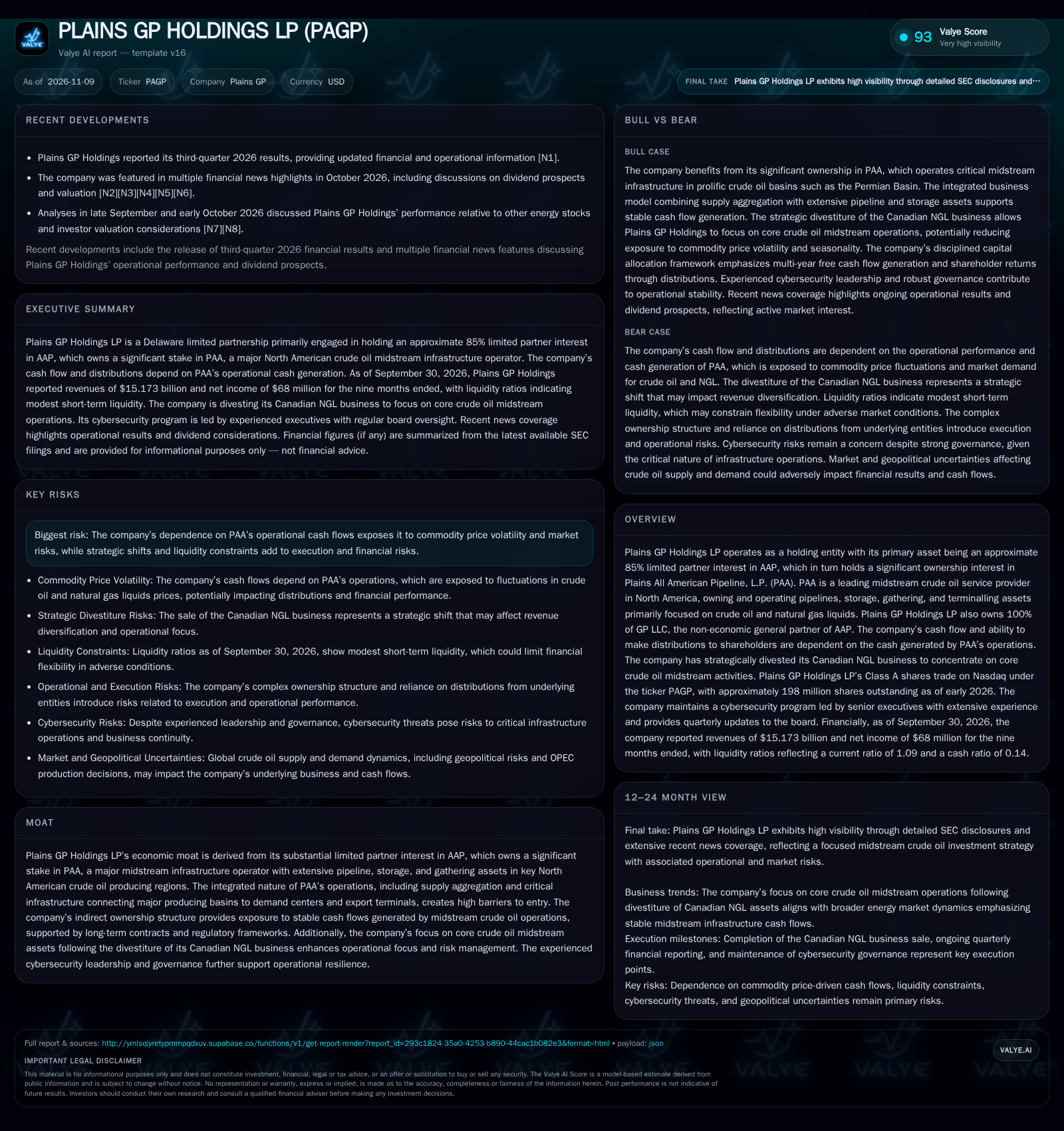
Plains GP Holdings is consolidating around its primary U.S. crude oil midstream assets, completing a strategic divestiture of Canadian NGL operations. Revenues for the first nine months of 2026 reached $15.2 billion, but net income was just $68 million, highlighting slim margins in a capital-intensive sector. The company’s ability to sustain and grow shareholder distributions depends on both operational execution at PAA and broader market dynamics affecting crude oil flows and pricing. [S1] [S2]
Plains GP Holdings’ 2026 trajectory is defined by a sharpened focus on core U.S. crude oil assets, following its divestiture of Canadian NGL operations. While the company maintains a substantial indirect stake in Plains All American Pipeline, its financial results reveal the tightrope it walks: massive top-line revenues but slim net income and modest short-term liquidity. With shareholder distributions hinging on PAA’s operational cash flows, the business is acutely exposed to commodity cycles, infrastructure utilization, and the discipline of capital allocation. How Plains manages these dependencies and executes its refocused strategy will determine its resilience and appeal to income-oriented investors.
Strategic Divestiture and Financial Realities Define 2026 Operating Environment
As of September 30, 2026, Plains GP Holdings reported revenues of $15.173 billion and net income of $68 million for the first nine months of the year, reflecting the high-volume, low-margin nature of the midstream business [S2]. The company is finalizing the sale of its Canadian NGL business, a move expected to close around Q1 2026, marking a pivot away from non-core operations and toward a tighter focus on U.S. crude oil infrastructure [S1]. [S2] The company’s ability to make shareholder distributions remains directly tied to the cash flows generated by its primary asset, Plains All American Pipeline (PAA) [S1].
Distribution Mechanics and Margin Pressures in a Capital-Heavy Model
Plains GP Holdings derives its cash flow almost exclusively from its indirect ownership in PAA, which operates a vast network of pipelines, storage, and terminal assets. The economics of this model hinge on throughput volumes, tariff rates, and the efficiency of asset utilization. Revenue is largely fee-based, but profitability is constrained by the sector’s capital intensity, regulatory compliance costs, and ongoing maintenance needs. The company distributes substantially all available cash to shareholders after reserving for capex, debt service, and other obligations, creating a direct pass-through of operational performance to investors [S1].
Operating leverage is inherently limited: while incremental volume growth can improve margins, the fixed cost base is high and pricing power is constrained by contract structures and competitive dynamics. The recent divestiture of the Canadian NGL business reduces exposure to seasonal and commodity-linked volatility, potentially smoothing cash flow, but also narrows revenue sources. [S2]
The capital intensity inherent in midstream infrastructure also imposes a multi-year horizon on return realization, meaning Plains GP Holdings must balance near-term distribution expectations with the necessity of sustained reinvestment to maintain asset integrity and regulatory compliance. This dynamic creates a tension between shareholder yield demands and the prudence of capital preservation, especially in an environment where commodity price volatility can abruptly alter throughput economics. Additionally, regulatory frameworks governing pipeline safety, environmental impact, and tariff approval processes introduce layers of compliance costs and potential project delays, which can further compress margins and complicate cash flow predictability.
Barriers, Substitutes, and the Realities of Midstream Competition
Plains GP’s competitive position is anchored in PAA’s extensive North American midstream network, especially its connectivity to prolific basins like the Permian. This infrastructure is difficult and expensive to replicate, giving incumbents high barriers to entry and some insulation from new competition. However, counterforces include regulatory oversight, potential for pipeline overcapacity, and evolving shipper preferences, especially as energy transition pressures mount.
Peer groups include other large midstream operators, many of which also pursue scale, operational efficiency, and long-term contracts as moats. While midstream assets can benefit from stable cash flows under take-or-pay or minimum volume commitments, actual contract terms and renewal rates are not disclosed, leaving uncertainty around revenue visibility and customer stickiness. Substitution risk exists in the form of alternative transport modes (rail, truck) and, longer-term, shifts to lower-carbon energy sources that could reduce demand for traditional crude oil infrastructure.
While the midstream sector benefits from substantial entry barriers due to the high fixed costs and regulatory approvals required for new pipeline projects, Plains GP Holdings must remain vigilant against emerging competitive threats such as technological innovations in alternative energy transport or shifts in end-market demand patterns. The increasing emphasis on decarbonization and renewable energy sources could gradually erode crude oil production volumes, thereby impacting pipeline utilization rates. Moreover, evolving shipper preferences toward more flexible contract terms or integrated service offerings may challenge traditional fee structures, compelling Plains GP to adapt its commercial strategies to retain and attract customers within a changing competitive landscape.
Volume Growth and Capital Discipline Could Drive Sustainable Distribution Upside
If crude oil production volumes in key basins like the Permian remain robust and PAA successfully renews or wins long-term shipper contracts, Plains GP could see improved throughput, higher asset utilization, and more reliable fee-based cash flows. The focused exit from the Canadian NGL business may further stabilize earnings by reducing exposure to margin volatility and operational complexity. Effective capital discipline—prioritizing maintenance and high-ROI growth projects while avoiding overextension—could support growing distributions without undue balance sheet risk.
Confirmation of this scenario would come from rising quarterly distribution levels, improved net income margins, and evidence that the company is maintaining or growing market share in core gathering and transportation corridors. Additional upside signals would include successful completion of growth projects on time and budget, and continued positive commentary from management on contract renewals and basin activity.
In scenarios where Plains GP Holdings leverages its strategic focus to optimize operational efficiencies, incremental throughput gains could disproportionately enhance cash flow due to the high fixed cost structure. Additionally, successful navigation of contract negotiations to secure longer-term commitments with favorable terms would reduce revenue volatility and underpin more confident distribution guidance, enhancing investor confidence in the company’s cash flow stability.
Stable but Constrained: Cash Flow Pass-Through Amid Industry Cyclicality
The most plausible trajectory for Plains GP Holdings is continued stable but thin-margin performance, with distributions closely tracking the cash flows generated by PAA’s midstream operations. The strategic refocus on core U.S. crude oil assets should reduce operational noise, but the business will remain subject to volume fluctuations, modest pricing power, and ongoing capital expenditure needs. Liquidity will likely remain adequate but not ample, reinforcing the importance of disciplined capital allocation and careful working capital management.
This scenario is confirmed by relatively flat distribution growth, maintenance of liquidity ratios near current levels, and the absence of significant new debt or equity issuance. Revenue and net income trends that mirror broader crude oil production and transportation activity would further validate the base case.
Commodity Shocks or Execution Missteps Could Pressure Distributions and Flexibility
A significant downturn in crude oil prices or production volumes—whether due to macroeconomic weakness, OPEC policy shifts, or regulatory hurdles—could reduce throughput on PAA’s pipelines, compressing cash flows and limiting the funds available for shareholder distributions. If the company faces unexpected operational disruptions, cost overruns, or difficulty renewing key contracts, the impact would be magnified by the reported liquidity position cushion and limited revenue diversification following the NGL exit.
Downside confirmation would include distribution cuts, negative net income trends, deteriorating liquidity ratios, or the need for emergency capital raises. Early warning signs could also include increased customer churn, declining asset utilization rates, or unfavorable contract renegotiations if disclosed.
What Will Determine Plains GP’s Resilience and Distribution Stability?
Quarterly distribution per share trends: Any increase, decrease, or suspension would directly signal underlying cash flow health.
Throughput volumes and asset utilization rates at PAA: If disclosed, these would help test whether the core infrastructure is being fully and efficiently used.
Contract renewal rates and new contract wins: Disclosure of major contract terms or customer retention would clarify revenue visibility.
Completion and proceeds from the Canadian NGL business divestiture: Confirmation and use of sale proceeds will spotlight capital allocation discipline.
Capital expenditure guidance and actuals: Overspend or deferral could signal either growth ambition or stress.
Commentary on regulatory, geopolitical, or commodity price shocks: Management disclosures about risk exposures will be critical to understanding downside vulnerability.
Cybersecurity incident disclosures or commentary: Given the infrastructure’s criticality, any breach or significant event would test operational resilience.
Disclaimer: This is research-only, informational analysis and not investment advice. It may include AI-generated interpretation and general industry context. Always verify important details using primary sources.

Comments