
Aura Biosciences 2026: Pivotal Trial Milestones, Capital Uncertainty, and the Stakes of Clinical-Stage Oncology Ambition
Aura Biosciences has reached a critical inflection point with its lead candidate bel-sar completing Phase 3 enrollment in eye cancer, extending its cash runway, and enacting leadership changes. Yet, substantial net losses, going concern warnings, and the absence of commercial products underscore the binary nature of its near-term prospects.
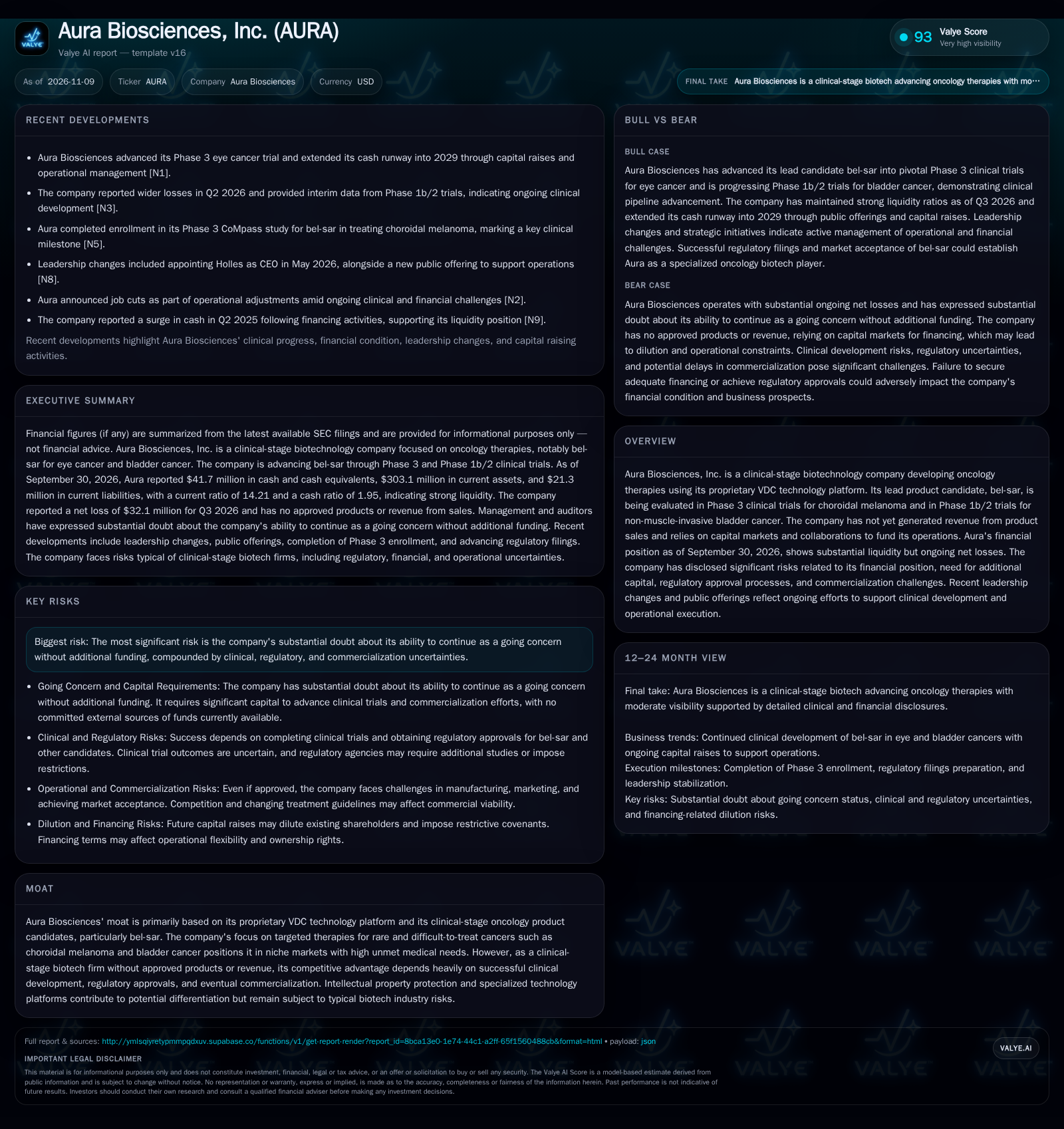
Aura Biosciences’ completion of Phase 3 enrollment for bel-sar in choroidal melanoma and recently extended cash runway reflect operational progress, but ongoing net losses and explicit going concern warnings highlight acute dependence on future clinical success and additional capital. With no approved products or revenue, the company’s thesis now pivots on pivotal trial results, regulatory outcomes, and access to non-dilutive funding.
Aura Biosciences stands at a decisive crossroads as of late 2026. With its lead candidate bel-sar completing Phase 3 enrollment in choroidal melanoma and interim clinical progress in bladder cancer, the company is closer than ever to a potential regulatory inflection. However, persistent net losses, explicit going concern warnings, and a lack of commercial revenue mean Aura’s future now hinges almost entirely on the outcome of pivotal clinical trials and its ability to secure additional funding. Leadership changes and operational adjustments highlight both the urgency and uncertainty that characterize the clinical-stage biotech landscape.
Pivotal Trial Completion and Financial Strain Define Aura’s Current State
Aura Biosciences recently marked a major clinical milestone by completing enrollment in its Phase 3 CoMpass study for bel-sar in choroidal melanoma, positioning the company for a pivotal regulatory filing in a rare cancer with high unmet need [N5]. This advance coincides with the company reporting $41.7 million in cash and cash equivalents as of September 30, 2026, and extending its projected cash runway into 2029 following recent capital raises [S2] [N1]. However, the company posted a net loss of $32.1 million for Q3 2026 and continues to operate with no approved products or commercial revenue, explicitly warning of substantial doubt about its ability to continue as a going concern without additional funding [S2]. A leadership transition, including the appointment of a new CEO and operational restructuring with job cuts, further underscores the urgency and pressure Aura faces in navigating this critical period [N2] [N8].
Economics of a Pre-Revenue Oncology Platform: High Burn, High Stakes
Aura’s business model typifies the clinical-stage biotech archetype: high upfront research and development spending, negligible revenue, and acute dependence on external capital. The company’s cost structure is dominated by R&D expenses—particularly for advancing bel-sar through late-stage trials—while G&A costs rise as the organization grows to support regulatory, operational, and pre-commercialization activities. Without approved products, Aura generates no product revenue and must repeatedly access capital markets or pursue partnerships to fund operations. If bel-sar achieves regulatory approval, the economics could shift dramatically: rare oncology indications often could support premium pricing and relatively rapid adoption among specialist prescribers, though the ultimate revenue scale is bounded by the small patient population.
Operating leverage is largely absent until commercialization, at which point fixed infrastructure (manufacturing, regulatory, commercial) could be spread over growing sales. However, substantial post-approval investment would likely be required for launch, market access, and potential label expansion. The capital intensity and binary nature of clinical-stage oncology economics mean that future value is acutely sensitive to trial outcomes, regulatory decisions, and access to non-dilutive funding. Ongoing net losses and going concern warnings highlight that Aura’s near-term economics are not self-sustaining and that dilution or restrictive financing may be unavoidable if clinical milestones are delayed or fall short.
Niche Focus and Platform Ambition: Positioning in the Oncology Landscape
Aura’s core differentiator is its proprietary VDC (virus-like drug conjugate) technology platform, with bel-sar targeting rare, underserved cancers such as choroidal melanoma. This niche focus offers a plausible pathway to regulatory incentives (e.g., orphan drug status) and reduced direct competition compared to more crowded oncology indications. The potential for first-mover advantage in a rare cancer could yield pricing power and specialist prescriber loyalty if clinical data support meaningful benefit.
However, Aura’s competitive position remains theoretical until clinical validation and regulatory approval are secured. Other modalities—such as checkpoint inhibitors, targeted small molecules, or radiotherapies—could be considered substitutes, even if not directly approved for the same indication. The risk of new entrants or larger oncology players repurposing existing agents is ever-present. Intellectual property protection and proprietary platform claims may provide some insulation, but in practice, the absence of commercial traction, payer relationships, or operational scale leaves Aura vulnerable to both scientific and market-based competitive shocks.
Transformational Success: Pivotal Data Drive Approval and Market Entry
In a favorable scenario, bel-sar’s pivotal Phase 3 data in choroidal melanoma demonstrate clear clinical benefit and safety, enabling a smooth regulatory review and eventual approval. Given the high unmet need and lack of established alternatives, regulatory agencies could grant expedited review or orphan designation, supporting premium pricing and facilitating rapid uptake among ocular oncology specialists. Successful approval could also unlock the potential for label expansion into related indications and support further development of the VDC platform in bladder cancer or other oncology targets.
Confirmation of this scenario would come from positive top-line Phase 3 results, regulatory acceptance of filings, and clear guidance on launch timelines. Early commercial traction—evidenced by initial sales (if disclosed), payer coverage decisions, or inclusion in treatment guidelines—would further validate the upside case. Non-dilutive partnerships or licensing deals, particularly with larger pharma, would provide additional confirmation by derisking both funding and commercial execution.
Navigating Clinical, Regulatory, and Funding Hurdles in a Binary Environment
The most plausible near-term path is continued operational progress punctuated by acute binary risks. Aura is likely to advance bel-sar through regulatory review, but the outcome and timing are uncertain. Delays in regulatory feedback, requests for additional data, or modestly positive (but not practice-changing) clinical results could slow the path to market and increase funding needs. In this scenario, Aura may be forced to pursue further capital raises—potentially dilutive to shareholders—to bridge to commercialization.
Evidence confirming this scenario would include regulatory correspondence indicating additional review steps, incremental financing rounds, and ongoing net losses without offsetting partnership revenue. [N1] The base case remains highly contingent on both clinical outcomes and capital market receptivity.
Failure to Deliver: Clinical Setbacks or Funding Gaps Threaten Viability
An adverse scenario would see bel-sar’s pivotal trial failing to meet primary endpoints, revealing safety concerns, or producing equivocal results that undermine regulatory approval prospects. In such a case, Aura would lose its lead value driver, and the company’s pre-revenue status would leave it exposed to a severe funding crisis—especially given explicit going concern warnings and the absence of alternative commercial-stage assets. Even a delay or regulatory setback could force Aura to seek emergency financing under unfavorable terms, resulting in heavy dilution or loss of operational control.
Confirmation of this scenario would come from negative or inconclusive Phase 3 trial readouts, regulatory rejections or major delays, sharp increases in net loss or cash burn, and announcements of workforce reductions or asset sales. A failed financing round or public statements indicating an inability to secure new capital would be decisive downside signals.
Milestones That Could Reshape Aura’s Investment Thesis
Top-line results from the Phase 3 CoMpass study for bel-sar in choroidal melanoma; these will determine regulatory and commercial prospects.
Updates on the regulatory filing process for bel-sar, including acceptance of submission, review timelines, and agency feedback.
Interim and final data from Phase 1b/2 bladder cancer trials, which would help assess pipeline depth and platform potential.
Disclosure of non-dilutive partnerships, licensing agreements, or collaborations that could offset capital needs.
Evidence of payer engagement and plans for market access (if disclosed), crucial for rare oncology commercialization.
Additional leadership or workforce changes, which may signal either stabilization or further operational stress.
Any new financing events, including public offerings or debt, and their terms—especially if they dilute existing shareholders or include restrictive covenants.
Disclaimer: This is research-only, informational analysis and not investment advice. It may include AI-generated interpretation and general industry context. Always verify important details using primary sources.

Comments