
The cited source reports dividend-related activity; that disclosure alone does not establish dividend-policy continuity, management confidence, or a material constraint on capital flexibility.
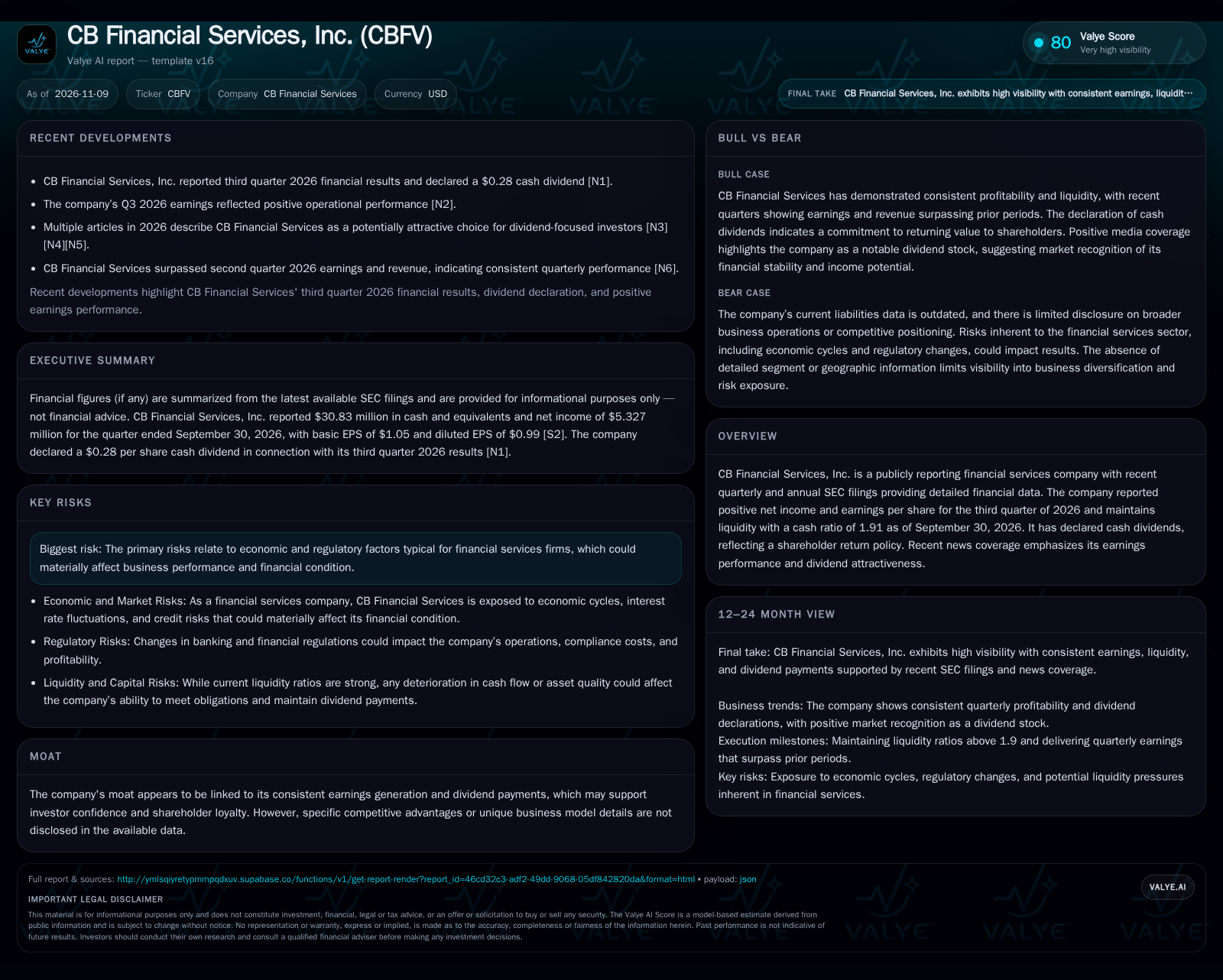
CB Financial Services, Inc. has posted solid third-quarter 2026 results, exceeding earnings estimates, maintaining a reported cash position, and continuing its dividend payments.
Economic cycles and regulatory shifts could materially impact future performance. [S2] [N1] [N2] [N6]
CB Financial Services, Inc. stands out for its recent track record of exceeding earnings expectations and sustaining a reported cash position, as evidenced by its Q3 2026 results. As economic and regulatory challenges continue to shape the financial sector, the durability of CB Financial Services’ performance will depend on its underlying business mix, risk management, and adaptability—factors that are not fully illuminated by current disclosures.
Recent Results Spotlight Profitability, Liquidity, and Shareholder Returns
CB Financial Services, Inc. reported net income of $5.327 million for the quarter ended September 30, 2026, with basic earnings per share of $1.05 and diluted EPS of $0.99 [S2]. The cited source reports dividend-related activity; that disclosure alone does not establish dividend-policy continuity, management confidence, or a material constraint on capital flexibility. [S2] [N1] Notably, CB Financial Services exceeded both Q2 and Q3 2026 earnings and revenue expectations, signaling positive operational momentum [N2] [N6]. These facts collectively highlight a period of strong financial performance, reported liquidity position, and a commitment to returning capital to shareholders.
Beyond headline profitability and liquidity metrics, a deeper understanding of cash flow dynamics would enhance assessment of operational health. For instance, the quality of earnings—whether driven by recurring core operations or one-time items—affects the sustainability of reported net income.
How Earnings Are Generated: Underlying Drivers and Financial Structure
As a financial services company, CB Financial Services likely derives the bulk of its income from net interest margin—the spread between interest earned on loans and investments and interest paid on deposits and borrowings. Fee-based revenue, such as service charges, may supplement interest income, though the current report does not disclose the breakdown. The company’s recent profitability suggests a favorable balance between interest income and funding costs, possibly aided by prudent asset-liability management and credit quality. Operating leverage in this sector typically depends on scale and the ability to manage fixed costs relative to interest and fee revenue. However, limited disclosure on cost structure, loan portfolio composition, and non-interest income makes it difficult to assess the sustainability of current margins or sensitivity to rate changes. [S2]
The interplay between asset composition and funding strategy critically influences earnings stability in financial services. If the loan portfolio is heavily weighted toward variable-rate instruments, net interest income may exhibit greater sensitivity to interest rate fluctuations, potentially benefiting from rising rates but also exposing the company to repricing risk. Conversely, a concentration in fixed-rate loans funded by short-term liabilities could compress margins under a rising rate environment. Furthermore, the extent of reliance on wholesale funding versus stable retail deposits would impact liquidity risk and funding costs. A detailed breakdown of these elements would help evaluate how CB Financial Services navigates interest rate cycles and credit risk.
Assessing Market Position Without Full Visibility
CB Financial Services’ competitive positioning is challenging to discern due to a lack of detailed segment reporting or geographic disclosure. In the broader banking sector, competitive advantage can stem from local market share, customer relationships, low-cost deposit funding, or specialized lending expertise. The cited source reports dividend-related activity; that disclosure alone does not establish dividend-policy continuity, management confidence, or a material constraint on capital flexibility. Peer categories would include regional banks, community banks, and diversified financial services providers, all of whom face similar pressures from interest rate volatility, digital disruption, and regulatory compliance. The absence of stated unique offerings or differentiated customer segments leaves open the question of how CB Financial Services defends or grows its franchise against competitors and potential substitutes.
In the absence of detailed segment or geographic data, evaluating competitive positioning requires inference from broader industry dynamics. Regional financial institutions often compete on personalized service, local market knowledge, and niche lending expertise. However, they also face increasing pressure from larger banks with scale advantages and fintech entrants offering innovative digital solutions. CB Financial Services’ ability to leverage technology for operational efficiency or customer engagement could be a critical differentiator if disclosed. Additionally, the company’s strategic focus—whether on consumer, commercial, or specialized lending—would shape its vulnerability to competitive and regulatory pressures, influencing long-term franchise value.
What Could Drive Outperformance: Sustained Earnings Momentum and Capital Deployment
A favorable scenario for CB Financial Services would see it continue to surpass earnings expectations, supported by stable or expanding net interest margins and disciplined cost control. Concrete evidence of business line expansion, improved non-interest income, or market share gains—if disclosed—would confirm that operational outperformance is not merely cyclical but rooted in durable business advantages. Positive signals would include sustained above-peer return on equity, low credit losses, and growing fee income.
Sustaining Core Profitability Amid Sector Headwinds
This scenario would be confirmed by ongoing quarterly profitability, stable or slightly improving margins, and steady credit quality metrics—if disclosed. However, absent greater transparency into business mix or risk management, the company may remain vulnerable to sector-wide pressures such as narrowing net interest margins, rising regulatory costs, or shifts in customer behavior. Any evidence of stagnating loan growth, declining non-interest income, or rising credit costs would suggest a more challenging operating environment.
How Macro and Regulatory Shocks Could Pressure Results
Should economic conditions deteriorate—resulting in higher loan losses, compressed net interest margins, or deposit outflows—CB Financial Services could face a squeeze on profitability and capital ratios. Regulatory changes or increased compliance costs could further erode margins, especially if the company lacks scale or diversified revenue streams. A downturn in local or regional markets, particularly if the company’s loan portfolio is concentrated in vulnerable sectors, would exacerbate risk. Confirmation of this scenario would include rising credit provisions, declining net income, or a reduction in dividend payments. Any material erosion of the current cash ratio or negative trends in asset quality—if disclosed—would be early warning signs.
What Will Reveal the Durability of CB Financial Services’ Performance?
Quarterly net interest margin trends, if disclosed, would clarify sensitivity to rate changes and underlying profitability.
Loan growth rates and portfolio composition would help assess the company’s capacity to expand and manage credit risk.
Non-interest income as a proportion of total revenue—if provided—would indicate business diversification and fee-generation capabilities.
Credit quality metrics such as non-performing loans or charge-offs would signal risk management effectiveness.
Capital adequacy ratios—if disclosed—would provide transparency on regulatory compliance and loss-absorption capacity.
Evidence of technology investments or digital banking initiatives would help gauge competitive positioning and future growth potential.
Any disclosure of market share or customer growth would shed light on the company’s ability to compete and capture new business.
Disclaimer: This is research-only, informational analysis and not investment advice. It may include AI-generated interpretation and general industry context. Always verify important details using primary sources.

Comments