
EBR Systems and the Commercialization Stakes of Leadless CRT: Technology, Adoption, and the Next Phase
With FDA approval and initial U.S. market entry for its WiSE CRT System, EBR Systems stands at a critical inflection point. As the only FDA-approved leadless cardiac resynchronization therapy (CRT) device, the company’s next challenge will be converting clinical and reimbursement validation into commercial traction while navigating entrenched competition and scaling operationally.
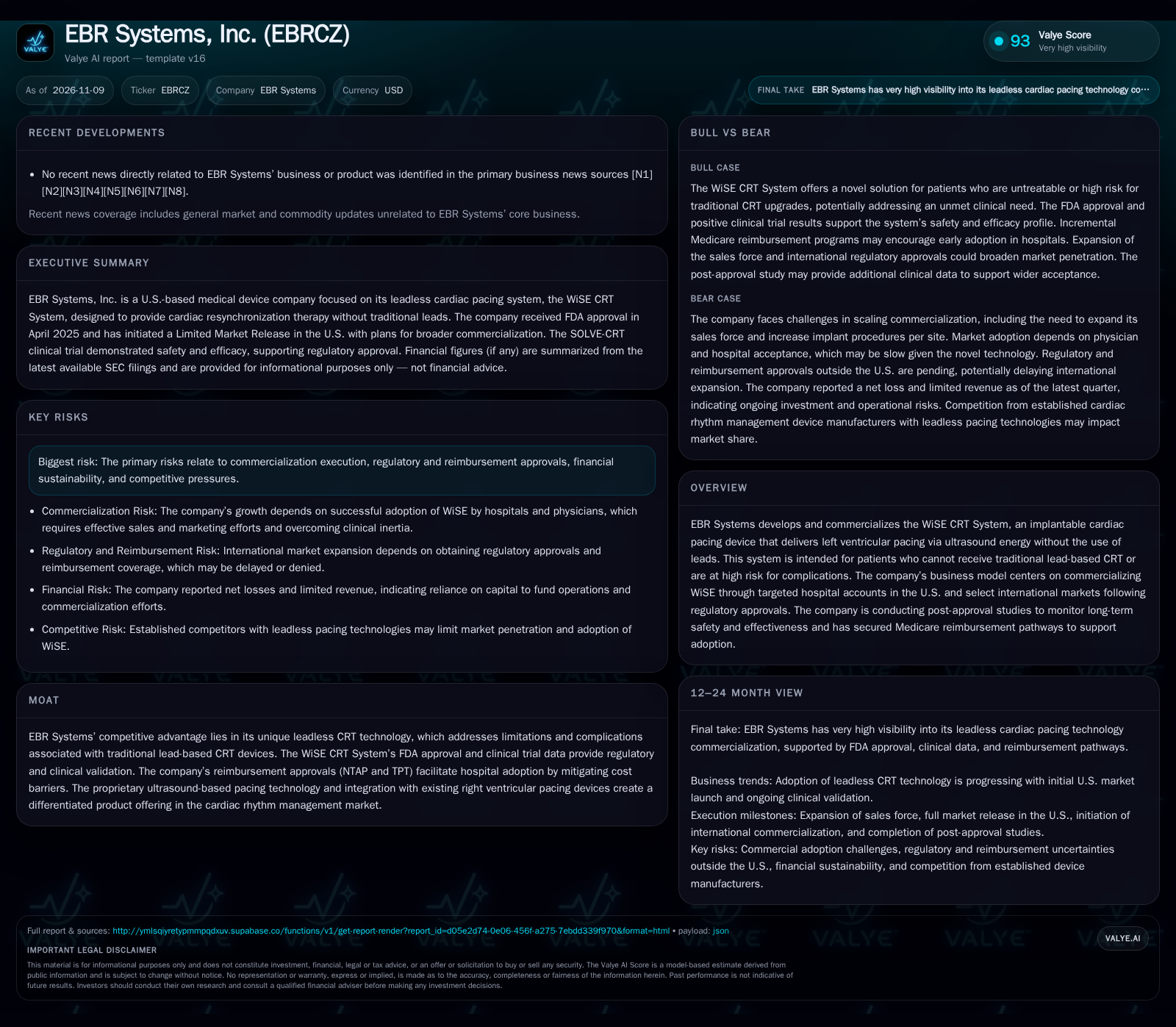
EBR Systems has FDA-approved, differentiated leadless CRT technology and early U.S. commercialization with Medicare reimbursement support. The company’s ability to expand adoption, achieve international regulatory milestones, and manage operational scale will determine whether it can transition from validation to sustainable growth. Execution and market acceptance risks remain high, and near-term revenues are limited relative to ongoing investment needs. [S1] [S2]
EBR Systems, Inc. is positioned at a pivotal moment in its evolution from technology developer to commercial-stage medical device company. With FDA approval for its WiSE CRT System, the first leadless CRT solution for high-risk and untreatable patients, EBR is now tasked with demonstrating that its clinical and regulatory milestones can translate into sustainable hospital adoption and revenue. The company’s financials highlight the classic tension: early commercialization brings limited revenue against ongoing net losses, while the capital base must support both U.S. rollout and international ambitions. Whether EBR can achieve critical mass before competitors respond or capital constraints tighten will define its next chapter. [S1] [S2]
FDA Approval, Initial U.S. Launch, and Financial Position: Where EBR Systems Stands Now
EBR Systems’ WiSE CRT System received FDA premarket approval in April 2025 for adult patients who have failed or are at high risk for traditional lead-based CRT upgrades. This regulatory milestone establishes a unique clinical position for the company, as WiSE is the first and only leadless CRT device approved in the U.S. [S1].
Commercial activity is ramping from a Limited Market Release (LMR), which began October 2025 and targets high-volume hospitals from pivotal trial sites, toward a planned full market release in the second half of 2026. EBR also aims to expand internationally, but is still pursuing approvals and reimbursement in Australia, the UK, and the EU [S1].
On the financial front, EBR reported $2.487 million in revenue and a net loss of $16.644 million for the nine months ended September 30, 2026. The company holds $13.985 million in cash and $71.43 million in short-term investments, yielding a current ratio of 2.11 [S2]. While these resources provide a buffer, ongoing losses underscore the importance of accelerating adoption and scaling revenue.
How Leadless CRT Could Reshape Economics: Pricing, Cost Structure, and Scaling Challenges
EBR Systems’ business model is predicated on capturing premium pricing for a novel, less-invasive CRT solution—likely positioning the WiSE CRT System as a higher-cost alternative to traditional lead-based CRT devices due to its unique mechanism and target population. The total system comprises an implantable electrode, catheter delivery system, external transmitter, and programmer, suggesting a bundled hardware/software offering with potential for both upfront device sales and recurring revenue from supporting components or service contracts if such models are adopted.
Variable costs may be high initially, given the complexity of the device and the need for clinical support during early market rollout, but over time, manufacturing scale and process refinement could improve gross margins. Fixed costs are substantial in the near term, driven by ongoing R&D, regulatory compliance (including the mandated post-approval WiSE-UP study), and the need to expand both sales and clinical support teams.
Operating leverage is possible if EBR can drive higher procedure volume per hospital and expand its installed base, allowing sales and support costs to be spread over a larger revenue base. However, the timing and extent of margin improvement will depend on adoption rates, reimbursement stability, and the company’s ability to control costs as it moves from LMR to full launch.
Technology Differentiation vs. Incumbent Power: The Competitive Landscape in Cardiac Rhythm Management
EBR’s WiSE CRT System is differentiated by its leadless, ultrasound-powered approach, which addresses key limitations of traditional lead-based CRT (such as lead failure, infections, and anatomical constraints). This offers a compelling clinical value proposition for patients ineligible for standard CRT.
However, the cardiac rhythm management device market is dominated by large, established players with broad product portfolios, entrenched hospital relationships, and significant sales/clinical infrastructure. These incumbents are also developing or have introduced their own leadless pacing technologies, though none have FDA-approved leadless CRT solutions as of the current date [S1].
Competitive response is likely to intensify if WiSE demonstrates commercial traction, with rivals leveraging distribution muscle, pricing flexibility, and integrated device/ecosystem offerings. Switching costs for hospitals may be moderate, as CRT device choice is influenced by physician preference, procedural complexity, and reimbursement rather than direct end-user lock-in. EBR’s moat will depend on clinical outcomes, ease of adoption, and continued reimbursement support.
If Adoption Accelerates: How EBR Could Convert Validation into Market Leadership
In a favorable scenario, EBR’s WiSE CRT System gains rapid adoption among high-volume hospitals, supported by robust clinical data, CMS reimbursement (NTAP and TPT) lowering cost barriers, and strong word-of-mouth among electrophysiologists. As hospitals observe positive patient outcomes and manageable procedural learning curves, WiSE could become the standard of care for patients unsuitable for traditional CRT, and potentially expand into broader populations if future studies support label expansion.
Early international approvals and reimbursement in key European and Asia-Pacific markets would further expand the addressable market, leveraging clinical trial data and U.S. experience as proof points. Operating leverage would improve as procedure volumes rise and manufacturing/sales costs are spread over a larger base.
Confirmation of this scenario would require evidence of accelerating revenue growth quarter-over-quarter, higher procedure volumes per site, successful expansion of the sales force, and positive updates from the post-approval WiSE-UP study. Announcements of new reimbursement wins or published real-world outcome data would further validate momentum.
Early Commercialization: A Measured Ramp with Execution Hurdles and Capital Needs
The most plausible near-term path is a gradual ramp in U.S. adoption as EBR works to expand its hospital footprint, train physicians, and build clinical familiarity. Initial uptake may be concentrated in a subset of high-volume academic centers familiar with the technology through the pivotal trial, with slower diffusion into broader community settings.
Revenue growth is likely to lag operating expense growth in the near term, given the need to invest in sales, training, and ongoing clinical evidence generation. International expansion could be delayed by regulatory and reimbursement hurdles, limiting the speed of addressable market growth outside the U.S.
This scenario would be confirmed by steady but unspectacular quarterly revenue increases, ongoing net losses, and a measured pace of new site activations. Watch for incremental progress on international approvals, updates from the WiSE-UP study, and any signs of competitive pushback from larger device firms.
Commercial Friction, Slow Uptake, and Competitive Pressure: What Could Derail the Thesis
Adverse outcomes could stem from slower-than-expected adoption due to physician inertia, concerns over procedural complexity, or limited real-world data beyond the pivotal trial. If hospitals are slow to embrace the technology or require more robust evidence, revenue could stagnate while fixed costs remain high.
Competitive threats may materialize as larger cardiac device companies accelerate their own leadless CRT development or bundle competing solutions with aggressive pricing or service agreements. Regulatory or reimbursement setbacks, especially internationally, could further limit market expansion and increase dependence on the U.S. market.
This scenario would be reflected in flat or declining procedure volumes, missed revenue targets, increasing operating losses, or a need to raise additional capital sooner than anticipated. Negative safety signals from post-approval studies or delays in international reimbursement would also be red flags.
Milestones That Will Test EBR’s Transition from Validation to Commercial Success
Quarterly revenue growth rate and procedure volume trends by hospital site, if disclosed, to assess adoption velocity and breadth.
Updates on the number of new hospital accounts actively implanting WiSE CRT, including expansion beyond initial trial centers.
Progress reports and safety/efficacy outcomes from the ongoing WiSE-UP post-approval study, particularly any adverse events or device complications.
Status and timing of international regulatory approvals and reimbursement decisions in the EU, UK, and Australia.
Expansion and productivity metrics of the sales and clinical support teams, as indicated by new site activations or training milestones.
Competitive product launches or major clinical trial readouts from incumbent cardiac rhythm management device manufacturers.
EBR’s cash burn rate and any updates on capital-raising plans, especially if operating losses persist or accelerate.
Disclaimer: This is research-only, informational analysis and not investment advice. It may include AI-generated interpretation and general industry context. Always verify important details using primary sources.

Comments