
Gladstone Investment’s Discounted Shares Spotlight Capital Constraints and Portfolio Execution Stakes
Gladstone Investment Corporation’s persistent NAV discount and high expense ratio shape its capacity to deploy capital and generate returns in the competitive Lower Middle Market BDC landscape. The interplay between capital access, contingent income streams, and portfolio company performance will determine the sustainability of dividends and NAV growth.
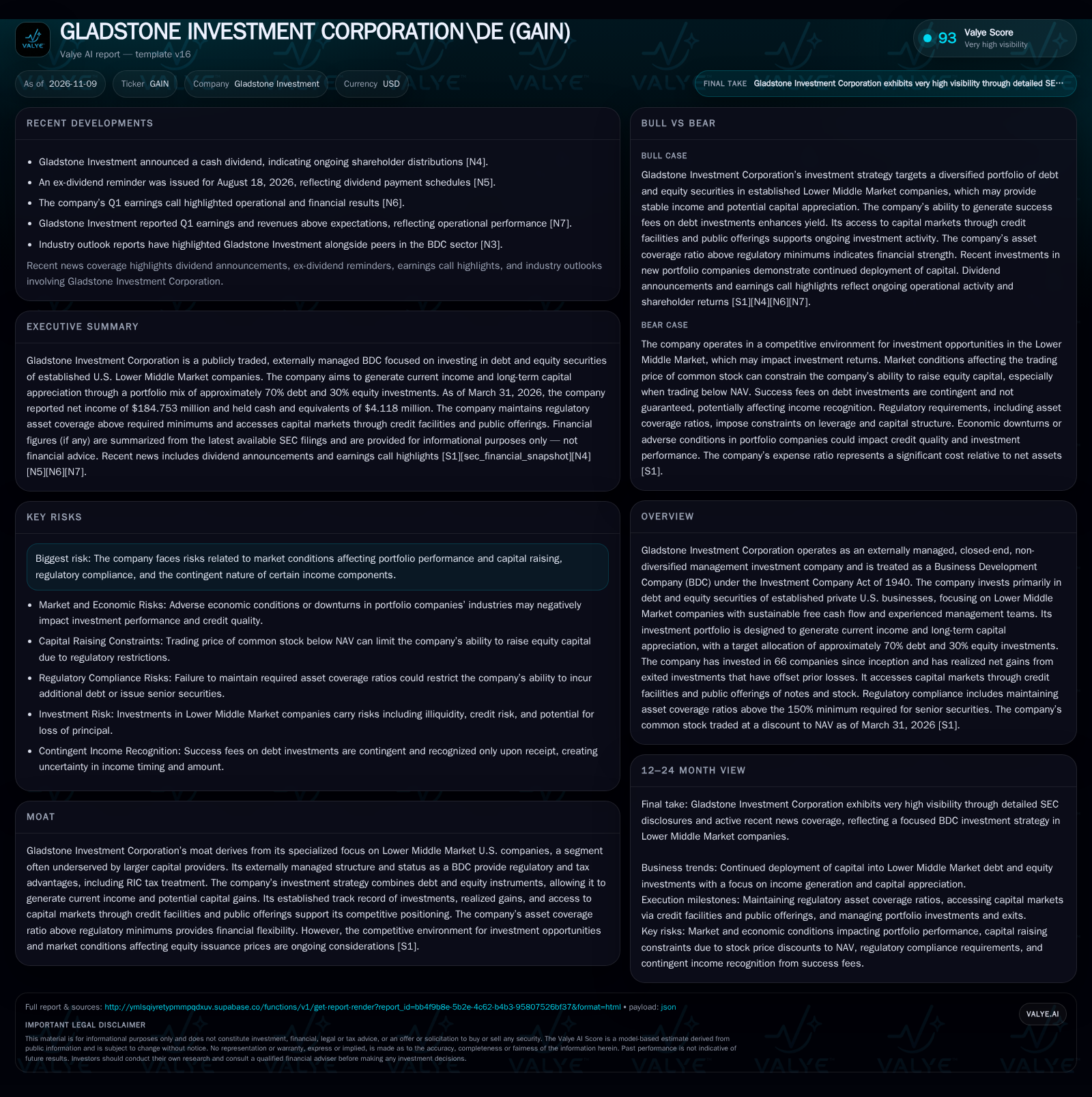
Gladstone Investment Corporation maintains a portfolio weighted toward debt investments in private Lower Middle Market U.S. businesses, with realized gains from exits offsetting historical losses. Shares trade at a notable discount to NAV, complicating equity capital raising and amplifying reliance on credit facilities for new investments. High expenses and the contingent nature of success fees pressure net returns. Future outcomes hinge on portfolio company performance, capital market access, and the sustainability of current dividend levels.
Gladstone Investment Corporation is navigating a complex environment as a Business Development Company focused on the Lower Middle Market, where its shares currently trade at a significant discount to NAV. This pricing dynamic restricts the company’s ability to raise equity capital efficiently, increasing dependence on credit facilities to fund new investments. While realized gains from portfolio exits have historically offset losses, the high expense ratio and reliance on contingent success fees challenge net returns. The cited source reports dividend-related activity; that disclosure alone does not establish dividend-policy continuity, management confidence, or a material constraint on capital flexibility.
Discounted Valuation, Capital Access, and Expense Structure Define the Current State
Gladstone Investment Corporation’s common stock traded at $14.20 per share as of March 31, 2026, representing a 15.4% discount to its reported NAV of $16.78 per share [S1]. This persistent discount constrains the company’s ability to issue new equity at prices that do not dilute existing shareholders, potentially limiting accretive capital raising. The investment portfolio was composed of approximately 70.8% debt and 29.2% equity at cost, consistent with the company’s target allocation [S1]. The asset coverage ratio on senior securities stood at 213.8%, well above the 150% regulatory minimum, indicating compliance with leverage constraints and supporting ongoing use of credit facilities. However, annualized expenses after fee credits totaled $143.2 million, or 23.13% of average net assets, highlighting a cost base that could weigh on distributable income [S1]. Recent investments include $49.5 million in Smart Chemical Solutions, LLC, and $12.8 million in Sun State Nursery and Landscaping, LLC, reflecting continued portfolio activity [S1].
How Gladstone Investment Generates Returns: Income, Fees, and Cost Pressures
Gladstone Investment’s business model is predicated on generating current income through debt investments and capital appreciation via equity stakes in private Lower Middle Market U.S. companies. Debt investments, often structured as secured first lien loans, provide regular interest income and may be enhanced by success fees—performance-based payments contingent on certain outcomes, such as portfolio company exits or refinancing. Equity positions offer upside potential but introduce greater volatility and longer holding periods before realization.
The company’s 70/30 debt-to-equity mix is designed to balance steady income generation with participation in capital gains. However, the high expense ratio—over 23% of average net assets—means a significant share of gross investment returns is absorbed by operating costs and external management fees. This cost structure raises the hurdle rate for generating distributable income and sustaining dividends.
Capital for new investments is sourced primarily from a $300 million credit facility and, when possible, public offerings of unsecured notes or equity. Because shares trade below NAV, issuing new equity is typically dilutive, making debt financing the preferred near-term option. This creates a potential feedback loop: constrained equity issuance may limit growth, while increased leverage can raise risk if portfolio performance deteriorates.
Competing for Lower Middle Market Deals in an Oversupplied Capital Environment
Gladstone Investment operates in a highly competitive Lower Middle Market, where private equity sponsors, alternative credit providers, and other BDCs aggressively pursue deals. The company’s focus on businesses with sustainable free cash flow and experienced management teams aims to mitigate credit risk, but also narrows the investable universe.
Its externally managed structure and BDC status provide regulatory and tax advantages, such as RIC treatment, but do not guarantee superior deal flow or pricing power. In practice, competition for quality assets can compress yields and increase purchase multiples, especially in periods of abundant private capital. Gladstone’s ability to generate success fees on debt investments offers a potential differentiator, but these fees are contingent and not guaranteed.
Peers include other public BDCs and private debt funds targeting the same segment. The durability of Gladstone’s realized gains on exited investments—$399 million net from 33 exits since inception—suggests some sourcing and underwriting differentiation, but cyclicality and competition remain persistent counterforces [S1].
Portfolio Exits and Success Fees Drive NAV Growth and Dividend Sustainability
A favorable scenario for Gladstone Investment would involve continued robust performance from portfolio companies, enabling profitable exits and realization of contingent success fees on debt positions.
Additional evidence would include the ability to redeploy capital from repayments or exits into new, higher-yielding investments without a measurable increase in credit losses. A narrowing of the share price discount to NAV would further validate market confidence in the company’s strategy and execution.
Managing Through Constraints: Steady Income Amid Limited Equity Issuance
The most plausible medium-term path for Gladstone Investment is steady portfolio deployment funded predominantly by credit facilities, with income generation anchored by the existing debt-heavy allocation. The company is likely to maintain compliance with asset coverage ratios and regulatory requirements, supporting continued leverage at current levels.
With shares trading below NAV, the company will likely refrain from issuing new equity except in opportunistic or defensive circumstances. Portfolio exits will offset losses over time, but the high cost base and contingent nature of some income streams mean distributions and NAV will remain sensitive to periodic portfolio shocks or market downturns.
A persistent discount to NAV and little change in expense ratio would further characterize the status quo.
Credit Losses and Persistent Discount Undermine Distribution and Growth Capacity
A negative sequence would be triggered by underperformance or distress among portfolio companies, leading to credit losses, reduced or missed success fees, and downward pressure on NAV. If the trading discount to NAV widens or persists, Gladstone Investment may be unable to raise equity without significant dilution, making it increasingly reliant on debt financing to sustain investment activity.
Should economic or sector-specific shocks affect the lower middle market, the company could face higher defaults or restructurings, compressing income and potentially forcing dividend reductions. A rising expense ratio, due to either lower asset levels or increased management fees, could intensify the pressure on net returns.
Evidence supporting this scenario would include rising non-accruals, declining or negative realized gains, a widening discount to NAV, and any dividend cuts or suspensions.
Factors That Will Shape Gladstone Investment’s Dividend Resilience and NAV Performance
Quarterly trends in net realized gains and losses from portfolio exits—continued positive realizations would support NAV and dividends.
The level and timing of success fee income—if disclosed, higher and more consistent success fees would indicate management’s ability to structure advantageous deals.
Expense ratio as a percentage of net assets—a reduction here would directly improve net investment income and distribution capacity.
Asset coverage ratio—sustained compliance above the 150% threshold is essential for ongoing leverage and regulatory flexibility.
Movement in the share price discount or premium to NAV—a narrowing discount would enable less-dilutive capital raising and signal improved investor sentiment.
Non-accrual or impaired loans—if disclosed, an increase would suggest rising credit risk and pressure on income.
Disclaimer: This is research-only, informational analysis and not investment advice. It may include AI-generated interpretation and general industry context. Always verify important details using primary sources.

Comments