
Simmons First National: Regulatory Constraints, Regional Focus, and the Stakes of Capital Allocation
Simmons First National Corp faces a complex interplay of regulatory oversight, concentrated regional exposure, and evolving risk management demands. As it navigates capital deployment and dividend decisions, the company’s ability to balance operational resilience, compliance, and shareholder returns will shape its trajectory in a shifting banking landscape.
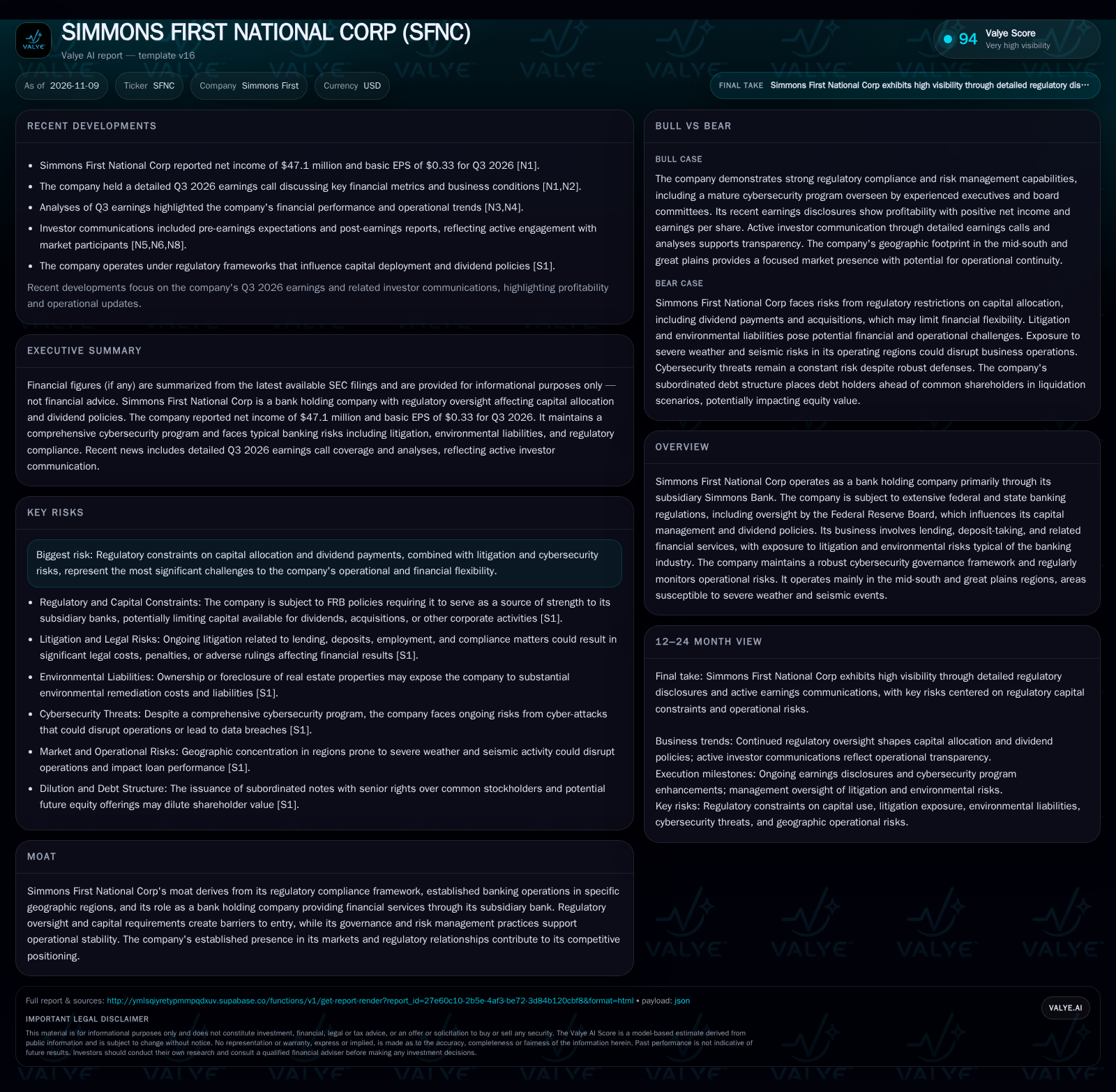
Simmons First National Corp reported Q3 2026 net income of $47.1 million and basic EPS of $0.33, but its capital allocation—especially dividends—remains tightly regulated by federal and state authorities. The company’s regional footprint in the mid-south and great plains exposes it to weather and seismic risks, while litigation, environmental liabilities, and cybersecurity threats add further complexity. The central question is how Simmons manages operational stability and shareholder value within these regulatory and environmental constraints. [S2] [S1]
Simmons First National Corp stands at a regulatory and operational crossroads. Its Q3 2026 earnings confirm continued profitability, but the company’s capital allocation decisions—especially those related to dividends and potential acquisitions—are shaped by stringent oversight from federal and state regulators. With a concentrated geographic footprint in the mid-south and great plains, Simmons must also actively manage environmental, litigation, and cybersecurity risks. The company’s future trajectory will depend on its ability to maintain operational resilience and shareholder value amid these persistent constraints.
Recent Earnings and Regulatory Levers Define the Operating Backdrop
Simmons First National Corp reported net income of $47.1 million and basic earnings per share of $0.33 for Q3 2026, providing a snapshot of ongoing profitability [S2]. However, the company’s ability to deploy capital—whether for dividends, acquisitions, or other strategic uses—is directly impacted by federal and state regulatory requirements. Recent dividends required explicit regulatory approval, underscoring the company’s limited discretion over capital allocation [S1]. In addition, Simmons operates mainly in the mid-south and great plains, regions that are particularly vulnerable to severe weather and seismic events, adding a layer of operational risk to its banking activities [S1]. These facts frame Simmons First’s current challenge: sustaining earnings while navigating regulatory and environmental headwinds.
How Regulatory Capital Shaping Drives Simmons' Economic Model
Simmons First National’s core economics revolve around interest income from lending and fee-based financial services, with profitability shaped by net interest margins, loan growth, and deposit stability. However, the company’s economics are uniquely shaped by regulatory capital requirements: as a bank holding company, it must serve as a source of financial strength for its subsidiary bank, often prioritizing subsidiary capitalization over upstreaming cash to the holding company for dividends or reinvestment [S1].
This regulatory constraint means that, even in periods of solid net income, the company’s ability to return capital to shareholders or pursue acquisitions is inherently limited by regulatory approvals and minimum capital thresholds. Fixed costs associated with compliance, risk management, and cybersecurity are also material, and likely to rise as expectations for operational resilience increase. Variable costs are driven by loan origination, servicing, and deposit acquisition, but the company’s expense base is further pressured by litigation and environmental remediation risks. Operating leverage may be modest given the need to maintain robust governance and compliance infrastructure, and capital needs are dictated as much by regulatory stress tests and risk-weighted asset calculations as by market opportunity.
Regional Focus and Compliance Rigor as a Double-Edged Sword
Simmons First’s competitive position is defined by its deep roots in the mid-south and great plains, providing local market knowledge and established customer relationships. This focus can drive stable deposit bases and lending franchises, but also concentrates risk in areas exposed to tornadoes and seismic activity [S1].
Regulatory rigor and strong governance may deter less sophisticated competitors and create barriers to entry for new banks or fintechs lacking the necessary compliance infrastructure. However, larger national or super-regional banks may have greater diversification and technological scale, while digital-first challengers could compete aggressively on cost and user experience. Simmons’ comprehensive cybersecurity program and proactive risk management are positives, but not a unique moat given industry-wide investments in similar systems. The company’s subordinated debt structure, with debt holders ahead of equity in a liquidation scenario, also affects its relative appeal to investors versus peers with less layered capital stacks.
Unlocking Value: Regulatory Easing or Superior Risk Performance Could Drive Upside
A favorable scenario for Simmons First would involve either a relaxation of regulatory capital requirements or demonstrably superior credit and risk management performance relative to peers. If regulators permit greater flexibility in capital deployment due to consistently strong earnings, low loan losses, and robust governance, Simmons could increase dividends, pursue accretive acquisitions, or repurchase shares—actions likely to boost shareholder value.
Evidence confirming this scenario would include regulatory approvals for larger or more frequent dividends, successful completion of supervisory stress tests with capital surpluses, and clear communication from management on capital allocation plans. Outperformance on credit metrics, such as lower net charge-offs and non-performing assets compared to regional peers, would further support this case. Conversely, regulatory resistance to capital returns, new capital buffer requirements, or operational missteps would falsify the upside thesis.
Operational Continuity Amid Persistent Constraints
The most plausible trajectory for Simmons First is continued profitability and operational stability, but with ongoing regulatory, environmental, and litigation constraints limiting the pace and magnitude of capital returns. The company will likely maintain moderate dividend payouts, reinvest in risk management and compliance infrastructure, and focus on organic growth in its regional footprint.
Confirmation of this scenario would come from steady but unspectacular earnings, regular (but not increasing) dividends subject to regulatory approval, and stable credit and deposit trends. Incremental improvements in cybersecurity and compliance, as well as manageable litigation and environmental costs, would also be consistent with this outlook. Signs that would falsify this scenario include a sharp deterioration in credit quality, major weather or seismic events disrupting operations, or regulatory actions limiting business flexibility.
Adverse Outcomes: Litigation, Environmental, or Regulatory Shocks Could Pressure Value
A negative scenario could unfold if Simmons First faces significant litigation losses, environmental remediation costs from foreclosed properties, or adverse regulatory actions restricting capital deployment. Severe weather or seismic events in its concentrated operating regions could also result in outsized loan losses or operational disruption.
Evidence for this scenario would include large legal settlements or judgments, regulatory enforcement actions or higher capital buffer requirements, and spikes in non-performing loans following natural disasters. Subordinated debt holders’ seniority in a stress scenario could amplify equity downside. If the company is forced to conserve capital, cut dividends, or raise dilutive equity, it would confirm the downside thesis. Conversely, the absence of such shocks and continued operational resilience would argue against this outcome.
Benchmarks for Testing Simmons First’s Ability to Balance Risk, Capital, and Growth
Net charge-off and non-performing asset trends, relative to regional peers, would help gauge credit risk management effectiveness.
Dividend approval frequency, size, and any changes in regulatory stance on capital returns would illuminate the company’s potential financial flexibility.
Regulatory capital ratios—especially any buffer above minimum requirements—would clarify Simmons’ capacity for growth or capital return.
Litigation expense levels and disclosure of new or material lawsuits, if disclosed, would signal risk to profitability.
Environmental remediation costs from foreclosed properties, if material, would test the impact of environmental liabilities.
Cybersecurity incident disclosures and audit results, if disclosed, would help assess operational resilience.
Deposit growth and stability, particularly in the context of regional economic and weather disruptions, would provide insight into franchise strength.
Management commentary on capital allocation priorities and risk appetite, particularly in earnings calls or regulatory filings, would help test the thesis.
Disclaimer: This is research-only, informational analysis and not investment advice. It may include AI-generated interpretation and general industry context. Always verify important details using primary sources.

Comments