
CECO Environmental: Order Surge, Execution Stakes, and the Economics of Engineered Compliance
A record order book and strong gross margins position CECO Environmental for potential operational leverage, but fixed-price contract exposure and integration risks from the Thermon acquisition underscore the importance of disciplined execution as regulatory and industrial demand for emissions solutions accelerates.
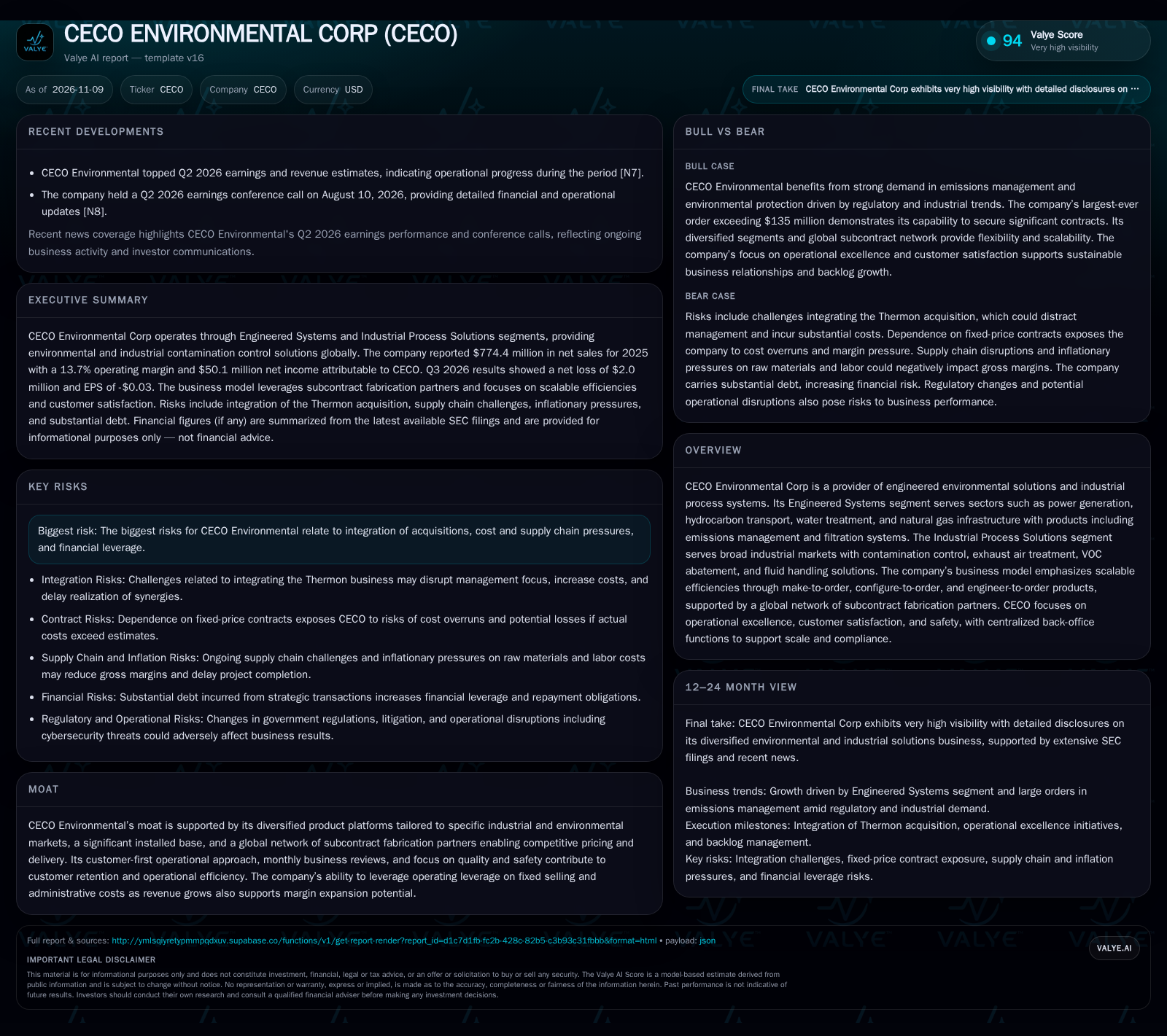
CECO Environmental reported $774.4 million in 2025 net sales and a record $1.06 billion in orders, highlighted by its largest-ever emissions management contract. While strong gross margins and scalable operations offer margin expansion potential, Q3 2026 brought a small net loss amid integration and cost challenges. Execution on large projects, supply chain management, and Thermon integration will determine whether CECO can convert backlog into sustainable earnings growth as industrial and regulatory tailwinds persist. [S1] [S2]
CECO Environmental’s record order book and healthy gross margins suggest the company is well-positioned to benefit from rising regulatory and industrial demand for emissions and contamination control solutions. However, the transition from backlog to profitable execution faces real-world friction: the company posted a small net loss in Q3 2026 amid Thermon acquisition integration and persistent cost inflation. With a business model built on scalable, make-to-order engineered systems and a global subcontractor network, CECO’s ability to manage project risk, cost overruns, and operational complexity will determine whether recent momentum translates into durable earnings and margin expansion.
A Surge in Orders, Margin Strength, and the Reality of Integration
CECO Environmental reported $774.4 million in net sales for 2025, achieving a gross profit of $269.2 million (34.8% margin) and operating income of $105.9 million (13.7% margin), culminating in $50.1 million in net income. The company’s order intake in 2025 surged to $1,064.3 million—a 59.5% increase over the prior year—driven by its largest-ever contract, a $135 million emissions management project for a Texas natural gas facility. This order book reflects growing demand for engineered environmental solutions, but also raises the stakes for flawless delivery and margin protection as the backlog converts to revenue. In Q3 2026, CECO reported a net loss of $2.0 million and EPS of -$0.03, signaling the near-term volatility associated with integrating the Thermon acquisition and managing cost pressures amid robust operational activity [S1] [S2].
How CECO’s Project Model Drives Margin—and Where It Can Break
CECO’s economics are fundamentally shaped by its make-to-order, configure-to-order, and engineer-to-order project model. Revenue is generated from complex environmental and industrial solutions spanning emissions control, filtration, VOC abatement, and fluid handling. Pricing is typically project-based, with contracts obtained through competitive bidding, negotiation, or upselling. The company’s largest cost component is subcontracted fabrication, which provides flexibility to scale up or down but also exposes CECO to execution and cost overrun risks—especially under fixed-price contracts.
Gross profit margins in 2025 were robust at 34.8%, reflecting a combination of disciplined project execution, value-added engineering, and a degree of pricing power in specialized compliance-driven markets. Operating leverage is present, as selling and administrative costs—covering sales, engineering, and corporate overhead—are relatively fixed in the short term, enabling margin expansion as revenue grows. However, cost inflation in materials and labor, supply chain disruptions, and the risk of underbidding large contracts can erode these gains. Capital requirements are moderate, as CECO’s asset-light model relies on third-party fabrication and focuses internal resources on project management, engineering, and customer service. Working capital management and project cash flows can be lumpy, especially as the backlog grows and project complexity increases.
Differentiation in Engineered Compliance: Flexibility, Breadth, and Subcontracting as Double-Edged Swords
CECO operates in a fragmented market for environmental and process systems, competing against diversified industrial conglomerates, specialized engineering firms, and regional solution providers. Its competitive strengths include a broad portfolio of engineered systems, the ability to customize solutions for regulatory compliance, and a global network of subcontract fabrication partners that allows for both cost efficiency and rapid scaling. This network enables CECO to bid on large, complex projects that smaller rivals may not be able to deliver, while its installed base and customer-first operations support retention.
However, reliance on subcontracting can also be a vulnerability: project quality, lead times, and cost discipline are harder to control at scale, especially in periods of supply chain stress. Fixed-price contracts—common in CECO’s industry—shift risk to the contractor, making accurate cost estimation and supply chain management critical. Substitution threats are primarily from new emissions and contamination technologies, automation, and lower-cost international competitors. The true test of CECO’s moat will be whether its operational discipline and project management can consistently deliver margin and customer satisfaction as project sizes and complexity increase.
Operational Excellence Converts Backlog into High-Margin Growth
If CECO can execute flawlessly on its record order book, particularly on large projects like the $135 million Texas emissions management contract, the company could realize significant margin expansion through operating leverage and improved project economics. Key drivers would include tight cost control on subcontracted work, successful integration of the Thermon acquisition to expand capabilities and cross-sell, and the ability to pass inflationary costs through to customers or lock in favorable terms with suppliers.
A favorable scenario would see backlog conversion rates accelerate, with gross and operating margins holding or improving as revenue scales. Confirmation would come from sequential margin improvement, rising return on invested capital, and continued large project wins without a corresponding rise in project write-downs or cost overruns. Evidence of successful Thermon integration—such as cross-segment synergies, expanded product offerings, and improved order intake in new verticals—would further support the upside case.
Backlog Converts, but Margin Expansion Remains Uneven
The most plausible path is that CECO delivers steady revenue growth as its backlog converts over the next 12–24 months, with margins fluctuating depending on project mix, execution, and cost pressures. The company’s project model and subcontracting flexibility allow it to scale, but fixed-price contract exposure and supply chain volatility create episodic margin pressure—especially on larger or more complex contracts.
Thermon integration proceeds with some delays or incremental costs, but without major disruption. Gross margins remain in the low- to mid-30% range, with operating margins in the low teens, reflecting both the opportunity for leverage and the reality of ongoing cost headwinds. Confirmation would be continued backlog conversion, stable or improving margins, and evidence that project delivery and customer satisfaction are not being compromised by growth. Falsification would involve rising project losses, margin compression, or persistent net losses despite a strong order book.
Cost Overruns, Project Delays, and Integration Stumbles Erode Earnings
In an adverse scenario, CECO struggles to manage the complexity and risk in its record backlog. Cost overruns on fixed-price contracts—possibly due to supply chain disruptions, inflation, or subcontractor failures—lead to project write-downs and margin erosion. Integration challenges with Thermon distract management and delay expected synergies, while new regulatory or customer requirements increase compliance costs.
Gross and operating margins decline, cash flow becomes volatile, and the company may face covenant pressure or the need to refinance debt. Confirmation would be a pattern of negative quarterly earnings, project loss disclosures, or guidance reductions driven by execution missteps. Persistent customer dissatisfaction or reputational damage from failed projects would further undermine the thesis.
Milestones That Will Shape CECO’s Margin Story and Growth Trajectory
The rate at which CECO converts its record backlog to revenue, including timing and mix of large projects, will indicate whether operational capacity is keeping pace with order growth.
Quarterly and annual gross and operating margin trends—especially on large fixed-price contracts—will reveal the effectiveness of cost management and project discipline.
Progress and disclosures related to the Thermon acquisition: integration costs, realized synergies, and cross-selling activity would help test the integration thesis.
Frequency and size of project write-downs or cost overruns, if disclosed, as a direct measure of execution risk.
Order intake momentum and customer diversification, with a useful metric being the proportion of new business from existing versus new customers.
Working capital swings and cash flow from operations, particularly in periods of heavy project activity or new order intake.
Management commentary on supply chain conditions, inflation pass-through, and subcontractor reliability, as these factors could rapidly alter margin outlook.
Disclaimer: This is research-only, informational analysis and not investment advice. It may include AI-generated interpretation and general industry context. Always verify important details using primary sources.

Comments