
APEX Tech Acquisition Inc.: Business Combination Uncertainty, Trust Capital, and the Clock on SPAC Viability
The outcome of its proposed merger with Korai Flix, Inc. will determine whether its capital can be deployed for growth—or must be returned to shareholders.
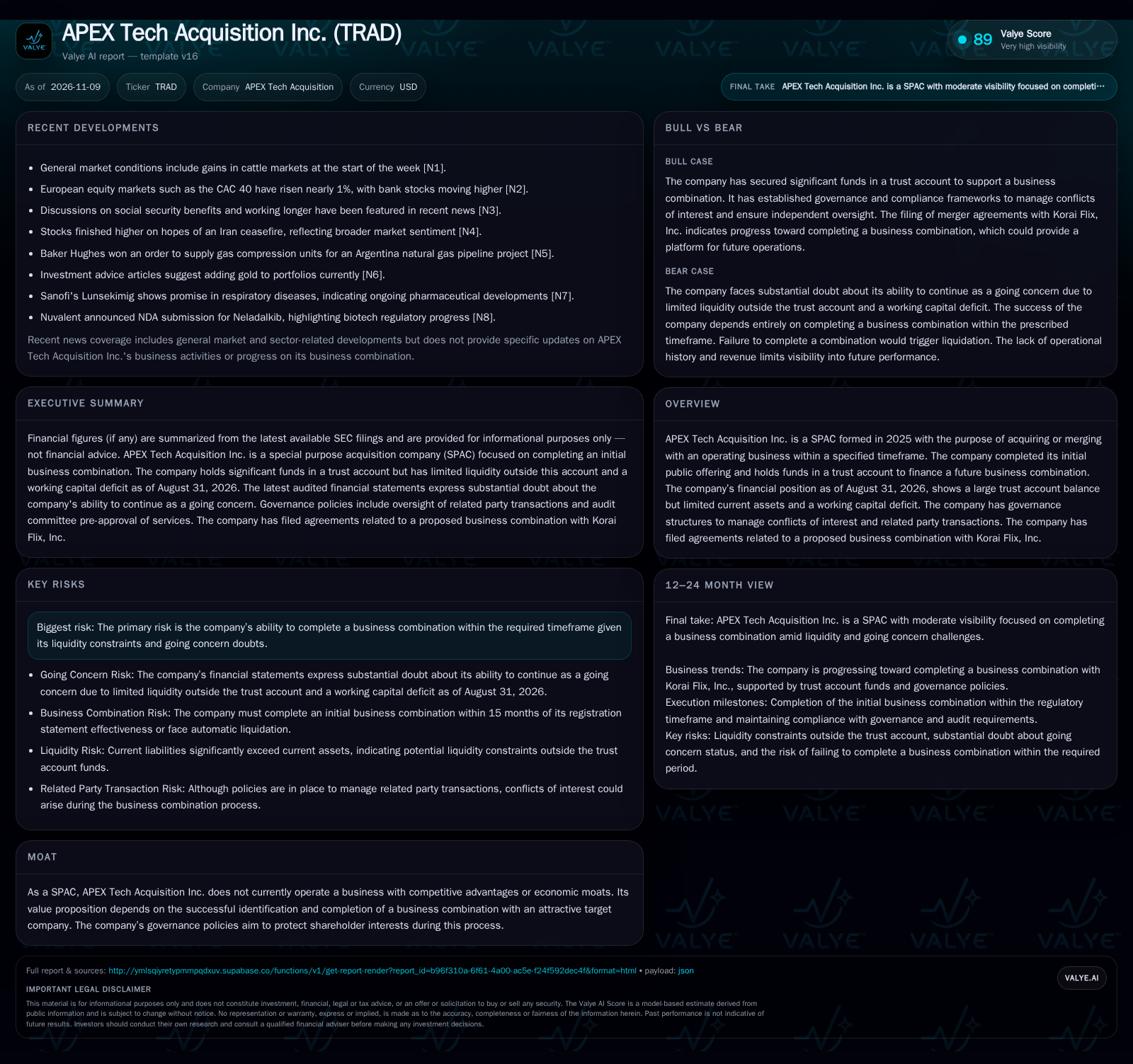
APEX Tech Acquisition Inc. is a SPAC with roughly $117 million in trust, but minimal liquidity outside that account and a working capital deficit as of August 31, 2026. The company’s future hinges on closing a proposed merger with Korai Flix, Inc. within its mandated timeframe. Failure to do so would trigger liquidation, returning trust proceeds to shareholders. The company’s going concern warning and reliance on a successful deal highlight both the opportunity and risk inherent in the SPAC structure. [S1]
APEX Tech Acquisition Inc. exemplifies the high-stakes, binary nature of the SPAC model in late 2026. With a $116.7 million trust account but virtually no operating liquidity, the company’s fate depends on successfully merging with Korai Flix, Inc. within a strict 15-month window. While the trust capital offers potential upside for a successful deal, a working capital deficit and a going concern warning reflect the acute risks if the clock runs out. The next few months will be determinative for both public investors and sponsors, as execution on the Korai Flix transaction will spell the difference between business launch and forced liquidation. [S1]
SPAC Timeline, Trust Capital, and Liquidity Crunch: Where APEX Stands Now
As of August 31, 2026, APEX Tech Acquisition Inc. held approximately $116.7 million in a trust account, earmarked to finance an initial business combination. This capital was raised in its February 2026 IPO, which included 11.2 million units at $10 per unit and a concurrent private placement. However, outside the trust, the company reported only $1,148 in current assets against $339,520 in current liabilities, resulting in a working capital deficit—a clear sign of immediate liquidity pressure. The company’s audited financials include a going concern warning, explicitly citing doubt about its ability to continue operating absent a successful business combination. Meanwhile, APEX has entered into agreements to merge with Korai Flix, Inc., but as of the latest filing, this transaction remains incomplete. The company’s survival and path forward depend entirely on closing this deal before the 15-month SPAC deadline lapses. [S1]
How a SPAC Like APEX Makes—or Loses—Money
A SPAC’s core economic model is binary: it either merges with a viable operating company, transforming itself into a new public entity, or it fails to do so and liquidates, returning the trust proceeds to shareholders. In APEX’s case, the $116.7 million in trust is held in escrow and cannot be used for ongoing expenses; it is reserved for the eventual business combination and potential redemptions. The company earns nominal non-operating income from trust investments (typically short-term Treasuries), but generates no operating revenue until after a merger.
Costs to operate—legal, audit, deal sourcing, and finder fees—must be funded from outside the trust, creating a structural cash squeeze. The recent Finder’s Engagement Agreement, now amended to a $500,000 non-refundable retainer and a $4.5 million contingent success fee, adds to the pre-deal cash outflow. If the Korai Flix merger closes, the economics shift: APEX’s trust funds become deployable to the combined company, deal costs are paid, and any remaining capital supports growth or working capital for the target. If the deal fails, liquidation costs and sponsor losses mount, while public shareholders get their money back but forgo upside. The SPAC structure offers sponsors leveraged upside for success but exposes them to total loss of their at-risk capital if the combination does not close in time.
SPACs in 2026: Crowded Field, Investor Fatigue, and the Challenge of Differentiation
APEX Tech Acquisition operates in a saturated SPAC market, where hundreds of blank-check companies are chasing a shrinking pool of attractive targets. By late 2026, investor enthusiasm for SPACs has waned compared to the 2021-2022 boom, driven by high-profile deal failures, regulatory scrutiny, and challenging post-merger performance for many de-SPACed companies. The primary competitive lever for a SPAC is its ability to source and close a deal faster, offer better terms to targets, and convince public investors of the long-term value of the merger.
APEX’s proposed merger with Korai Flix, Inc. is a differentiator only if the target offers compelling growth or profitability prospects—facts not established in the current filings. Its governance and conflict oversight structures are standard for the sector, but do not create a unique advantage. In the current climate, SPACs are also competing against traditional IPOs, direct listings, and private equity for quality targets, increasing pressure on deal quality and speed.
If the Korai Flix Merger Closes: From Trust to Operating Platform
The best-case scenario for APEX is a timely, successful completion of the Korai Flix, Inc. merger. In this scenario, the trust account is released, funding the acquisition and providing the combined entity with immediate capital. The economics then hinge on the operational quality of Korai Flix: if it demonstrates strong growth, profitability, or a distinctive market position, public shareholders could realize significant upside, and sponsors would convert their at-risk capital into valuable equity.
This scenario would be confirmed by: (1) a definitive closing announcement for the merger, (2) detailed public disclosure of Korai Flix’s financials and business model, and (3) positive post-merger trading or operational updates. Falsification would occur if the deal is delayed, abandoned, or if Korai Flix’s revealed business is weak, leading to mass redemptions or poor post-merger performance.
Most Likely Outcome: Race Against the SPAC Clock
Given the company’s working capital deficit, going concern warning, and the regulatory deadline, the most plausible outcome is a high-stakes race to close the Korai Flix merger before the 15-month window expires. The company will likely expend remaining non-trust resources on legal, compliance, and deal execution costs. If the merger closes, the trust will be deployed as planned, but the market’s reception will depend entirely on the quality of the acquired business.
If the deal is not completed in time, APEX will liquidate, returning trust proceeds to public shareholders, and sponsors will lose their investment. Confirmation of this scenario would come from news of deal closure (or lack thereof), continued going concern warnings, or extensions of the SPAC deadline. Falsification would require either an earlier-than-expected liquidation or an alternative business combination emerging.
Deal Failure or Delay: Liquidation and Sponsor Losses Loom
The adverse scenario is straightforward: the merger with Korai Flix fails to close before the deadline, either due to regulatory, diligence, or market obstacles, or if Korai Flix withdraws. In this event, APEX is forced to liquidate. Public shareholders receive their pro-rata share of the trust, but sponsors forfeit their at-risk capital and any upside from founder shares or warrants. The Finder’s fee structure means some costs have already been sunk, and additional expenses may accrue prior to liquidation.
This scenario would be confirmed by public announcements of deal termination, regulatory filings indicating impending liquidation, or explicit statements that the SPAC will not pursue an extension or alternative target. Falsification would require a last-minute deal rescue or extension of the SPAC’s operating window.
Milestones That Will Decide APEX’s Fate in the Coming Months
Definitive closing of the Korai Flix, Inc. merger—any public confirmation or regulatory approval would be pivotal.
Disclosure of Korai Flix’s financials, business model, and growth outlook—would help gauge post-merger upside if disclosed.
Any extension of the SPAC’s 15-month deadline, or regulatory filings indicating an extension request.
Trends in redemption rates among public shareholders ahead of the merger—high redemptions could deplete usable capital.
Material changes in working capital or liquidity outside the trust account, if disclosed, as a sign of runway or stress.
Updates on incurred or anticipated deal costs, especially relating to the Finder’s Agreement and legal expenses.
Any signals of sponsor or insider support for the merger—additional capital commitments or lock-ups would be meaningful.
Regulatory or audit committee commentary regarding the going concern risk and mitigation plans.
Disclaimer: This is research-only, informational analysis and not investment advice. It may include AI-generated interpretation and general industry context. Always verify important details using primary sources.

Comments