
Bio-Rad Laboratories: International Growth, Digital PCR Expansion, and the Stakes of Competitive and Regulatory Pressures
Bio-Rad Laboratories maintains robust financials and a diversified global presence as it advances digital PCR and molecular diagnostics, but persistent competitive, regulatory, and supply chain risks shape its future margin and innovation trajectory.
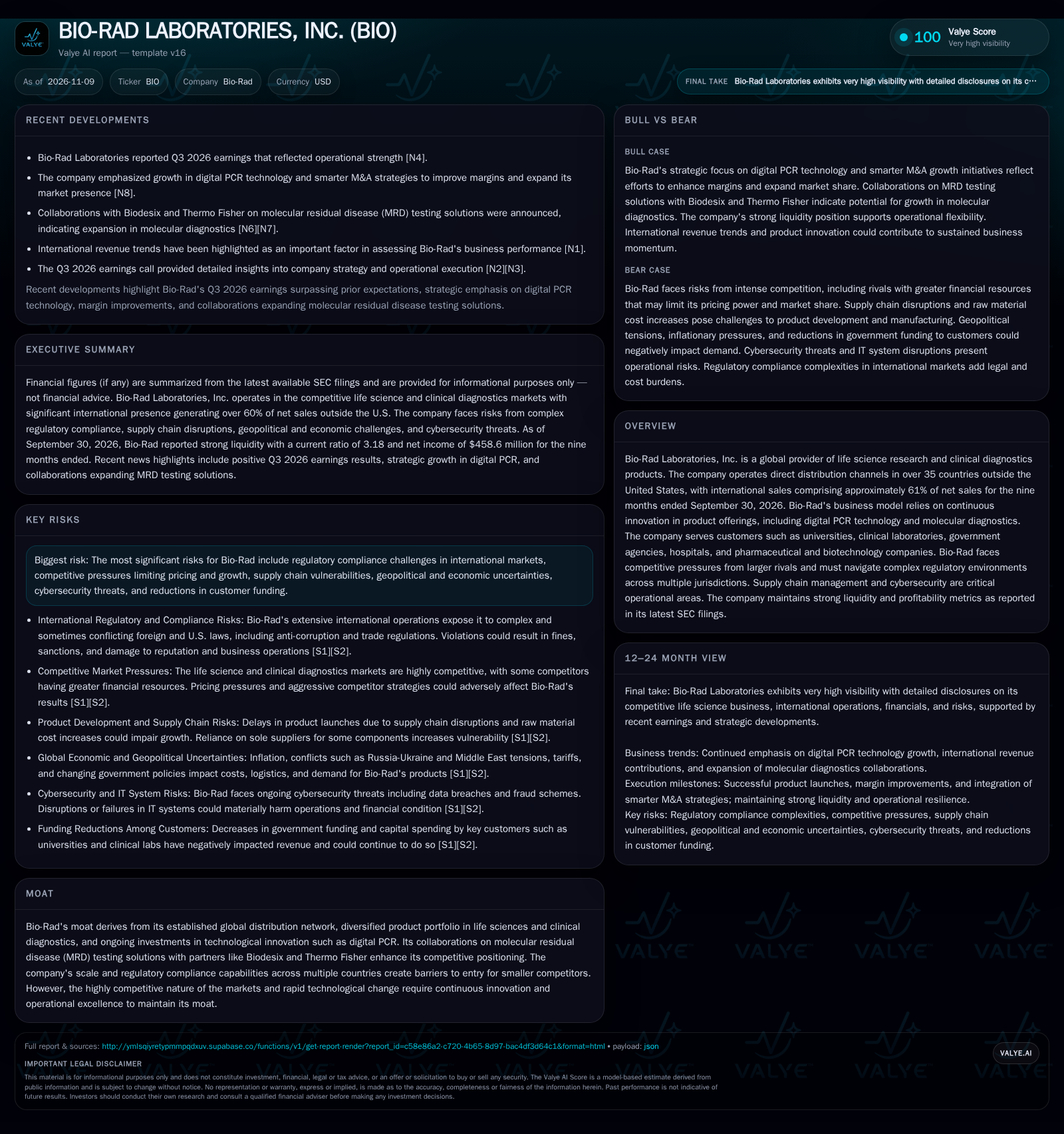
Bio-Rad Laboratories is leveraging its strong international footprint and product innovation—particularly in digital PCR and molecular residual disease (MRD) testing collaborations—to drive growth, supported by reported liquidity position and recent earnings outperformance. However, the company faces significant challenges from larger competitors, complex global regulations, supply chain vulnerabilities, and fluctuating government funding for major customer segments. The outcome will hinge on Bio-Rad’s ability to sustain innovation, execute on margin improvements, and navigate intensifying cost and compliance pressures.
Bio-Rad Laboratories, a global provider of life science and clinical diagnostics products, continues to demonstrate financial resilience and strategic agility as it navigates a rapidly evolving industry landscape. The company’s ability to drive growth through international markets—now accounting for more than 60% of sales—combined with its focus on high-value innovations such as digital PCR and molecular diagnostics collaborations, has underpinned recent earnings strength. Yet, Bio-Rad’s future trajectory is shaped by formidable headwinds: intensifying competition from larger players, complex and costly regulatory environments, supply chain vulnerabilities, and the ongoing challenge of maintaining innovation leadership amid shifting global economic and funding conditions.
Recent Performance and Strategic Moves Define Bio-Rad’s Current Landscape
Bio-Rad Laboratories reported net income of $458.6 million for the first nine months of 2026, with basic EPS of $17.13 and diluted EPS of $17.02, reflecting solid operating performance [S2]. The company’s Q3 2026 earnings topped analyst estimates, driven by margin improvements and robust execution [N4]. International markets contributed approximately 61% of net sales during this period, underscoring Bio-Rad’s reliance on global demand and its exposure to currency fluctuations and geopolitical risks [S2]. Recent collaborations with Biodesix and Thermo Fisher to develop molecular residual disease (MRD) testing solutions, alongside a strategic emphasis on digital PCR technology and M&A, point to Bio-Rad’s push into higher-growth, innovation-driven diagnostics segments [N7] [N8]. These moves are critical as the company contends with supply chain disruptions, regulatory complexity, and evolving customer funding dynamics.
How Bio-Rad’s Business Model Balances Innovation, Scale, and Margin Pressures
Bio-Rad generates revenue by selling a mix of life science research and clinical diagnostics products to universities, hospitals, clinical labs, and biopharma companies. The business model is anchored in continuous product innovation—particularly in areas such as digital PCR and molecular diagnostics—where differentiation and new capabilities can command premium pricing and drive margin expansion if successfully commercialized. However, the company’s cost structure is exposed to both fixed costs (R&D, regulatory compliance, global distribution) and variable costs (raw materials, logistics), with supply chain disruptions and input cost inflation posing material risks to margin stability.
Operating leverage is attainable as Bio-Rad scales newer technologies and grows its installed base, but the capital intensity of R&D and the need for constant product refreshes limit the speed and sustainability of margin expansion. International diversification enhances revenue growth opportunities but increases exposure to foreign currency volatility, local regulatory requirements, and geopolitical disruptions. The company reported cash and liquidity metrics for the period; these figures do not by themselves establish operating runway, investment capacity, financial flexibility, or financing capacity. Nonetheless, the ability to translate innovation into recurring, high-margin revenue streams—especially in competitive and price-sensitive markets—remains a central challenge.
Assessing Bio-Rad’s Edge in an Intensely Competitive Diagnostics Arena
Bio-Rad operates in highly competitive life science and clinical diagnostics markets, facing rivals with greater financial resources and technological capabilities [S1] [S2]. Its competitive positioning is supported by a broad, diversified product portfolio, established global distribution channels, and a track record of regulatory compliance across more than 35 countries. The company’s investments in digital PCR and MRD testing collaborations may provide a technological edge and access to higher-growth segments, but these advantages are not insurmountable.
Larger competitors can outspend Bio-Rad on R&D, marketing, and acquisition of emerging technologies, potentially eroding market share or compressing margins through aggressive pricing. Furthermore, the rapid pace of technological change means that past innovation does not guarantee future leadership; customer loyalty can be limited if switching costs are low and new entrants offer superior performance or integration. The company’s global scale and compliance experience create meaningful barriers to entry for smaller firms, but ongoing supply chain and regulatory challenges could blunt these advantages if not carefully managed. Ultimately, Bio-Rad’s ability to defend and extend its position will depend on continuous innovation, successful product launches, and maintaining strong relationships with key customers and partners.
Pathways to Outperformance: Innovation Commercialization and Global Expansion
A favorable scenario for Bio-Rad would see its investments in digital PCR and molecular diagnostics translating into strong revenue growth and sustained margin expansion. Successful commercialization of new products—especially those developed through collaborations like the MRD testing solutions with Biodesix and Thermo Fisher—could capture share in higher-growth, higher-margin segments. If international sales continue to outpace domestic growth, supported by effective localization and regulatory execution, Bio-Rad could leverage its global platform to deepen market penetration and diversify earnings streams.
Confirmation of this scenario would come from accelerating top-line growth in digital PCR and molecular diagnostics, evidence of new product adoption by major customers, and further expansion of strategic partnerships. Margin improvement, as seen in Q3 2026, would need to persist, with cost discipline offsetting inflationary and supply chain pressures. Conversely, a lack of traction in new product categories, stalled international growth, or margin compression would undermine the upside case.
Maintaining Momentum Amid Ongoing Headwinds
The most plausible medium-term outlook for Bio-Rad involves moderate revenue growth driven by incremental gains in digital PCR, core diagnostics, and continued international sales expansion. While product innovation and collaborations provide some uplift, persistent challenges—such as competitive pricing pressure, regulatory hurdles, and supply chain volatility—are likely to cap margin upside.
This scenario is supported if Bio-Rad continues to report stable or modestly improving margins, maintains its international revenue mix, and demonstrates steady progress on product launches and partnerships. Early signs of trouble would be a slowdown in new product sales, rising R&D or compliance costs outpacing revenue growth, or increased customer churn in key segments. The base case assumes the company can manage through economic and geopolitical turbulence without major operational or financial disruptions.
Margin Compression and Innovation Stagnation in a Tougher Environment
In a downside situation, Bio-Rad could face a convergence of adverse factors: intensified competition from larger players leading to lost market share or price erosion, supply chain disruptions delaying key product launches, and further reductions in government or institutional funding for major customer groups. Regulatory compliance costs may escalate, particularly in volatile international markets, while currency fluctuations could amplify earnings volatility given the company’s 61% international sales exposure [S2].
This scenario would be confirmed by declining or stagnating revenue growth, deteriorating margins, and missed product launch timelines. High-profile cybersecurity or IT failures, which the company has identified as ongoing risks, could further damage reputation and customer trust. Signs of distress would include rising inventory levels, increased reliance on sole-source suppliers, or erosion of liquidity due to higher working capital needs or unplanned compliance expenditures.
Milestones and Metrics That Will Shape Bio-Rad’s Innovation-Driven Thesis
Year-over-year revenue growth in digital PCR and molecular diagnostics—if disclosed—would help test whether innovation is translating into commercial traction.
Gross and operating margin trends, particularly in the face of inflation and supply chain volatility, are critical for assessing underlying profitability.
International sales mix and growth rates: Given 61% of sales are already international, further expansion or contraction would be highly material.
Progress and outcomes from MRD testing collaborations with Biodesix and Thermo Fisher, including any disclosed product launches, customer wins, or regulatory clearances.
The pace and success of new product introductions, including any delays attributed to supply chain or regulatory challenges.
Frequency and severity of cybersecurity incidents or major IT disruptions, as these could impact both operations and customer trust.
Trends in customer funding—especially government and institutional budgets for research and diagnostics—as these directly affect demand for Bio-Rad’s products.
Any major changes in the market value of the Sartorius AG stake, which could influence reported financial results and capital allocation flexibility.
Disclaimer: This is research-only, informational analysis and not investment advice. It may include AI-generated interpretation and general industry context. Always verify important details using primary sources.

Comments