
Verde Clean Fuels: financial position, Investor Activity, and the Unanswered Questions of Commercial Scale
Verde Clean Fuels, Inc.
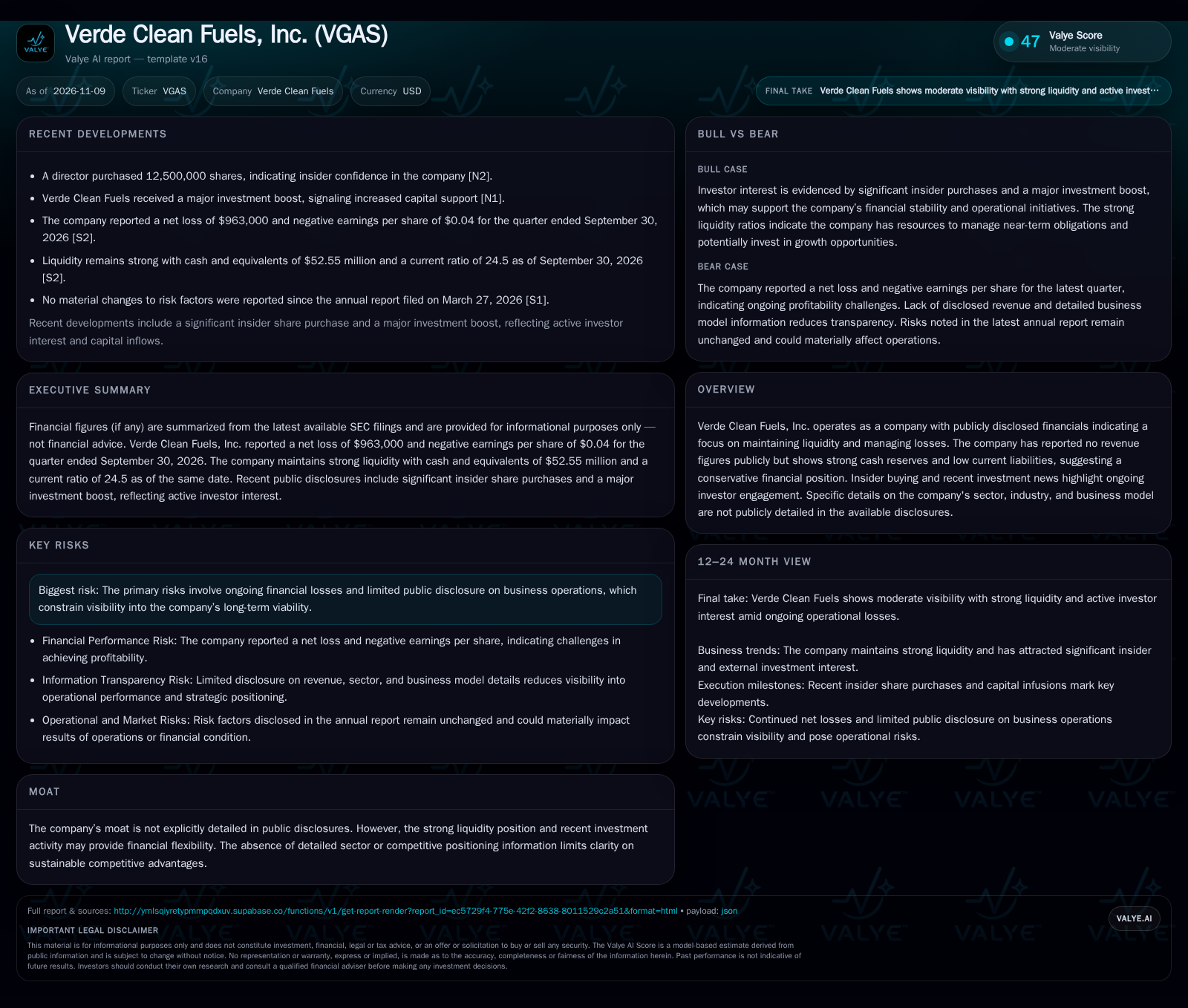
Verde Clean Fuels, Inc. (VGAS) holds $52.55 million in cash with minimal liabilities and recently attracted both major insider buying and an external investment boost. However, the company has not disclosed revenues or clarified its business model, and continues to post operating losses. The central question is whether this liquidity and investor interest can be converted into a sustainable, revenue-generating business.
Verde Clean Fuels, Inc. stands out for its fortress-like liquidity—$52.55 million in cash against just $2.18 million in current liabilities—and recent waves of insider and external investment. Yet, in stark contrast to this capital strength, the company’s lack of disclosed revenue, absent business model specifics, and ongoing net losses leave its commercial trajectory unclear. For investors and analysts, the core issue is not whether Verde can weather the near term, but whether it can transform cash and investor confidence into a viable, scalable business.
Insider Buying and Investment Influx Amid Persistent Losses
[S2] The company, however, recorded a net loss of $963,000 for the quarter with negative earnings per share of $0.04, and it has not publicly disclosed any revenue figures or business model specifics [S2]. Two notable capital events stand out: a director’s purchase of 12.5 million shares in February 2025, and a major investment boost in March 2026, both signaling continued investor engagement [N1] [N2]. These developments establish a paradox—high investor interest and substantial cash on hand, but continued operating losses and limited operational transparency.
How Capital Could Translate into Revenue—If a Scalable Model Emerges
With no disclosed revenue and limited detail on products, services, or operational structure, Verde Clean Fuels’ business economics are largely opaque. The company's substantial cash reserves could be deployed toward technology development, project deployment, or acquisitions in the clean fuels space—a sector that typically involves long development cycles, high upfront capital costs, and regulatory hurdles. If Verde’s business model resembles other early-stage clean energy firms, revenue generation may hinge on successful demonstration projects, licensing technology, or entering offtake agreements with industrial partners. Each scenario entails a different capital burn rate, revenue recognition pattern, and margin structure.
If the company plans to build and operate its own facilities, the path to positive operating leverage would require sufficient project scale to cover fixed costs, which can be high in clean fuels infrastructure. Alternatively, a technology-licensing or project-development model could offer a more asset-light path, but would depend on validation and adoption by third parties. Until Verde discloses its commercial mechanics, the direct link between current liquidity and future cash flow remains speculative.
The timing and scale of Verde Clean Fuels’ capital deployment will critically influence its path to sustainability. If the company opts for a capital-intensive build-own-operate model, the upfront investment in infrastructure and regulatory compliance could extend the cash runway significantly, requiring patient capital and potentially multiple financing rounds. Conversely, an asset-light approach, such as licensing or technology-as-a-service, might preserve liquidity but demands robust intellectual property and market acceptance to generate recurring revenue. The interplay between capital intensity, operational scalability, and market dynamics will ultimately determine the company’s break-even horizon and margin profile.
Potential Advantages and the Unknowns of Market Positioning
Verde Clean Fuels’ competitive position is difficult to assess without details on its technology, customer base, or market focus. In the broader context, clean fuels companies compete with both established energy incumbents and a wave of venture- and SPAC-backed startups, many of which are targeting similar goals—lower-carbon fuels for power, transport, or industrial use. Key competitive levers in this sector include proprietary process technology, cost of production, access to feedstock, regulatory incentives, and ability to secure long-term offtake contracts.
However, the absence of revenue or disclosed partnerships means there is no evidence of commercial traction or technology differentiation. Without a clear moat, switching costs, or barriers to entry, the company’s defensibility—and thus its long-term value capture—remains uncertain.
In assessing Verde’s competitive landscape, the potential for differentiation hinges on both technological innovation and strategic positioning. If the company’s technology offers a substantive cost or efficiency advantage, it could command premium pricing or secure exclusive contracts, creating entry barriers for competitors. However, absent clear proprietary advantages, Verde faces commoditization risks, where price competition and customer churn could erode margins. Additionally, access to feedstock and regulatory incentives varies by geography and policy environment, meaning Verde’s ability to navigate these external factors will be as crucial as its internal capabilities. The company’s strategic partnerships and alliances, if disclosed, would provide further insight into its competitive moats.
What Success Could Look Like: From Liquidity to Commercial Validation
A favorable outcome for Verde Clean Fuels would involve deploying its capital to achieve a tangible commercial milestone—such as a successful pilot project, a signed offtake agreement, or the securing of a government contract. This could validate the company’s technology or business model, unlock recurring revenue streams, and potentially attract strategic partners or customers. Evidence that would confirm this scenario includes announced project wins, revenue recognition, or disclosure of multi-year commercial relationships.
Insider buying and external investment suggest that some stakeholders see this pathway as plausible [N1] [N2]. However, the thesis would be falsified if, over the next 12-18 months, Verde fails to disclose new commercial agreements, continues to report net losses without revenue, or is forced to pivot strategy due to lack of traction.
Prolonged Development Phase with High Cash Burn and Unresolved Model
Operating losses are likely to persist as the company seeks to establish proof points, attract partners, or advance toward its first commercial deployment. Confirmation of this scenario would include continued net losses, ongoing R&D or project-related expense disclosures, and limited or no reported revenue.
This scenario would be challenged if the company unexpectedly announces a meaningful revenue-generating contract, partnership, or licensing deal, which would suggest a faster-than-expected transition to commercial operations.
Capital Erosion Without Commercial Breakthrough
A negative trajectory would see Verde Clean Fuels continue to incur operating losses without making discernible progress toward commercial milestones. This pattern is not uncommon among early-stage clean energy companies that face technical, regulatory, or market adoption hurdles.
Clear signs of this scenario would be ongoing net losses, shrinking cash reserves without offsetting revenue, management turnover, or disclosures indicating strategic pivots or downscaling. The risk of dilution or distressed financing would increase as liquidity is depleted.
Milestones and Disclosures That Could Shift the Verde Clean Fuels Thesis
Public disclosure of any revenue, customer contracts, or commercial partnerships would clarify the company’s business model and test the timeline to commercialization.
Updates on project development status, pilot deployments, or regulatory approvals—if disclosed—would offer insight into operational progress.
Cash burn rate and expense structure in future filings will help gauge how long the current liquidity buffer may last under different scenarios.
Insider transaction activity was reported in the cited source; this activity does not by itself establish insider confidence.
Any material changes to risk factors in future SEC filings would help clarify evolving operational or market exposures.
Announcements of external financing, joint ventures, or strategic partnerships would indicate whether the company can attract third-party validation and support.
Disclosure of intellectual property, patents, or proprietary technology would help assess potential competitive advantage.
Monitoring the evolution of Verde Clean Fuels’ cash burn relative to milestones achieved will be essential to evaluate operational efficiency and financial discipline. A declining burn rate concurrent with progress toward commercial validation would suggest effective capital management and increasing business maturity. Conversely, sustained or accelerating losses without corresponding operational achievements could signal structural challenges or strategic misalignment. Furthermore, transparency around intellectual property filings or patent grants would help assess the durability of Verde’s technology edge, while disclosures regarding regulatory approvals or environmental certifications would shed light on potential market access and scalability constraints.
Disclaimer: This is research-only, informational analysis and not investment advice. It may include AI-generated interpretation and general industry context. Always verify important details using primary sources.

Comments