
Global Net Lease: Portfolio Diversification, Strategic Dispositions, and Profitability Risks from Rate Volatility
Global Net Lease, Inc. (GNL) operates a broad net lease portfolio spanning the U.S., Canada, and Europe, emphasizing long-term, investment-grade tenancy and sectoral diversification. Recent property sales and persistent negative earnings highlight both the adaptability of its asset strategy and the mounting challenge of sustaining profitability in a volatile rate environment.
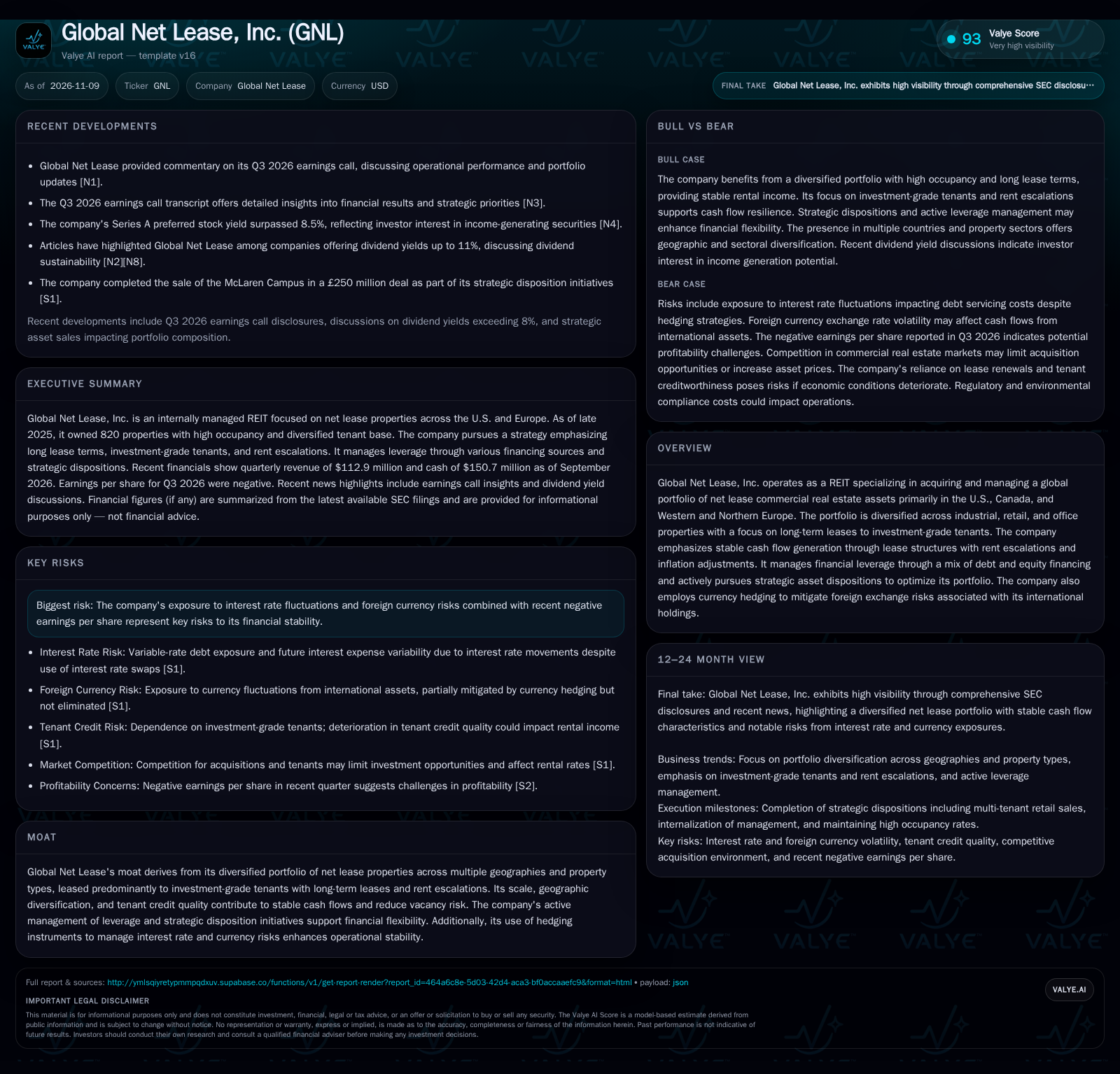
GNL maintains high occupancy and a diversified tenant base, with 820 properties across North America and Europe. Strategic asset sales and lease escalations aim to support stable cash flows, yet Q3 2026 revealed negative earnings per share, underscoring ongoing profitability pressures. Interest rate and currency risks remain material given the company’s leveraged, international exposure. The ability to enhance operating margins and manage refinancing will be critical to the thesis over the next 12-24 months. [S1] [S2]
Global Net Lease, Inc. (GNL) stands at a crossroads between the defensive stability of a global net lease REIT and the persistent headwinds of profitability in a changing macro environment. With nearly 41 million square feet under management and a tenant roster spanning 71 industries, the company’s long lease terms and investment-grade focus should, in theory, underpin consistent cash flows. Yet, recent quarters have exposed the friction between stable rental streams and rising capital costs, as reflected in negative Q3 2026 earnings and heightened preferred equity yields. The next phase for GNL will be defined by its ability to navigate refinancing, asset allocation, and tenant credit through a period of interest rate and currency volatility.
Recent Developments Highlight Adaptive Portfolio Management and Profitability Pressures
As of December 31, 2025, Global Net Lease owned 820 properties totaling 40.7 million rentable square feet, achieving a 97% occupancy rate with a weighted-average remaining lease term of 6.1 years. About 74% of portfolio rental income was generated in the U.S. and Canada, with the remainder sourced from European assets. The property mix—46% industrial/distribution, 27% retail, and 27% office—reflects deliberate sectoral diversification. The company executed a major strategic disposition in the first half of 2025, selling 99 multi-tenant retail properties, and also completed the £250 million sale of the McLaren Campus. These moves align with a portfolio optimization strategy focused on cash flow stability and quality. [S1]
Operationally, GNL reported quarterly revenue of $112.9 million and cash and equivalents of $150.7 million as of September 30, 2026. However, Q3 2026 earnings per share were -$0.31, underscoring ongoing profitability challenges. Meanwhile, the yield on the company’s Series A preferred stock moved above 8.5% during this period, suggesting increased risk premiums demanded by investors. [S2] [N4]
How Lease Structures and Portfolio Mix Drive Cash Flows—But Not Always Profits
GNL’s core economic engine is the net lease structure, which typically passes property-level operating expenses (taxes, insurance, maintenance) to tenants, allowing the REIT to capture a high proportion of contractual rent as NOI. With 86% of leases containing annual rent escalations averaging 1.4%, the company aims to build in inflation protection and steady cash flow growth. The focus on investment-grade tenants (66% of annualized rental income) and long lease terms (6.1 years weighted average) is intended to minimize vacancy and credit risk, supporting predictable revenue streams. [S1]
However, the economics of this model are bounded by acquisition yields, financing costs, and the ability to redeploy capital from asset sales into higher-yielding or more resilient properties. The company’s $2.6 billion consolidated debt, with both fixed and variable rates, exposes it to interest rate volatility—partially hedged but not eliminated. The persistent negative earnings per share, despite strong occupancy and top-line revenue, suggests that rising financing costs, G&A, or non-cash charges (such as depreciation or impairment) are eroding bottom-line profitability. The cited source reports dividend-related activity; that disclosure alone does not establish dividend-policy continuity, management confidence, or a material constraint on capital flexibility. [S2]
Diversification, Scale, and Tenant Quality as Differentiators—But Competition Is Intense
GNL’s competitive positioning rests on its geographic breadth (ten countries), sectoral diversification (industrial, retail, office), and a tenant roster spanning 231 companies across 71 industries, with no single industry exceeding 10% of rental income. This limits concentration risk and, in theory, should buffer the company from sector-specific downturns or tenant defaults. The emphasis on investment-grade tenants and long leases is typical of net lease REITs seeking portfolio resilience.
However, GNL competes with both publicly traded REITs and private real estate funds for acquisition opportunities, often bidding in a crowded market where yield compression is pronounced, especially for prime, investment-grade assets. The company’s ability to source off-market deals, execute strategic dispositions, and manage cross-border operational complexity may provide modest differentiation. But sector peers—particularly those with lower leverage, higher margins, or more focused industrial portfolios—may enjoy a cost-of-capital advantage, especially as higher rates compress spreads between cap rates and borrowing costs. Currency and regulatory risks are also elevated for cross-border REITs.
If Portfolio Optimization and Lease Escalations Outpace Funding Costs
A bullish outcome for GNL would see the company successfully redeploying proceeds from asset sales into higher-yield, resilient sectors (such as industrial or necessity retail) while maintaining high occupancy and tenant quality. If lease escalation clauses (averaging 1.4% annually) are able to keep pace with or exceed inflation and operating cost growth, and if refinancing risk is managed through prudent hedging and laddered maturities, cash flow per share could stabilize or improve—even in a higher-rate environment.
Confirmation of this scenario would include a return to positive EPS or consistent growth in FFO/AFFO, evidence of accretive acquisitions or successful repositioning of the portfolio, and a narrowing yield on preferred stock (signaling reduced risk perceptions). Sustained high occupancy and tenant retention rates would further validate the thesis. Conversely, failure to deploy disposition proceeds or further margin compression would undermine the upside case.
Stability in Rental Income, Pressure on Margins—A Plausible Status Quo
The most plausible near-term scenario is that GNL maintains high occupancy and stable rental income due to its long-term lease structure and diversified portfolio. Annual rent escalations provide a modest buffer against inflation, and strategic dispositions may continue to prune underperforming assets. However, refinancing activity at higher rates and ongoing G&A or impairment charges are likely to keep GAAP profitability under pressure, with negative or marginal EPS persisting unless material cost savings or revenue growth are realized.
Evidence supporting this scenario would be continued high occupancy, flat to modestly growing revenue, and stable or slightly compressed operating margins. Falsification would come from a sharp deterioration in tenant credit, a spike in vacancy, or an inability to refinance maturing debt on acceptable terms.
Refinancing Risk, Tenant Stress, and Macro Shocks Could Exacerbate Losses
A negative scenario for GNL could unfold if interest rates rise further or credit spreads widen, increasing the cost and difficulty of refinancing its $2.6 billion in consolidated debt. If tenant credit quality deteriorates—particularly among office or discretionary retail tenants—vacancy could rise, impairing rental income and forcing further asset sales, potentially at a discount. Currency volatility could also erode the dollar value of European cash flows despite hedging.
Confirmation of this scenario would include rising vacancy rates, tenant defaults, further declines in EPS or FFO, and a persistent or widening yield on preferred stock. Difficulty in executing accretive acquisitions or being forced to sell assets below book value would further validate downside risk.
Milestones and Developments That Could Shift GNL’s Net Lease Outlook
Quarterly trends in occupancy rates and weighted-average lease term—deterioration here could signal weakening tenant demand or credit.
Refinancing activity and the average cost of new debt—if disclosed, rising costs or difficulty rolling debt would be a warning sign.
Reported FFO and AFFO per share, in addition to GAAP EPS, to gauge true cash flow coverage of dividends and capital needs.
Changes in the yield and trading volume of preferred stock, which could reveal shifting investor risk appetite.
Details on redeployment of asset sale proceeds—evidence of accretive acquisitions or portfolio upgrades would support the upside case.
Tenant credit rating mix and any material tenant defaults or lease restructurings.
Foreign currency impact disclosures, particularly if macro volatility accelerates.
Disclaimer: This is research-only, informational analysis and not investment advice. It may include AI-generated interpretation and general industry context. Always verify important details using primary sources.

Comments