
Hamilton Insurance Group: E&S Expansion, Underwriting Discipline, and the Stakes of Catastrophe Volatility
Hamilton Insurance Group’s surge in specialty insurance and reinsurance is underpinned by disciplined underwriting, a unique tech-driven investment partnership, and growing exposure to the US Excess & Surplus market. Yet, rising catastrophe losses and intensifying competition pose real tests to its margin ambitions and capital resilience.
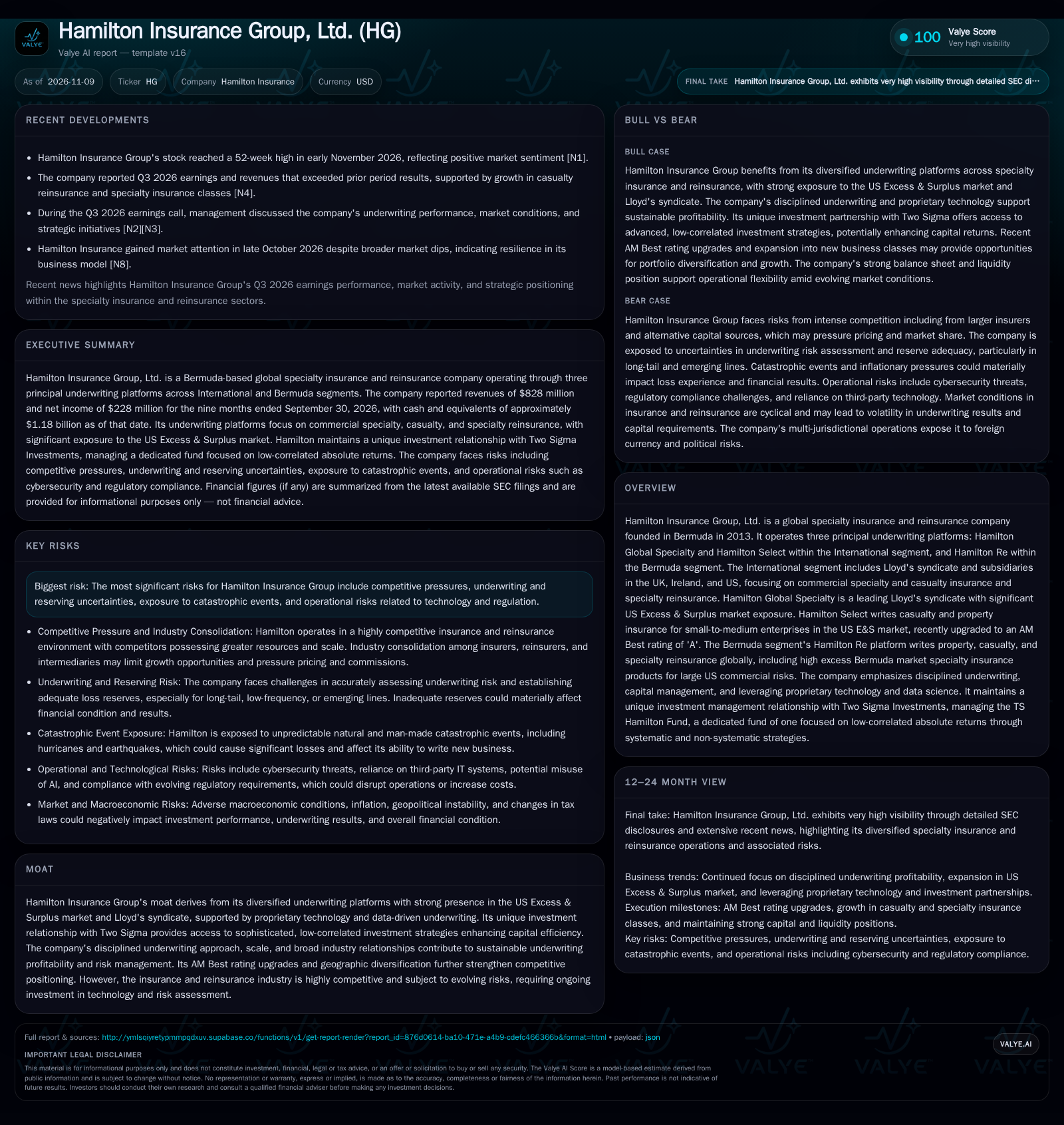
Hamilton Insurance Group reported strong revenue and net income growth through Q3 2026, driven by its diversified specialty and reinsurance platforms and supported by robust cash reserves. The firm’s competitive edge stems from disciplined underwriting, proprietary technology, and its partnership with Two Sigma. However, a sharp rise in its combined ratio—reflecting increased catastrophe and acquisition costs—highlights the ongoing challenges in risk selection, pricing, and capital management in a volatile market.
Hamilton Insurance Group has carved out a prominent place in the global specialty insurance and reinsurance landscape, leveraging its Bermuda roots, Lloyd’s syndicate, and a data-driven approach to underwriting. Yet, a notable increase in its combined ratio signals the mounting impact of catastrophe losses and acquisition costs, raising questions about the sustainability of its underwriting edge as market cycles evolve and competitive intensity heightens.
Recent Financial Performance and Catastrophe Losses Shape the Risk-Reward Profile
Hamilton Insurance Group reported $828 million in revenues and $228 million in net income for the nine months ended September 30, 2026, with cash and cash equivalents totaling $1.18 billion at period end [S2]. These results reflect the strength of its diversified specialty insurance and reinsurance platforms, particularly in the US Excess & Surplus (E&S) market and Lloyd’s syndicate. However, the Q3 2026 combined ratio climbed to 97.3% from 87.8% in the prior year, driven by higher catastrophe loss and acquisition cost ratios [S2]. This sharp swing underscores both the earnings power and vulnerability of Hamilton’s model to volatile loss events and competitive dynamics.
The recent AM Best rating upgrade for Hamilton Select—its US E&S carrier focused on small-to-medium enterprises—bolsters its credibility and could support further premium growth [S2]. Meanwhile, the company’s unique investment relationship with Two Sigma continues to provide access to differentiated, low-correlated absolute return strategies, adding a layer of capital flexibility and risk diversification.
How Hamilton’s Diversified Model Converts Risk into Profits
Hamilton’s economics rest on disciplined underwriting, risk selection, and the ability to price idiosyncratic and complex risks—especially in the E&S and specialty reinsurance markets. Premiums are generated through three main underwriting platforms: Hamilton Global Specialty (notably Lloyd’s syndicate business with US E&S exposure), Hamilton Select (US SME E&S), and Hamilton Re (Bermuda-based global reinsurance). The company earns underwriting income when its combined ratio (claims plus expenses divided by premiums earned) stays below 100%. In Q3 2026, the combined ratio’s rise to 97.3%—up from a more profitable 87.8% a year earlier—reflects the inherent volatility of catastrophe-exposed lines and the impact of acquisition costs [S2].
Hamilton’s capital model is reinforced by a partnership with Two Sigma, which manages the TS Hamilton Fund, investing in liquid global assets and derivatives to generate low-correlated absolute returns. This structure can enhance overall return on equity and smooth earnings volatility, but also introduces market risk that must be carefully managed.
The company’s capacity to deploy capital into hardening markets (where premiums rise due to tighter supply or recent losses) is a potential profit lever. However, its exposure to catastrophe events, inflation, and social inflation (rising claims severity due to legal and societal trends) means that reserve adequacy and loss trend assumptions are critical. Operating leverage can be favorable when premium growth outpaces expense growth, but is at risk if loss ratios spike or competition compresses margins.
Specialty Focus, Tech Investment, and Scale: How Hamilton Stacks Up
Hamilton’s competitive positioning is anchored by its presence in the US E&S market—an arena characterized by less regulated pricing and underwriting flexibility, allowing for attractive margins when risk selection is strong. Its Lloyd’s syndicate has been among the most profitable and least volatile in the market over the past decade, which supports its reputation and broker relationships [S2]. The recent AM Best upgrade for Hamilton Select further signals external confidence in its risk management and capital strength.
The company leverages proprietary technology and data science in underwriting, aiming to differentiate itself through better risk selection and pricing. Its investment relationship with Two Sigma is atypical for the industry, potentially providing an edge in capital efficiency and return diversification.
However, Hamilton faces intense competition from larger global insurers, reinsurers, and alternative capital providers (such as insurance-linked securities funds and catastrophe bond investors), who can underwrite similar risks and may accept lower returns. Industry consolidation, especially among intermediaries and carriers, could also pressure commission rates and market access. Substitution risk from parametric insurance, insurtech, and direct digital distribution adds further uncertainty. Ultimately, Hamilton’s ability to sustain superior returns will depend on maintaining underwriting discipline, technological innovation, and broker/channel relationships amid these counterforces.
If Market Hardening Persists and Tech-Driven Underwriting Delivers
Hamilton’s most compelling upside rests on sustained hard market conditions in E&S and reinsurance—driven by higher catastrophe frequency, capacity withdrawals by competitors, or regulatory tightening—which could allow for continued premium growth and robust pricing power. If Hamilton’s proprietary technology and data-driven underwriting enable it to select and price risks more accurately than peers, it could achieve combined ratios persistently below industry averages, translating into growing underwriting income and return on equity.
Additional upside could come from the Two Sigma partnership, if the TS Hamilton Fund continues to deliver positive, low-correlated returns even during periods of industry loss. The AM Best rating upgrade for Hamilton Select may also open up new distribution opportunities and attract higher-quality risks.
Evidence that would confirm this scenario includes: several quarters of combined ratios below 95% (especially in catastrophe-exposed lines), outsized premium growth in E&S and specialty classes, and investment returns from the TS Hamilton Fund exceeding peer benchmarks. On the commercial side, winning new large broker relationships or expanding into underpenetrated specialty lines would further support the upside thesis.
Sustaining Margins Amid Normalizing Loss Trends and Competitive Pricing
The most plausible trajectory for Hamilton is ongoing premium growth in E&S and specialty lines, but with combined ratios hovering in the mid- to high-90s as catastrophe losses revert to longer-term averages and competitive pricing pressures re-emerge. Underwriting discipline and technology investment are likely to help Hamilton avoid outsized losses, but not eliminate the impact of industry cycles or large events.
Investment returns may provide some diversification, but are unlikely to consistently offset underwriting volatility. The company’s capital position and rating strength should allow it to maintain market access and selectively grow in attractive niches. However, expense ratios may creep up if technology and compliance investments accelerate.
This scenario would be confirmed by steady, if unspectacular, growth in premiums, combined ratios in the 95–98% range, and return on equity in line with peers. Signs of stable broker relationships, limited reserve strengthening, and no significant loss creep from prior years would reinforce the base case.
If Catastrophe Volatility and Reserve Shocks Erode Profitability
Adverse outcomes could materialize if Hamilton experiences above-average catastrophe losses, reserve development on prior years’ claims, or unanticipated inflation in claims severity. A string of large events, or underestimation of exposure in new/emerging business lines, could drive the combined ratio well above 100%, leading to underwriting losses and potential capital strain.
Competitive dynamics could worsen if alternative capital floods the market, driving down pricing and compressing margins—especially in reinsurance. If Hamilton’s technology edge fails to deliver better risk selection, or if operational/cyber risks disrupt core systems, the firm could lose its differentiated status.
Confirmation of the downside scenario would include: consecutive quarters of combined ratios above 100%, negative reserve development, capital-raising activity under duress, or a downgrade in credit/AM Best ratings. Market share losses in core E&S or Lloyd’s segments, or adverse outcomes in the TS Hamilton Fund, would further amplify downside risk.
What Will Determine Hamilton’s Edge in Specialty Insurance Going Forward?
Quarterly combined ratio trends, especially the relative contribution of catastrophe and acquisition costs, would help test the sustainability of Hamilton’s underwriting discipline.
Premium growth rates and mix across E&S, Lloyd’s, and Bermuda reinsurance platforms—if disclosed—will indicate whether Hamilton is successfully expanding in target niches or simply riding market cycles.
The frequency and severity of large loss events, as well as reserve development on prior accident years, will reveal the effectiveness of risk selection and reserving.
Updates on the performance of the TS Hamilton Fund managed by Two Sigma, including returns versus benchmarks and portfolio volatility, would clarify the investment partnership’s impact on capital efficiency.
Changes in AM Best and other rating agency outlooks, especially following loss events or industry downgrades, would be material for broker and customer confidence.
Expense ratio evolution, particularly as technology and compliance investments scale, would signal whether operating leverage is improving or deteriorating.
Broker and distribution partner feedback (if disclosed) on Hamilton’s technology, service, and claims management would provide qualitative insight into its competitive differentiation.
Any reported cyber incidents, regulatory fines, or operational disruptions would be important in assessing non-underwriting risk exposure.
Disclaimer: This is research-only, informational analysis and not investment advice. It may include AI-generated interpretation and general industry context. Always verify important details using primary sources.

Comments