
BayCom Corp: Managing Interest Rates and Credit Risks in Regional Banking Growth
BayCom Corp’s recent earnings highlight the ongoing tension between interest rate risk management, credit quality, and the realities of competing as a regional bank. With a balanced asset-liability profile and active monitoring by its Asset Liability Committee, BayCom’s ability to preserve net interest margins and asset quality remains central to its forward trajectory.
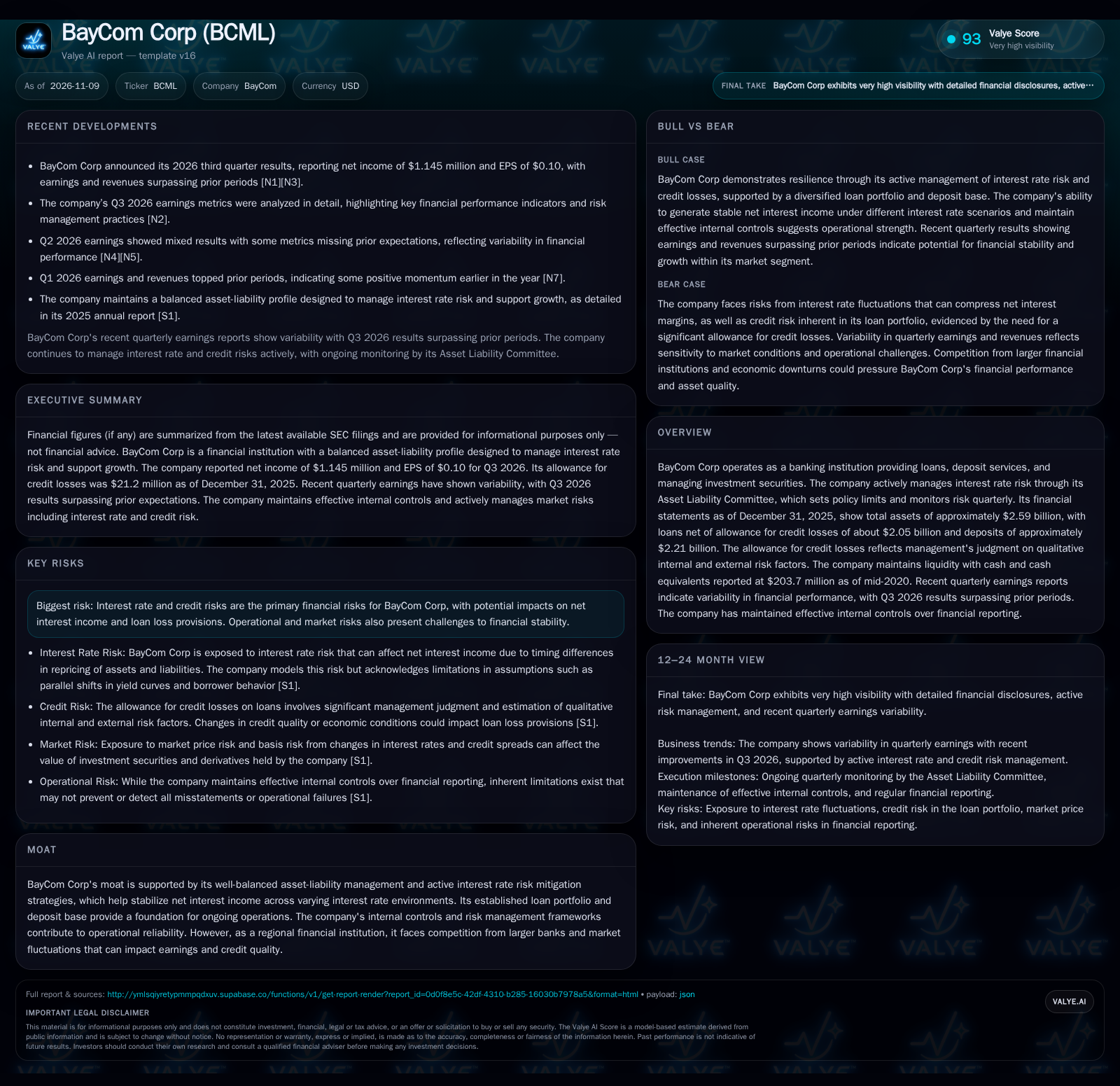
BayCom Corp reported Q3 2026 net income of $1.145 million and maintains a balanced mix of loans and deposits, with $2.05 billion in loans and $2.21 billion in deposits as of December 2025. The company’s asset-liability management and credit loss allowance ($21.2 million) reflect a focus on risk mitigation, but interest rate volatility and regional competition continue to shape its earnings power and loan quality outlook [S1] [S2] [N2].
BayCom Corp operates as a regional financial institution navigating the dual challenges of interest rate volatility and credit risk management. Its recent financial results—highlighted by modest profitability, a sizable loan portfolio, and vigilant risk oversight—underscore the critical role of asset-liability balancing in sustaining earnings. As larger banks encroach and economic conditions remain uncertain, BayCom’s ability to defend margins and credit quality will shape its prospects in a competitive regional banking landscape.
Recent Earnings and Balance Sheet: Assessing Risk and Return Dynamics
BayCom Corp reported net income of $1.145 million for Q3 2026, translating to basic and diluted EPS of $0.10 per share [S2] [N2]. As of December 31, 2025, the company’s total assets were approximately $2.59 billion, with loans net of allowance for credit losses at about $2.05 billion and deposits totaling $2.21 billion [S1]. The allowance for credit losses on loans stood at $21.2 million, reflecting management’s estimate of embedded portfolio risk. These figures underscore the company’s moderate scale and the ongoing importance of credit risk management and interest rate exposure as defining features of its operating profile.
BayCom’s Revenue Model: Focus on Net Interest Income and Expense Efficiency
BayCom Corp’s fundamental economic engine is net interest income—the spread between interest earned on assets (primarily loans) and interest paid on liabilities (mainly deposits). With $2.05 billion in loans and $2.21 billion in deposits, the company’s revenue model depends on both loan growth and the ability to price deposits effectively relative to prevailing market rates [S1]. The presence of a substantial base of noninterest-bearing deposits provides some cost advantage, but the mix of interest-earning assets and liabilities means BayCom is sensitive to shifts in the yield curve.
Operating leverage in this context is typically modest for a regional bank: while some fixed costs (branches, compliance, technology) can be spread over a growing asset base, variable costs (credit provisioning, deposit costs) rise with scale and risk. The $21.2 million loan loss allowance represents both a direct expense and a buffer against future credit impairments—its adequacy will be tested in the event of economic stress. Capital requirements and regulatory constraints limit the degree to which the bank can aggressively expand; prudent growth, rather than rapid balance sheet expansion, is likely to define the economic model.
The sensitivity of BayCom’s net interest income to interest rate fluctuations is further nuanced by the duration and repricing characteristics of its asset and liability portfolios. If the bank’s loan portfolio consists predominantly of fixed-rate loans with longer maturities, the ability to reprice assets in a rising rate environment may lag behind the repricing of deposits, which are often shorter term or variable rate. Conversely, a higher proportion of adjustable-rate loans could provide a natural hedge against rising rates, supporting margin stability. Understanding the detailed composition of the loan book by product type and maturity would help clarify this dynamic and the potential impact on net interest margins under varying interest rate scenarios.
Additionally, the cost structure associated with managing credit risk—such as underwriting, monitoring, and collections—can materially affect BayCom’s operating leverage. In periods of economic uncertainty, increased provisioning requirements and elevated operational expenses related to risk management may compress earnings even if loan growth remains steady. The interplay between credit risk management costs and revenue generation highlights the importance of efficient processes and technology adoption in maintaining profitability. If BayCom invests in advanced credit analytics or automation, it could improve risk-adjusted returns and reduce incremental costs associated with credit deterioration.
Competitive Landscape: Challenges in Differentiating Regional Banking Services
BayCom operates in a crowded regional banking environment where scale, customer relationships, and risk management are the primary axes of competition. While its asset-liability committee and internal controls suggest operational discipline, the company faces intense pressure from larger banks with greater technology budgets, broader service offerings, and lower funding costs. Fintech entrants and direct digital lenders also threaten to erode the traditional banking value chain by siphoning off high-margin loan and deposit business.
BayCom’s competitive strengths may include local market knowledge, established relationships, and the flexibility to tailor lending to regional business needs. However, these advantages are partially offset by limited pricing power, thinner margins, and the risk of customer churn if deposit rates lag those of national competitors. In the absence of a distinctive fee-based revenue stream or proprietary technology, the company’s ability to maintain its niche depends on continuous vigilance in credit underwriting and deposit gathering.
From a competitive standpoint, BayCom’s regional focus offers both opportunities and constraints. While local market knowledge and personalized service can drive customer loyalty, these advantages may be insufficient if larger competitors leverage scale to offer more attractive pricing or innovative digital solutions. The bank’s ability to integrate technology that enhances customer experience without disproportionately increasing costs will be critical. Furthermore, regulatory compliance costs tend to be relatively fixed, so smaller institutions like BayCom must balance investments in compliance infrastructure with the need to remain agile and responsive to market demands.
Moreover, BayCom’s competitive resilience may depend on its capacity to identify niche lending segments or underserved customer profiles within its regional footprint. Specialization in sectors where the bank has demonstrated expertise could allow for higher risk-adjusted yields and lower credit losses compared to more commoditized lending markets. However, this approach requires robust risk assessment frameworks and continuous market intelligence to avoid concentration risks. The bank’s strategic choices in portfolio diversification versus specialization will influence its vulnerability to sector-specific economic downturns and its overall competitive positioning.
Expanding Margins Through Deposit Strength and Prudent Credit Practices
An upside scenario for BayCom would see the company capitalize on a stable or declining interest rate environment, allowing it to reprice liabilities faster than assets and expand net interest margins. If BayCom can grow its base of noninterest-bearing deposits, it could further reduce funding costs and improve profitability even in the face of tepid loan demand. Additionally, disciplined credit underwriting that keeps charge-offs and nonperforming assets below peer averages would limit the need for additional loss provisioning, supporting earnings.
Confirmation of this scenario would come from sequential improvements in net interest margin (NIM), stable or rising noninterest-bearing deposit balances, and a declining trend in nonperforming loans relative to total assets. Conversely, a spike in credit costs or a sharp outflow of core deposits would challenge this outcome.
Conservative Risk Management Supports Steady Growth Trajectory
The most plausible trajectory for BayCom involves modest loan growth, stable deposit balances, and ongoing management of interest rate and credit risks. Net interest income could remain under pressure if funding costs rise faster than asset yields, but active asset-liability management may mitigate the worst effects. Credit quality is likely to remain within historical ranges, with the allowance for credit losses providing a buffer against moderate economic headwinds.
Evidence supporting this base case would include steady quarterly profitability, relatively flat net interest margin, and loan loss provisions tracking with regional banking peers. A breakdown could be signaled by persistent margin compression, sustained deposit outflows, or a material uptick in nonperforming loans.
Risks of Margin Squeeze Coupled with Credit Quality Decline
A downside scenario would be triggered by a combination of rising funding costs (as higher deposit rates are required to retain customers) and sluggish loan growth or declining asset yields. In this environment, net interest margin could compress significantly, squeezing profitability. Simultaneously, if economic conditions deteriorate, credit losses could rise, forcing BayCom to increase its loan loss allowance and further eroding earnings.
Confirmation would be found in sequential declines in NIM, elevated loan loss provisions, and a spike in nonperforming assets. Early warning signs might include rapid deposit outflows, aggressive repricing of deposit products, or a pronounced uptick in criticized or classified loans.
Evaluating BayCom’s Outlook: Company-Specific Developments and Market Influences
Net interest margin (NIM) trends over the next several quarters—rising NIM would support margin expansion, while declines would suggest pressure from funding costs.
Quarterly changes in noninterest-bearing deposit balances—growth would signal franchise strength; declines could indicate competitive stress.
Trends in loan loss provisioning and allowance coverage ratios—if disclosed, these would reflect management’s evolving view of credit risk.
Movement in nonperforming loans as a percentage of total loans—persistent increases would raise concerns about asset quality.
Quarterly loan growth rates relative to regional peers—a useful metric to assess competitiveness and market share retention.
Any disclosed changes in the composition of the loan book by sector or geography—shifts might signal risk concentration or diversification.
Updates on technology investment or digital banking initiatives—would help test BayCom’s ability to compete with larger or digitally native banks.
Regulatory or economic shocks in BayCom’s core markets—external events could affect both credit quality and deposit stability.
Disclaimer: This is research-only, informational analysis and not investment advice. It may include AI-generated interpretation and general industry context. Always verify important details using primary sources.

Comments