
Zymeworks’ Oncology Ambitions: Licensing Leverage, Clinical Progress, and the Stakes of Integration
Zymeworks Inc. has advanced its oncology strategy through a high-value licensing deal with Roche, positive clinical data, and strategic acquisitions—backed by solid Q3 profitability and liquidity. The company’s next phase depends on the realization of pipeline value, successful integration of acquired assets, and the durability of partnership economics.
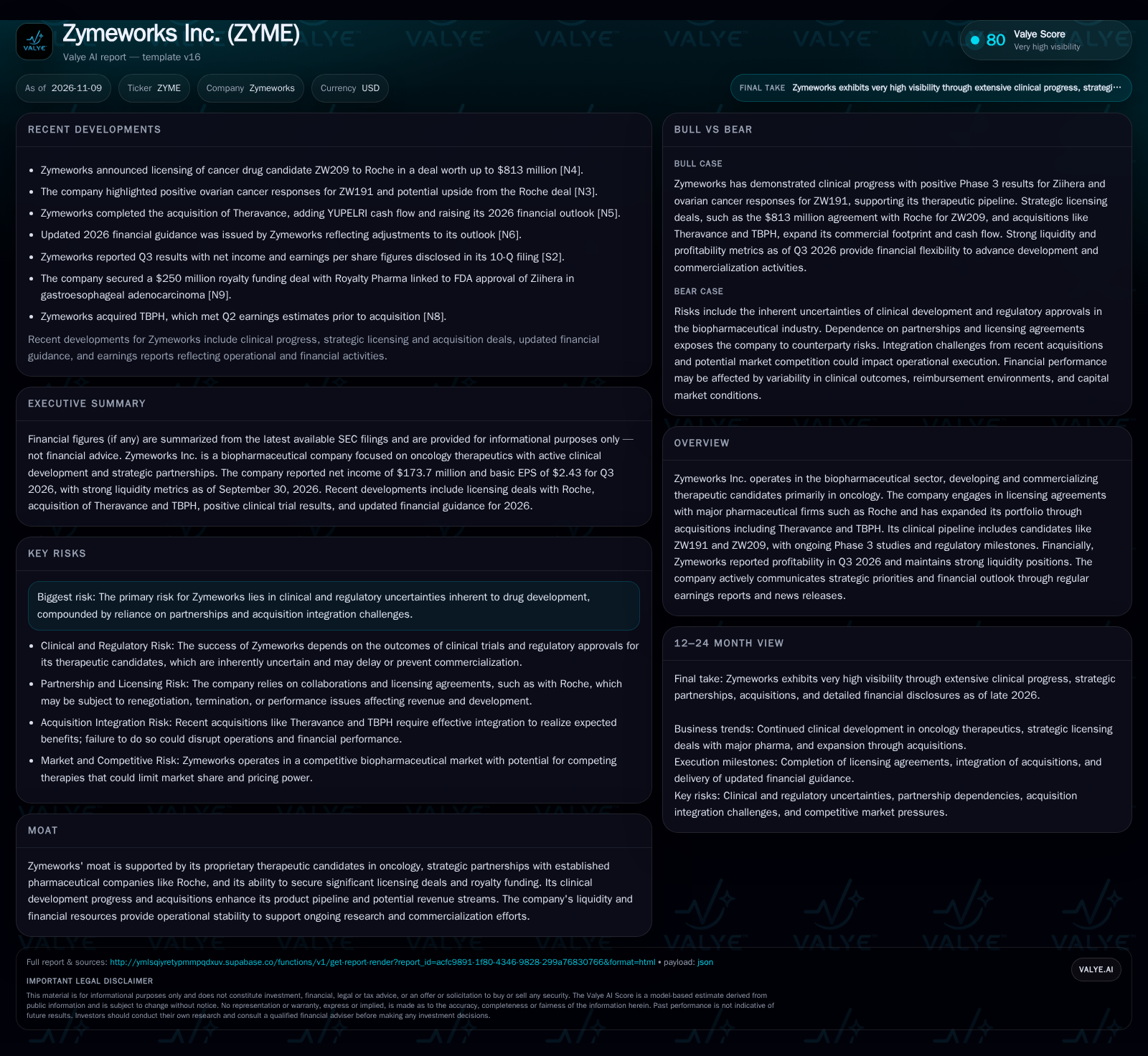
Zymeworks’ $813M licensing deal with Roche, positive ovarian cancer trial updates, and a profitable Q3 with reported liquidity position highlight its current momentum. The company’s future will hinge on clinical and regulatory outcomes, execution of acquisition integrations, and its ability to translate partnerships into recurring revenue streams, with material risks tied to development setbacks and competitive pressures. [N3] [N4] [S2]
Zymeworks Inc. stands at a pivotal juncture in late 2026, propelled by a transformative licensing deal with Roche, encouraging clinical data in ovarian cancer, and a profitable third quarter marked by reported liquidity position. While these developments validate its platform and commercial strategy, the company’s trajectory will be shaped by the interplay between successful execution of licensing and acquisition integration, continued clinical progress, and the ability to mitigate inherent biopharma risks. As Zymeworks seeks to translate pipeline promise and partnership economics into recurring value, the coming quarters will test both its operational discipline and the resilience of its growth thesis.
Recent Milestones Redefine Zymeworks’ Strategic Position
Zymeworks’ latest quarter was defined by several material events: the licensing of oncology candidate ZW209 to Roche in a deal valued up to $813 million, positive clinical responses for ZW191 in ovarian cancer, and a Q3 2026 net income of $173.7 million with basic EPS of $2.43. The Roche partnership signals external validation of Zymeworks’ R&D platform and introduces the prospect of milestone and royalty income, while positive ZW191 clinical data strengthens the company's near-term pipeline narrative [N3] [N4] [S2].
The company reported cash and liquidity metrics for the period; these figures do not by themselves establish operating runway, investment capacity, financial flexibility, or financing capacity. [N8] [S2]
How Partnerships, Milestones, and Pipeline Mix Shape Revenue Streams
Zymeworks’ economics are characterized by a hybrid model: direct R&D investment in proprietary oncology candidates, monetization through licensing (as with Roche), and, following recent acquisitions, potential commercial product cash flows. The Roche deal structure—up to $813 million, presumably in staged milestones and potential royalties—provides non-dilutive funding and reduces dependence on dilutive equity or debt. However, the timing and certainty of these payments depend on clinical, regulatory, and commercial progress, which are inherently uncertain [N4].
The company’s Q3 profit is likely influenced by licensing revenue recognition and possibly one-time items, rather than recurring product sales, underscoring the episodic nature of biopharma P&Ls at this stage [S2]. As Zymeworks integrates TBPH and other assets, it faces the challenge of converting acquired pipelines into revenue-generating products. If successful, this could diversify income streams beyond milestone-driven lumpiness into more stable royalty or product sales revenue, but this transition typically involves significant upfront costs and execution risks.
Pipeline Value, Partner Access, and the Realities of Oncology Competition
Zymeworks’ competitive position rests on three pillars: differentiated oncology assets validated through external partnerships (notably Roche), a pipeline with clinical proof-points (as with ZW191), and the ability to attract further licensing or acquisition interest. In the oncology sector, access to large pharma partners can be a force multiplier, providing validation, global reach, and funding for late-stage development.
However, these advantages are counterbalanced by substantial risks: the oncology landscape is crowded, with numerous competitors pursuing overlapping targets and modalities. The success of Zymeworks’ assets will depend not only on clinical efficacy and safety but also on differentiation versus both approved therapies and other pipeline entrants. Furthermore, reliance on partners can introduce dependency risk—should Roche or other collaborators reprioritize, Zymeworks’ economics and strategic options could be impaired.
Recent acquisitions expand the pipeline and potential addressable markets but also require integration skill—failure to realize synergies or commercialize acquired assets efficiently could erode any competitive edge. Ultimately, the company’s moat is conditional: it is reinforced by scientific and partnership capital, but vulnerable to development setbacks and evolving competitive dynamics.
Unlocking Value through Clinical Success and Partnership Execution
In a favorable scenario, Zymeworks achieves pivotal clinical milestones with ZW191 and other assets, triggering substantial milestone and royalty payments under the Roche and other licensing agreements. Positive clinical readouts would not only unlock near-term economics but also enhance the company’s negotiating leverage for future deals, potentially attracting additional partners or acquirers.
If integration of TBPH and other recent acquisitions yields accelerated development and commercialization of new assets, Zymeworks could transition from episodic licensing revenue to a hybrid of recurring royalties and direct product sales. Sustained profitability would follow, supported by operational leverage and the company’s ability to reinvest in pipeline expansion.
Evidence to confirm this scenario would include the achievement of clearly defined clinical endpoints, new or expanded licensing agreements, accelerating milestone/royalty revenue, and successful commercial launches of acquired or in-house products. Falsification would be signaled by major clinical setbacks, missed milestones, or partner disengagement.
Translating Pipeline and Partnerships into Incremental Progress
The most plausible trajectory for Zymeworks is a mix of progress and volatility: ongoing clinical development yields a combination of successes and setbacks, with periodic milestone income from partners like Roche. The company continues to invest in its pipeline and integration of acquired assets, but substantial recurring revenue remains several years away, dependent on the pace of regulatory approvals and partner commercialization.
Profitability fluctuates due to the lumpy nature of licensing income and R&D spend. Liquidity, while currently robust, is gradually drawn down by development expenses and integration costs. The company’s valuation and capital access are tied to clinical and commercial news flow, making execution and external validation (e.g., new deals, positive trial data) critical to maintaining momentum.
This scenario would be confirmed by incremental clinical progress, additional but not transformative partnership activity, and continued financial stability without a step-change in recurring revenue. Falsification would occur if clinical programs stall, integration falters, or major partners reduce their engagement.
Execution Risks: Clinical Setbacks, Integration Challenges, and Partnership Friction
In an adverse scenario, Zymeworks experiences clinical trial failures or delays, undermining both the pipeline’s intrinsic value and the economics of licensing agreements. Milestone and royalty revenues fall short of expectations, and partners like Roche may reprioritize or renegotiate terms, exposing Zymeworks to revenue gaps and increased funding needs.
Integration of TBPH and other acquisitions could prove more complex than anticipated, leading to operational inefficiencies, higher costs, and missed synergies. Without the offset of new licensing deals or successful commercialization, the company’s cash position erodes, potentially forcing additional capital raises on unfavorable terms.
Confirmation of this scenario would come from negative clinical trial updates, reduction in guidance, impairment charges related to acquisitions, or announcements of partner terminations or renegotiations. Diminished liquidity or a shift to net losses over multiple quarters would further substantiate downside risk.
Milestones and Metrics That Will Shape Zymeworks’ Next Chapter
Progression of ZW191 and other lead oncology assets through key clinical development stages; data readouts and regulatory filings would help validate pipeline value.
Timing and amount of milestone and royalty payments received from the Roche ZW209 agreement and other licensing deals, as disclosed in future filings.
Integration milestones for TBPH and other acquired assets: achievement of cost synergies, pipeline advancement, and any updates on commercial product performance.
Sustained profitability or trends in quarterly operating income, distinguishing between recurring and non-recurring revenue components, if disclosed.
Cash burn rate and liquidity evolution as development and integration costs are absorbed; quarterly updates on cash and equivalents would help test the thesis.
Announcements of new or expanded partnerships, licensing agreements, or collaborations with major pharma, indicating continued external validation.
Competitive developments in oncology: approvals or pivotal trial results from competing therapies that could impact Zymeworks’ addressable markets or differentiation.
Regulatory and reimbursement environment changes affecting the commercialization prospects of Zymeworks’ pipeline and acquired products.
Disclaimer: This is research-only, informational analysis and not investment advice. It may include AI-generated interpretation and general industry context. Always verify important details using primary sources.

Comments