
Emerson Electric: Software-Led Growth Faces Liquidity and Integration Pressures
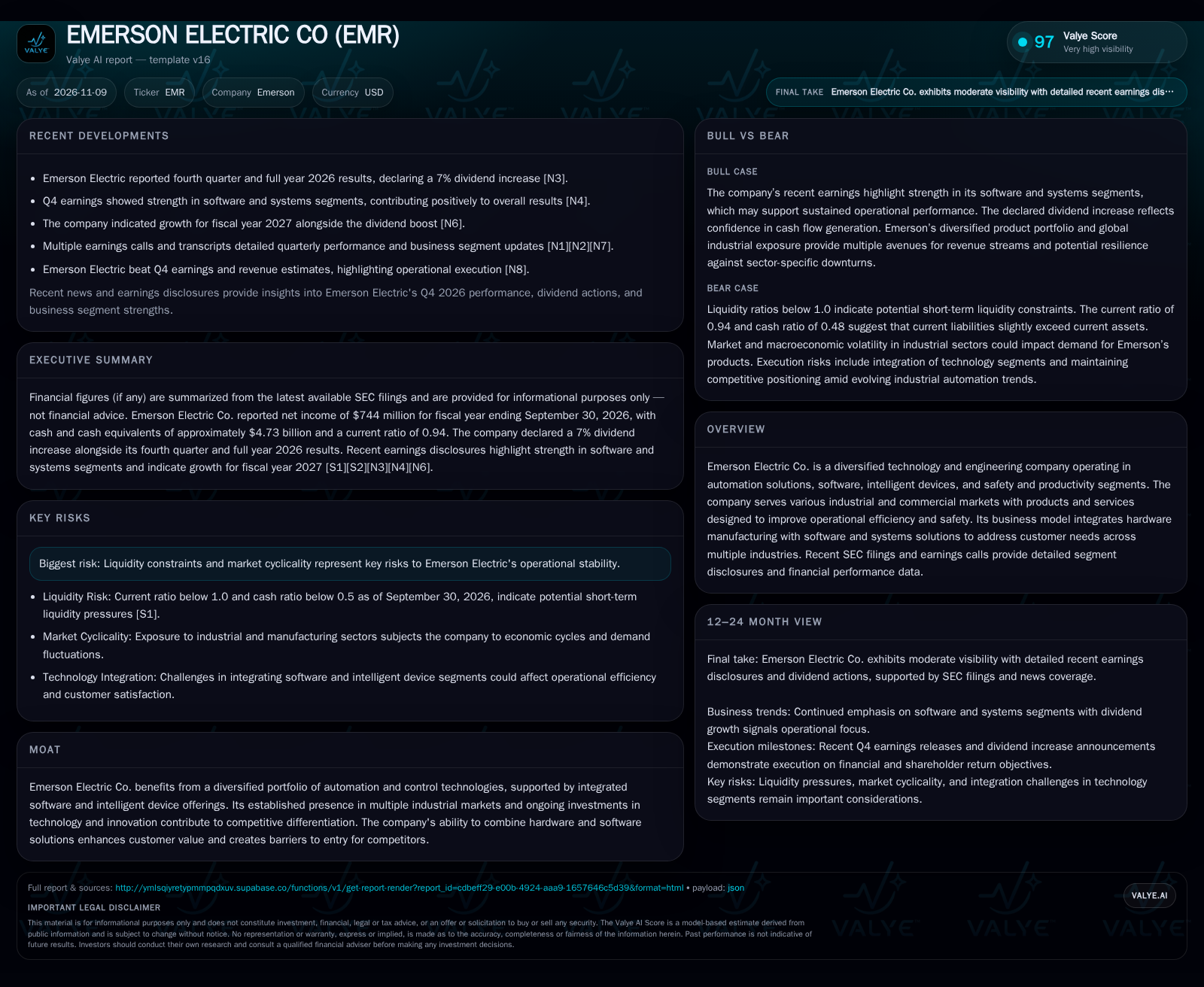
Emerson Electric reported $744 million in net income for fiscal 2026 and increased its dividend by 7%, with software and systems segments driving Q4 outperformance.
Emerson Electric reported $744 million in net income for fiscal 2026 and increased its dividend by 7%, with software and systems segments driving Q4 outperformance. However, a current ratio below 1.0 highlights short-term liquidity pressures. The company’s integrated hardware–software model aims at industrial automation leadership, but successful technology integration and market cyclicality are key swing factors for future earnings trajectory. [S1] [N3] [N4]
Emerson Electric’s latest results highlight a company at a strategic crossroads. Strong net income for 2026 and outperformance in software and systems segments suggest progress on its industrial automation ambitions. The interplay between successful execution in next-generation automation and the ability to manage balance sheet pressures will be decisive for Emerson’s trajectory as it enters fiscal 2027.
Recent Results Spotlight Software Strength and Near-Term Liquidity Constraints
Emerson Electric reported net income of $744 million for the fiscal year ending September 30, 2026, underscoring continued profitability at scale. The company’s Q4 2026 earnings beat both revenue and earnings estimates, with particular strength attributed to its software and systems segments—suggesting that investments in digital automation are yielding tangible returns. The cited source reports dividend-related activity; that disclosure alone does not establish dividend-policy continuity, management confidence, or a material constraint on capital flexibility. This combination of operational momentum and liquidity pressure sets the stage for a critical period of execution and risk management. [S1] [N3] [N4] [N8]
How Emerson’s Hybrid Model Seeks Margin Expansion and Recurring Revenue
Emerson’s business model blends the traditional sale of hardware—such as sensors, controllers, and industrial devices—with higher-margin software and systems solutions. Historically, hardware sales in industrial automation have been capital-intensive and cyclical, with fixed costs tied to manufacturing and variable costs driven by materials and labor. The company’s pivot toward software and systems, as highlighted in recent earnings, is designed to shift the revenue mix toward more resilient, recurring streams (e.g., software licenses, system upgrades, and ongoing support). If successful, this could drive operating leverage: incremental software revenue tends to have higher gross margins and lower incremental costs compared to hardware expansion.
However, the model’s success hinges on effective integration of acquired or internally developed technology platforms and the ability to cross-sell bundled solutions to existing and new customers. Upfront capital requirements for R&D and potential acquisitions remain substantial, while the pace of customer adoption in industrial markets can be slow due to long sales cycles and switching frictions. As a result, the economic upside depends on both the expansion of high-margin software penetration and the company’s ability to contain integration costs and manage working capital under liquidity constraints.
The shift toward a hybrid business model that combines hardware with software and systems also introduces complexities in revenue recognition and cost allocation. Software revenues often follow subscription or usage-based models, which can smooth revenue volatility but require robust billing and customer management infrastructure. Additionally, the transition may necessitate changes in salesforce capabilities and incentives, as selling integrated solutions demands deeper technical expertise and longer sales cycles. These organizational adjustments can temporarily pressure operating margins and cash flow until the new model achieves scale and efficiency.
From a capital allocation perspective, the balance between investing in R&D for software innovation and maintaining competitive hardware offerings is critical. Over-investment in software without corresponding hardware support risks eroding the installed base that serves as a platform for digital upselling. Conversely, under-investment in hardware may lead to commoditization and loss of differentiation. Therefore, Emerson’s ability to dynamically allocate resources based on market feedback and technology adoption rates will be a key determinant of margin expansion and long-term resilience.
Where Emerson Stands in the Evolving Industrial Automation Landscape
Emerson faces a dynamic competitive environment, with global industrial automation peers, diversified conglomerates, and pure-play software providers all vying for share. Its long-standing relationships and installed base in process industries—such as energy, chemicals, and manufacturing—provide a platform for cross-selling intelligent devices and digital solutions. Emerson’s integrated hardware–software approach is strategically aimed at differentiating its offering from hardware-only or software-only competitors, potentially raising customer switching costs through ecosystem lock-in.
Yet, the competitive landscape is intensifying as industrial customers increasingly prioritize interoperability, open standards, and the flexibility to integrate best-of-breed solutions. Large automation vendors, as well as emerging cloud and industrial IoT players, are targeting adjacent segments with data analytics, AI-driven process optimization, and subscription-based platforms. Emerson’s ability to keep pace with technology cycles, maintain interoperability, and offer clear ROI for digital upgrades will determine whether its current portfolio creates a lasting moat or faces margin erosion from commoditization and integration challenges.
If Software-Led Automation Gains Traction, Margin and Growth Could Inflect
A favorable scenario for Emerson would see accelerated adoption of its integrated software and systems offerings across industrial and commercial customers. If the company successfully leverages its installed hardware base to upsell digital solutions and achieves high software attachment rates, the revenue mix would shift toward higher-margin, recurring streams. This could drive both gross margin expansion and more stable, predictable cash flows, even amid broader industrial cyclicality.
Confirmation of this scenario would come from sustained outperformance in software and systems revenue, rising segment margins, and evidence of multi-year customer contracts or renewals tied to digital platforms. Additional signals would include successful integration of technology acquisitions, new large-scale customer wins in automation, and a trend toward improving working capital efficiency—helping to ease liquidity pressures. Evidence against this scenario would include stagnation in software growth, margin compression, or customer resistance to bundled solutions.
In addition to revenue and margin improvements, a successful software-led automation strategy could create strategic optionality through data monetization and advanced analytics services. By leveraging data generated from installed hardware and software platforms, Emerson could develop value-added offerings that enhance customer operations and create new recurring revenue streams. This would require investments in cloud infrastructure, cybersecurity, and AI capabilities, but could further differentiate Emerson’s ecosystem and increase switching costs, reinforcing customer loyalty and enabling premium pricing.
Moreover, if Emerson’s integrated solutions demonstrate clear operational efficiencies and cost savings for customers, it could accelerate adoption during periods of industrial capital discipline. In such environments, customers may prioritize investments that deliver measurable productivity gains or reduce downtime, favoring bundled automation solutions over standalone hardware purchases. This dynamic could partially decouple Emerson’s growth from traditional industrial capex cycles, providing more predictable revenue streams and enhancing valuation multiples tied to recurring software revenues.
Integration Progress and Industrial Cycles Set the Likely Course
The most plausible trajectory for Emerson is a period of moderate growth, with incremental gains in software and systems offset by the realities of industrial demand cycles and the challenges of integrating diverse technology platforms. The company’s diversified end-market exposure provides some insulation from sector-specific downturns, but overall revenue and margin trends will likely track broader capital spending patterns in manufacturing, energy, and process industries.
Evidence supporting this path would be steady, but not rapid, growth in software and systems, stable gross margins, and continued but measured increases in shareholder returns. Signs against this scenario would be significant margin volatility, major integration missteps, or a deterioration in the company’s ability to manage its short-term obligations.
Liquidity Strains and Integration Failures Could Disrupt Momentum
Simultaneously, if the integration of software and intelligent device platforms falters—leading to customer dissatisfaction, project delays, or cost overruns—the company could lose share to more agile or better-capitalized competitors.
Confirmation of this scenario would include deteriorating current and cash ratios, covenant breaches, reductions in R&D or capital expenditures, and negative earnings surprises. Additional warning signs would be customer defections, significant one-time charges related to integration failures, or a dividend cut. Evidence against this scenario would be stabilization or improvement in liquidity metrics and continued positive cash flow from operations.
Signals That Will Clarify Emerson’s Automation Ambitions and Resilience
Quarterly revenue and margin trends in the software and systems segments, if disclosed, to assess the pace and profitability of the digital transformation.
Disclosure of multi-year software contracts or renewals, which would signal the emergence of recurring revenue streams and customer lock-in.
Updates on integration costs and the success of technology platform rollouts, including any disclosed synergies or one-time charges.
Industrial customer capital spending trends, as these will impact both hardware and software demand within Emerson’s core markets.
Evidence of cross-segment bundling or uptake of intelligent device–software packages, which would validate the company’s hybrid model.
Reports of large-scale customer wins or losses, especially in automation and digital systems, to gauge competitive traction.
Disclaimer: This is research-only, informational analysis and not investment advice. It may include AI-generated interpretation and general industry context. Always verify important details using primary sources.

Comments