
Esquire Financial’s Consistent Profitability: Navigating Growth, Liquidity, and Sector Risks
Esquire Financial Holdings, Inc. demonstrates strong recent profitability and maintains significant liquidity, drawing investor interest amid a backdrop of sector-specific uncertainties and limited business model transparency.
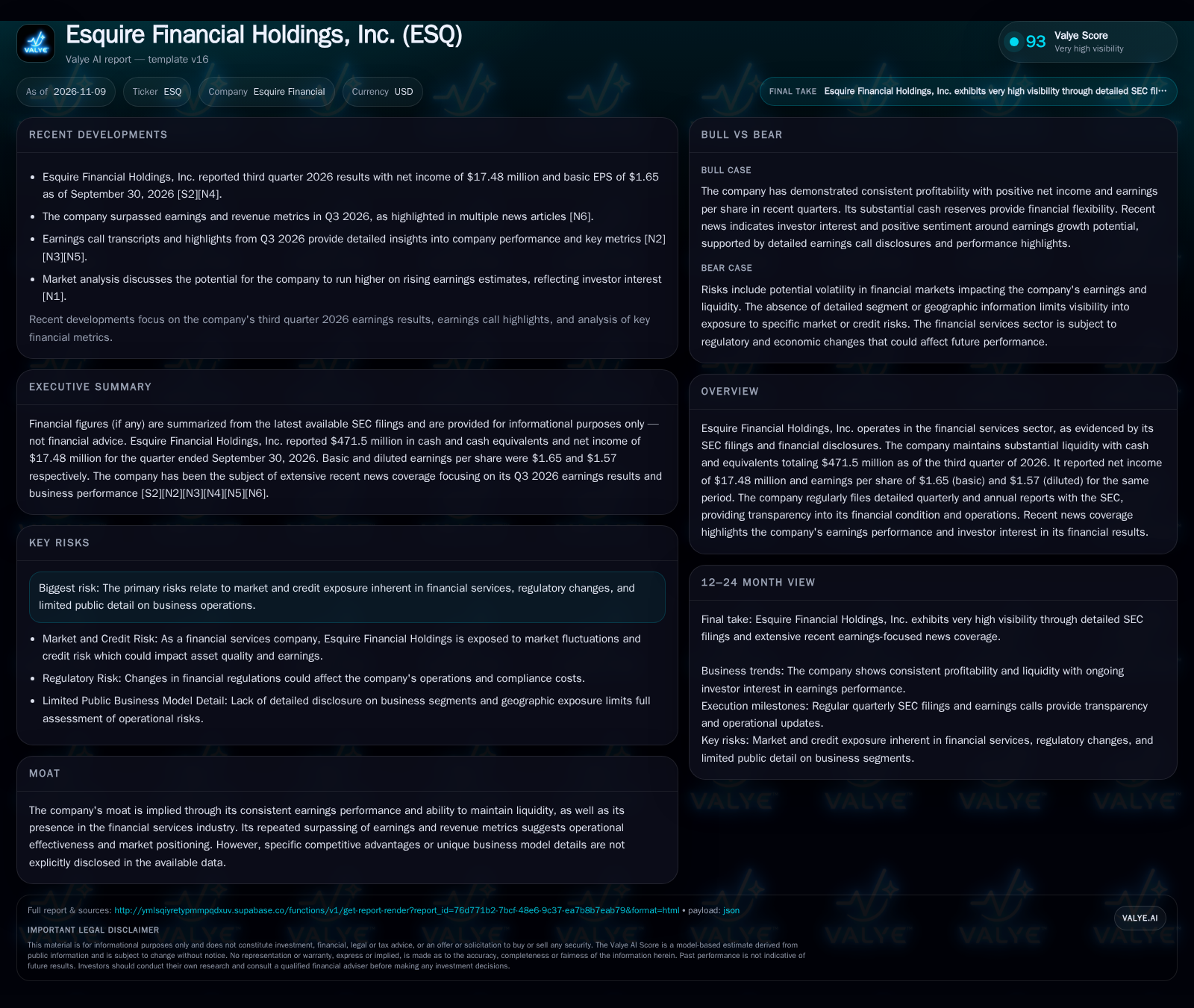
Esquire Financial reported $17.48 million in Q3 2026 net income and holds $471.5 million in cash and equivalents as of September 30, 2026. The company has a pattern of surpassing earnings expectations, which has fueled market attention. However, incomplete public details about its business model and exposure to sector risks moderate the outlook. Sustained earnings growth and transparency will be critical for future valuation and resilience. [S2] [N6]
Esquire Financial Holdings stands out in the financial services sector for its consistent quarterly profitability and reported liquidity position. With $471.5 million in cash and equivalents and Q3 2026 net income of $17.48 million, the company has attracted heightened investor attention, especially as it continues to beat earnings expectations. Still, the lack of granular detail about its business segments and risk exposures leaves open questions about the durability of its earnings outperformance and its ability to navigate sector headwinds. Understanding the mechanics behind its results and monitoring disclosure trends will be central to assessing its long-term trajectory. [S2] [N6]
Recent Profitability and Liquidity Define Esquire Financial’s Current Standing
Esquire Financial Holdings reported net income of $17.48 million for the third quarter of 2026, with basic and diluted earnings per share of $1.65 and $1.57, respectively. As of September 30, 2026, the company held $471.5 million in cash and cash equivalents. Notably, it has established a pattern of surpassing both earnings and revenue estimates in recent quarters, which has intensified investor interest and led to positive market analysis regarding its growth prospects. However, public disclosures remain high-level, with limited insight into the company’s specific business lines, credit exposures, or geographic footprint. This combination of strong headline results and opaque business model details sets the context for both optimism and caution. [S2] [N6]
How Esquire Financial Might Generate Sustainable Returns
As a financial services company, Esquire’s core economics likely depend on the spread between its funding costs and the returns generated from loans, investments, or fee-based services. If it operates primarily as a commercial bank or specialty lender, net interest margin would be a key earnings driver—meaning profitability is sensitive to both the yield on earning assets and the cost of deposits or other funding sources. Operating leverage may be present if the company’s fixed costs (such as compliance, technology, and personnel) are covered by a stable base of recurring revenue, allowing incremental revenue growth to flow more directly to the bottom line.
With $471.5 million in cash and equivalents, Esquire may have flexibility to deploy capital opportunistically, whether through lending, investment, or share repurchases. However, without detailed segment data, it is unclear how much revenue comes from interest income versus non-interest income, such as fees or advisory services. The absence of disclosed asset composition or loan book breakdown makes it difficult to assess risk-adjusted returns or sensitivity to credit cycles. Capital needs and funding stability could become more important if the company seeks to scale or if market conditions shift.
Assessing Esquire’s Position in a Crowded Financial Services Landscape
Esquire competes in a sector dominated by both large national banks and specialized regional or niche financial institutions. Its recent ability to surpass earnings expectations suggests operational effectiveness, but the lack of public detail on its customer base or product suite makes it challenging to pinpoint sources of competitive advantage. If Esquire focuses on underserved or niche markets—such as legal professionals, small business owners, or certain geographies—it could benefit from higher pricing power or lower competition, but this remains speculative without disclosure.
Key counterforces include larger banks’ scale, technology-driven entrants’ efficiency, and the ongoing commoditization of basic lending and deposit products. Regulatory compliance and risk management are also critical, as smaller institutions may face disproportionate costs or challenges compared to their larger peers. The question is whether Esquire’s business model offers defensible switching frictions, unique value propositions, or brand loyalty that can sustain above-average returns through cycles.
Earnings Momentum Translates into Lasting Franchise Value—If Underlying Drivers Prove Durable
The most favorable scenario for Esquire is that its recent streak of beating earnings and revenue estimates reflects genuine competitive strengths, such as superior credit underwriting, product innovation, or a sticky client base. If these advantages persist, the company could continue to compound earnings, reinvest in growth, and potentially expand its market share.
Evidence that would confirm this scenario includes continued outperformance versus peer banks or financial services firms in both earnings growth and asset quality, as well as increased transparency around business lines and risk exposures. Disclosures of durable fee income streams, high retention rates, or proprietary technology platforms would also validate the presence of a sustainable moat. Conversely, if future results show volatility or if new disclosures reveal heavy reliance on cyclical or risky segments, this upside case would weaken.
Solid Earnings, But Visibility Limits Conviction on Longevity
The company may continue to report modest growth and maintain investor interest as long as headline financials remain strong and sector conditions are stable.
This scenario would be confirmed by ongoing quarterly profits, steady or improving net interest margins (if disclosed), and a continued pattern of meeting or slightly exceeding analyst expectations. A lack of material credit losses or regulatory issues would also support the base case. Falsification would come from a sharp reversal in earnings trends, sudden credit or liquidity shocks, or new disclosures that reveal significant concentration risks or business model fragility.
Opaque Exposure or Market Shocks Undermine Profitability and Confidence
On the downside, Esquire’s limited public disclosure on business segments and risk concentrations could mask vulnerabilities to adverse market or credit events. If the company is significantly exposed to higher-risk lending, volatile funding sources, or concentrated client bases, a deterioration in asset quality or a spike in funding costs could rapidly erode earnings and capital buffers. Regulatory changes or compliance failures could also disproportionately impact smaller or less diversified financial institutions.
This scenario would be confirmed by a sudden rise in loan losses (if disclosed), a sharp drop in net interest margin, or a material reduction in cash and equivalents not explained by growth investments. Negative regulatory headlines, restatements, or guidance cuts would further signal emerging stress. Conversely, detailed disclosures showing diversified revenue streams and stable asset quality would help refute this downside risk.
What Will Test Esquire Financial’s Earnings Quality and Resilience?
Quarterly breakdowns of net interest margin and non-interest income, if disclosed, to clarify core earnings drivers and sensitivity to rate changes.
Detailed loan portfolio composition and credit quality metrics, such as non-performing assets or charge-off rates, to assess risk exposure.
Trends in deposit growth, funding mix, and any reliance on wholesale funding channels, which would indicate funding stability or vulnerability.
Regulatory developments or changes in compliance costs that could impact profitability, especially for smaller financial institutions.
Evidence of customer concentration or geographic exposure, which would test the durability and scalability of the business model if disclosed.
Management’s forward guidance or commentary on strategic priorities, including technology investments, new product launches, or expansion plans.
Any new disclosures around fee-based or recurring revenue streams that could diversify earnings and reduce dependence on interest income.
Market reactions to earnings releases and analyst estimate revisions, as a proxy for investor confidence and perceived transparency.
Disclaimer: This is research-only, informational analysis and not investment advice. It may include AI-generated interpretation and general industry context. Always verify important details using primary sources.

Comments