
StepStone Group: Global Expansion, Fee Pressures, and the Evolution of Private Markets Advisory
StepStone Group’s global push and technology-enabled advisory model position it to capture a growing share of private markets allocations, but profitability headwinds and fee variability underscore the importance of execution and scale. The next phase hinges on sustaining client momentum, integrating new geographies, and weathering the volatility inherent in private asset cycles.
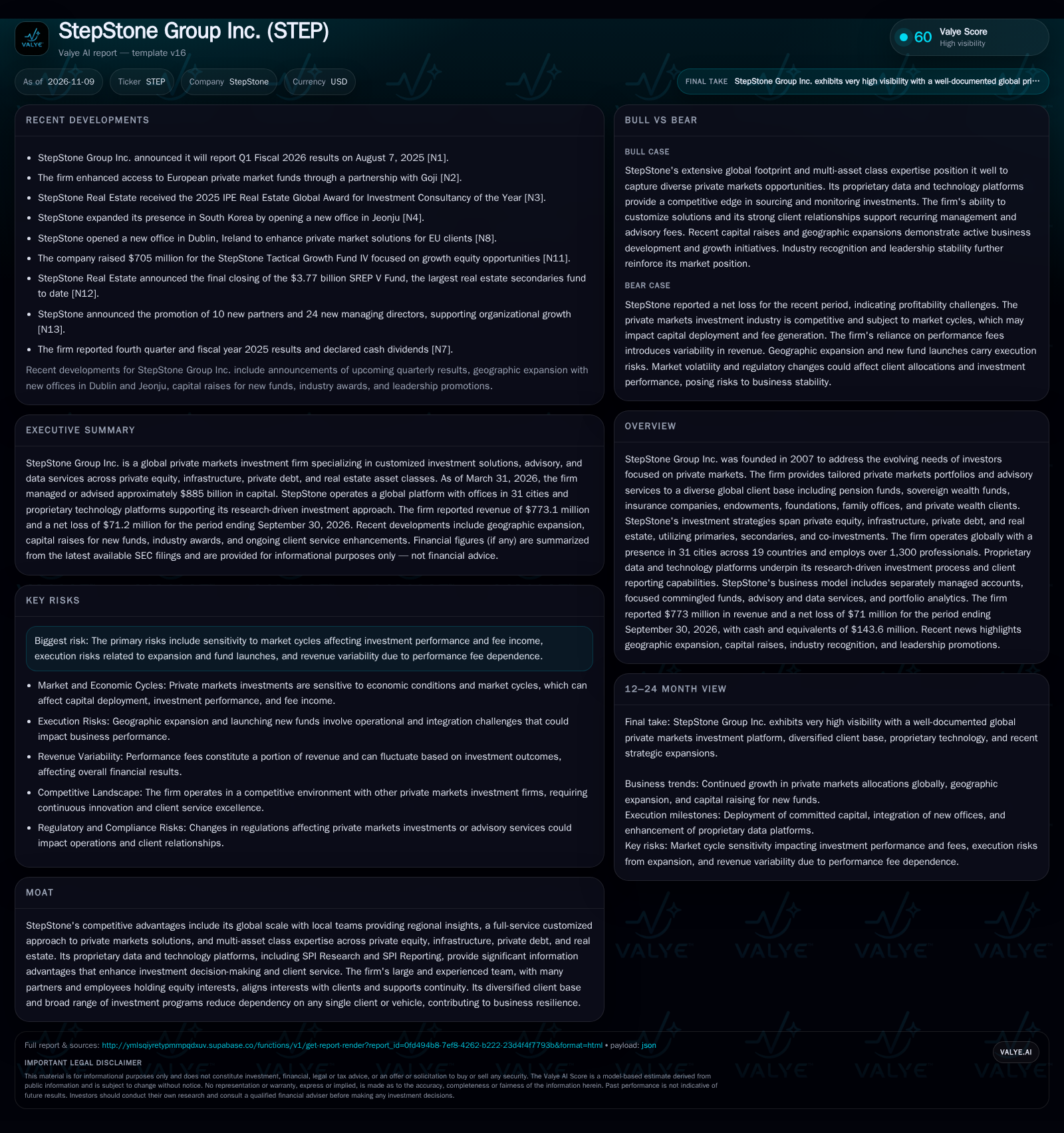
StepStone Group has reinforced its global presence and capital-raising capabilities, but recent net losses underline persistent margin and revenue variability challenges. The business model’s reliance on both recurring and performance-based fees, coupled with geographic and asset-class diversification, offers resilience but also exposes the firm to execution risks and cyclical headwinds. Execution on capital deployment, client retention, and the integration of new offices will be pivotal to StepStone's next growth chapter. [S2] [N4] [N8]
StepStone Group Inc. is navigating a pivotal period marked by ambitious global expansion, robust capital-raising activity, and the ongoing challenge of translating scale into sustainable profitability. As a leading private markets solutions provider, StepStone leverages proprietary data and technology platforms to serve a broad client base across institutional and private wealth channels. Recent developments—including new offices in Europe and Asia and the closure of multi-billion dollar funds—underscore its growth ambitions. However, a recently reported net loss highlights the sector’s inherent fee and performance volatility, raising questions about the scalability and resilience of its business model in the face of market cycles and increasing competition. [S2] [N4] [N8]
Recent Expansion and Profitability Set the Strategic Backdrop
StepStone Group reported $773 million in revenue and a net loss of $71 million for the period ending September 30, 2026, reflecting the firm’s ongoing struggle to convert scale into consistent profitability. The company’s global expansion continues with new offices in Dublin and Jeonju, signaling a deliberate push into European and Asian markets. Recent fundraises—$705 million for a tactical growth fund and $3.77 billion for a real estate secondaries fund—demonstrate StepStone’s ability to attract large pools of capital despite challenging market conditions. These developments matter because they illustrate StepStone’s dual challenge: maintaining growth momentum across geographies and asset classes while addressing margin pressures and the inherent variability in performance-driven fee income. [S2] [N4] [N8]
How StepStone’s Fee Model and Scale Interact with Private Markets Cyclicality
StepStone’s business model monetizes a combination of recurring management and advisory fees, performance-based (carry) fees, and ancillary data/technology services. Management and advisory fees are typically tied to committed capital and assets under management, providing a baseline of relatively predictable revenue. However, performance fees—often a meaningful portion of overall income—are inherently volatile, tied to realized gains and subject to private markets’ long investment cycles.
The firm’s expansion across asset classes (private equity, infrastructure, private debt, real estate) and client segments (institutions, private wealth) may help diversify fee streams and smooth volatility over time. However, growing headcount (over 1,300 professionals) and technology investments increase fixed costs, amplifying the need for scale and operating leverage. If StepStone can efficiently deploy new capital and convert recent fundraises into assets generating both management and performance fees, it could see margin improvement. Conversely, prolonged periods of weak investment realization or subpar returns could pressure both topline and bottom line, especially with elevated fixed costs from global expansion.
Capital needs for the business are moderate relative to direct asset managers, as StepStone primarily earns fees rather than investing its own balance sheet. However, funding organic growth, technology upgrades, and integration of new offices still requires ongoing investment, making cost discipline and capital allocation critical.
Differentiation in a Crowded Private Markets Ecosystem
StepStone competes with a mix of global alternative asset managers, consultants, fund-of-funds, and specialist advisory firms. Its advantages include a broad multi-asset platform, proprietary data/analytics tools, and the ability to tailor solutions across client types and geographies. The recent award for real estate consultancy and strategic partnerships (such as enhancing EU fund access with Goji) reinforce the firm’s positioning as a technology-enabled, solutions-oriented player.
However, the competitive landscape is intense: larger peers may have deeper client relationships and scale, while niche boutiques can offer specialized expertise. Technology is both an opportunity (for reporting, sourcing, and analytics) and a threat, as digital platforms increasingly commoditize portions of the value chain. Furthermore, the rise of direct investing by large institutions and the proliferation of semi-liquid private markets vehicles for wealth clients could erode traditional advisory economics if StepStone fails to continually innovate and demonstrate value-added sourcing, due diligence, and risk management.
Technology-Enabled Scale Drives Margin Expansion and Fee Growth
In an upside scenario, StepStone successfully integrates its new offices and capitalizes on geographic expansion, capturing incremental mandates from both institutional and private wealth channels. Its proprietary data and analytics platforms become a clear differentiator, improving investment outcomes and client reporting, which in turn drives higher retention and wallet share.
The critical causal chain would involve robust deployment of newly raised capital, above-benchmark investment performance, and a migration of more clients to higher-fee customized or data-driven solutions. If management fees on new funds ramp quickly and performance fees benefit from strong exits, operating leverage could improve materially. Evidence confirming this scenario would include a return to sustained profitability, margin expansion in future filings, visible client wins in new regions, and increased adoption of StepStone’s technology solutions by clients.
Diversified Fee Streams Buffer, But Don’t Eliminate, Market Cyclicality
The most plausible trajectory is one where StepStone’s global and multi-asset diversification provides some insulation from private market cycles, but does not fully offset fee and performance variability. Management and advisory fees from existing and new mandates underpin a stable core, while carry income remains lumpy and sensitive to exit timing and market conditions.
The firm continues to open offices and close new funds, but integration costs and competitive fee pressures temper margin improvement. Technology investments support steady client retention, but do not fully transform the economics or drive outsized growth. Evidence supporting this scenario would be continued revenue growth with moderate or fluctuating profitability, stable or gradually rising assets under management, and incremental but not dramatic improvements in operating margin. Conversely, persistent net losses or client attrition in new geographies would challenge this base case.
Global Expansion Outpaces Integration, Fee Pressure Intensifies
In a downside scenario, StepStone’s rapid geographic and product expansion encounters execution challenges—such as ineffective integration of new teams, regulatory hurdles, or cultural misalignment—leading to operational inefficiencies and elevated costs. If private markets experience a cyclical downturn, fundraising and deployment slow, shrinking the pool of fee-generating assets and suppressing performance fees.
Competition intensifies, driving down advisory and management fee rates, especially in commoditizing asset classes and among price-sensitive clients. Technology investments fail to deliver the expected differentiation, resulting in higher costs but not higher revenue. Confirming evidence would include sustained or widening net losses, declining margins, client departures, slower fund closings, and adverse regulatory or compliance developments in new regions.
What Will Test StepStone’s Thesis in the Next Phase
Trends in management/advisory fee rates and the mix between recurring and performance-based revenue in future filings.
Evidence of effective integration—such as client wins, team retention, or operational milestones—in new offices in Dublin, Jeonju, and other recent expansions.
Deployment pace and investment performance of recently closed funds, particularly the $3.77 billion real estate secondaries fund and the $705 million tactical growth fund.
Operating margin progression and cost discipline as technology and geographic investments scale.
Client retention and new mandate win rates, especially in competitive or newly entered geographies—if disclosed.
Adoption curve for proprietary technology platforms by clients (e.g., SPI Research, SPI Reporting)—a useful metric would be client engagement or upsell rates.
Regulatory or compliance developments in key regions that could impact business model or client relationships.
Disclaimer: This is research-only, informational analysis and not investment advice. It may include AI-generated interpretation and general industry context. Always verify important details using primary sources.

Comments