
Amarc Resources Advances BC Porphyry Districts with Strengthened JV Support
Amarc’s latest quarterly report highlights strategic joint venture restructuring and ongoing exploration progress across its British Columbia porphyry projects.
In Q2 2026, Amarc Resources enhanced its operational framework by forming AuRORA Minerals, a private joint venture controlling the JOY District. Freeport-McMoRan holds majority ownership and operates the project, while Amarc serves as primary contractor. Concurrently, active drilling campaigns continued across the JOY, DUKE, and IKE districts, financed largely through joint ventures with Freeport and Boliden. Proximity to key infrastructure supports exploration efficiency. However, reliance on external partners for capital and expertise underscores typical exploration-stage risks. Progress in permitting and geological work positions Amarc to capitalize on favorable metals market conditions amid ongoing financing and regulatory challenges.
Recent Quarterly Developments Clarify Exploration Trajectory and JV Alignments
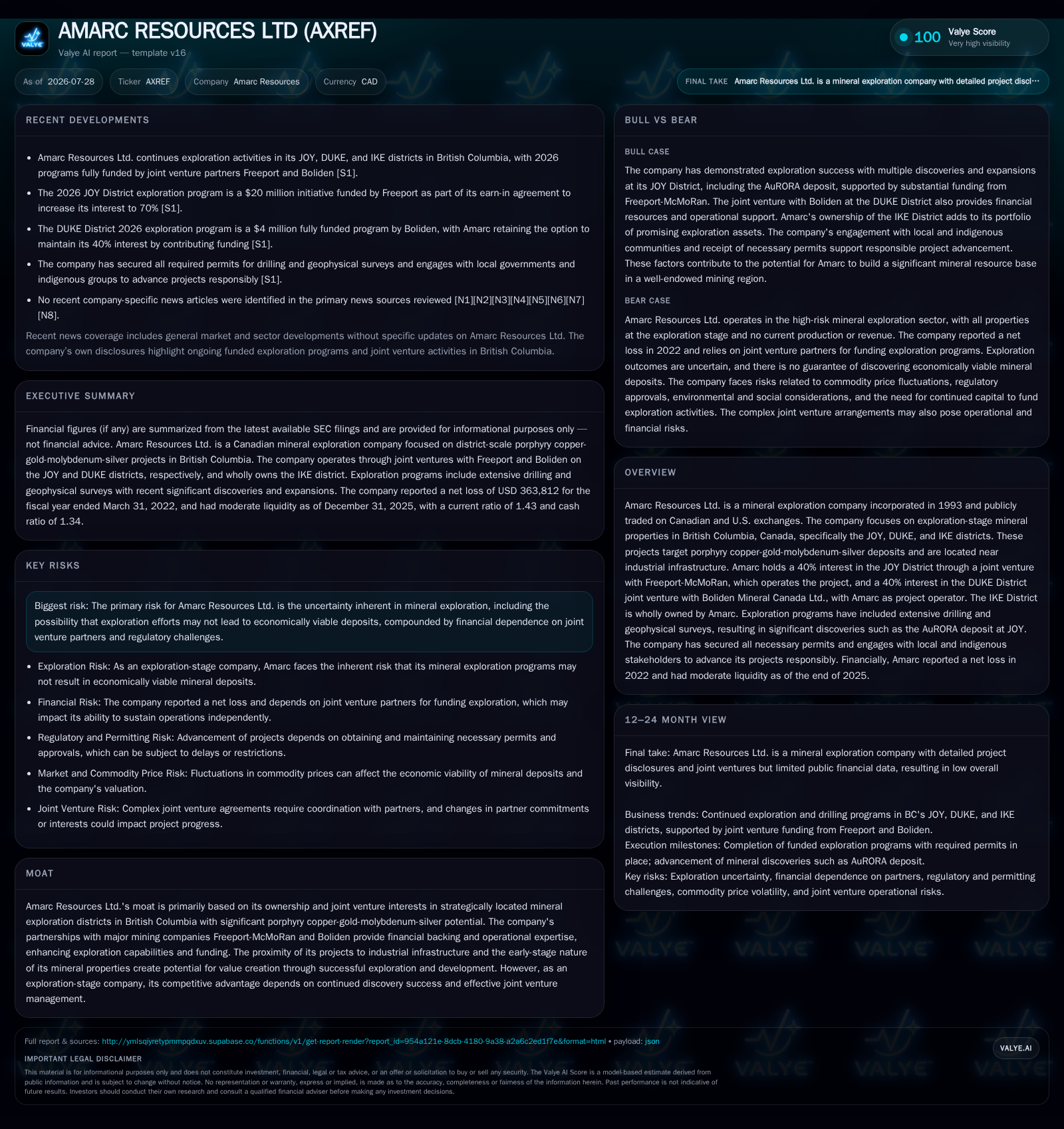
Amarc Resources Ltd. reported in its July 27, 2026 quarterly filing the establishment of AuRORA Minerals Ltd., a private joint venture consolidating the mineral rights and operations within the JOY District. Freeport-McMoRan holds a 60% majority interest and operates the project, while Amarc retains a 40% stake and assumes the role of primary contractor effective August 20, 2026 [S2]. This JV restructuring aims to enhance governance, streamline capital deployment, and leverage Freeport's operational expertise, marking a strategic shift from Amarc's prior operator role at JOY [S1][S2].
Concurrent exploration activities continue at the DUKE District under an earn-in joint venture with Boliden Mineral Canada Ltd., where Amarc serves as operator, and at the IKE District, which Amarc wholly owns and operates [S1][S18]. These three district-scale projects focus on porphyry copper-gold-molybdenum-silver mineralization and benefit from proximity to key industrial infrastructure such as power supply, highways, and rail, which reduces logistical complexity and supports efficient exploration operations [S1][S18].
During fiscal year 2026, Amarc's exploration expenditures totaled CAD 19.2 million, a slight decrease from CAD 22.6 million in fiscal 2025, reflecting sustained drilling activity balanced by partner-funded earn-in programs that share capital requirements and operational risk [S1][S14]. Ongoing permitting progress within British Columbia's stringent regulatory environment has facilitated uninterrupted fieldwork, supporting momentum in resource delineation efforts [S2]. These developments underscore Amarc's evolving business model emphasizing structured collaboration with major mining companies while maintaining technical leadership in project execution.
Business Model Centered on District-Scale Porphyry Exploration Supported by Major Joint Ventures
Amarc's business model focuses on early-stage exploration of large porphyry systems characterized by copper (Cu), gold (Au), molybdenum (Mo), and silver (Ag) mineralization [S1][S18]. The company holds mineral rights across three strategically located districts in British Columbia: JOY (north), DUKE (central), and IKE (south). Each district's proximity to industrial infrastructure—including power grids, highways, and rail—provides a competitive advantage by lowering exploration logistics costs and facilitating potential future development [S18].
As an exploration-stage company, Amarc currently generates no revenue from operations. Funding is primarily sourced through equity raises and joint venture earn-in agreements, which provide capital and technical expertise from established mining operators such as Freeport at JOY and Boliden at DUKE [S1][S18]. These joint ventures enable Amarc to retain significant minority interests (approximately 40%) while leveraging partners’ financial resources to advance capital-intensive drilling programs.
Amarc operates as the project operator at DUKE and IKE, maintaining direct control over technical exploration activities, while at JOY, the formation of AuRORA Minerals transitions Amarc into a contractor role under Freeport’s operational leadership [S2][S18]. Key operational metrics include meters drilled and number of drill holes completed, which serve as proxies for the scale of resource delineation and exploration progress. Permitting status is also critical, ensuring regulatory compliance and uninterrupted field operations amid environmental and indigenous consultation requirements [S2][S18]. Although no mineral reserves have been declared due to the early exploration stage, drill results inform geological models that guide future resource estimation and feasibility assessments [S1].
Industry Context: Junior Exploration Positioning with Strategic Partner Support
Within the North American mineral exploration sector, Amarc occupies a junior exploration role focused on district-scale porphyry copper-gold projects. Its strategic partnerships with major and mid-tier mining companies differentiate it from peers by providing operational leverage and risk-sharing. For example, First Quantum Minerals operates as a junior with exploration and early development focus, while mid-tier developers like Lundin Mining are transitioning toward production [S1][S18]. Amarc remains exploration-focused but benefits from infrastructure adjacency and joint venture collaborations that enhance project viability relative to more remote juniors
Joint ventures are a common industry mechanism to mitigate the high upfront capital requirements and technical risks inherent in mineral exploration. Amarc’s partnerships with Freeport and Boliden not only provide funding but also bring operational expertise critical for navigating complex permitting processes and stakeholder engagement in British Columbia’s mining jurisdiction [S1][S20]. Commodity price cycles influence capital availability; mid-2026 copper prices near US$5.95/lb and gold prices around US$4,423/oz provide a supportive backdrop for continued exploration investment [S17].
Growth Drivers: Strategic Drilling Progression, Permitting Momentum, and JV Funding Stability
Amarc’s ongoing drilling campaigns across JOY, DUKE, and IKE districts advance resource definition, a key driver of project value. Increasing meters drilled and positive drill intercepts serve as leading indicators of potential deposit scale and grade continuity, which are prerequisites for advancing to resource estimation and feasibility studies [S2][S18]. Maintaining a robust permitting pipeline is essential to ensure uninterrupted exploration activities within British Columbia’s rigorous environmental regulatory framework.
The stability of joint venture funding arrangements with Freeport and Boliden underpins Amarc’s ability to sustain exploration programs while mitigating its capital exposure. These partnerships facilitate access to advanced exploration technologies and operational best practices, enhancing the efficiency and effectiveness of drilling campaigns [S1][S2]. Furthermore, the global transition to green energy and associated demand for base metals such as copper and molybdenum provide structural support for the economic potential of Amarc’s projects.
Following the JOY District restructuring, Amarc’s contractor role within AuRORA Minerals may yield operational efficiencies compared to standalone juniors lacking such scale or partner integration [S2]. Continued progress in securing and renewing mining permits supports the company’s trajectory toward more detailed resource assessments, which typically precede pre-feasibility and feasibility study stages.
Risks: Exploration Uncertainty, Financing Dependence, and Regulatory Complexity
Despite positive operational developments, Amarc faces inherent risks typical of early-stage mineral exploration. The possibility of failing to delineate economically viable mineral reserves remains a significant risk case that could materially affect valuation and future financing prospects [S20][S22]. Metal price volatility may influence joint venture partners’ willingness to fund exploration or necessitate dilutive equity raises, impacting shareholder value [S22][S25].
The company’s reliance on joint venture partners introduces strategic alignment risk, where changes in partner priorities or market conditions could constrain funding availability. Operational risks such as drill rig availability, geological complexity, and technical challenges in resource modeling also contribute to timing and cost uncertainties.
Outlook: Key Milestones and Monitoring Points
Upcoming quarterly reports will provide critical updates on drilling progress, including meters drilled and assay results across the JOY, DUKE, and IKE districts, which will inform geological models and resource potential [S2][S3]. Monitoring permit acquisition and renewal status will be essential to assess the continuity of exploration programs within British Columbia’s regulatory framework.
Changes in joint venture agreements, funding commitments, or ownership structures—particularly related to AuRORA Minerals—will signal shifts in financial and operational dynamics. Technical updates on grade consistency and deposit scale at JOY’s AuRORA deposit will be key indicators of discovery trajectory ahead of more capital-intensive feasibility studies.
Metal price trends and provincial or federal regulatory developments affecting mining claims and environmental compliance will provide important context shaping exploration momentum and project economics.
This analysis synthesizes Amarc Resources’ Q2 2026 filings highlighting strategic joint venture formation at JOY alongside ongoing multi-district drilling supported by major partner collaborations. Positioned advantageously near infrastructure within a stable Canadian jurisdiction, Amarc faces typical early-stage exploration risks including financing dependency, regulatory challenges, and commodity price sensitivity, which require ongoing monitoring.
All insights are derived solely from publicly filed documents without speculative forecasts.
Disclaimer: This is research-only, informational analysis and not investment advice. It may include AI-generated interpretation and general industry context. Always verify important details using primary sources.

Comments