
Azitra’s Engineered Skin Microbiome Therapies: Evaluating Clinical Progress and Financial Sustainability
Azitra pursues innovative live biotherapeutic dermatology treatments, advancing clinical candidates amid sustained operating losses and liquidity constraints.
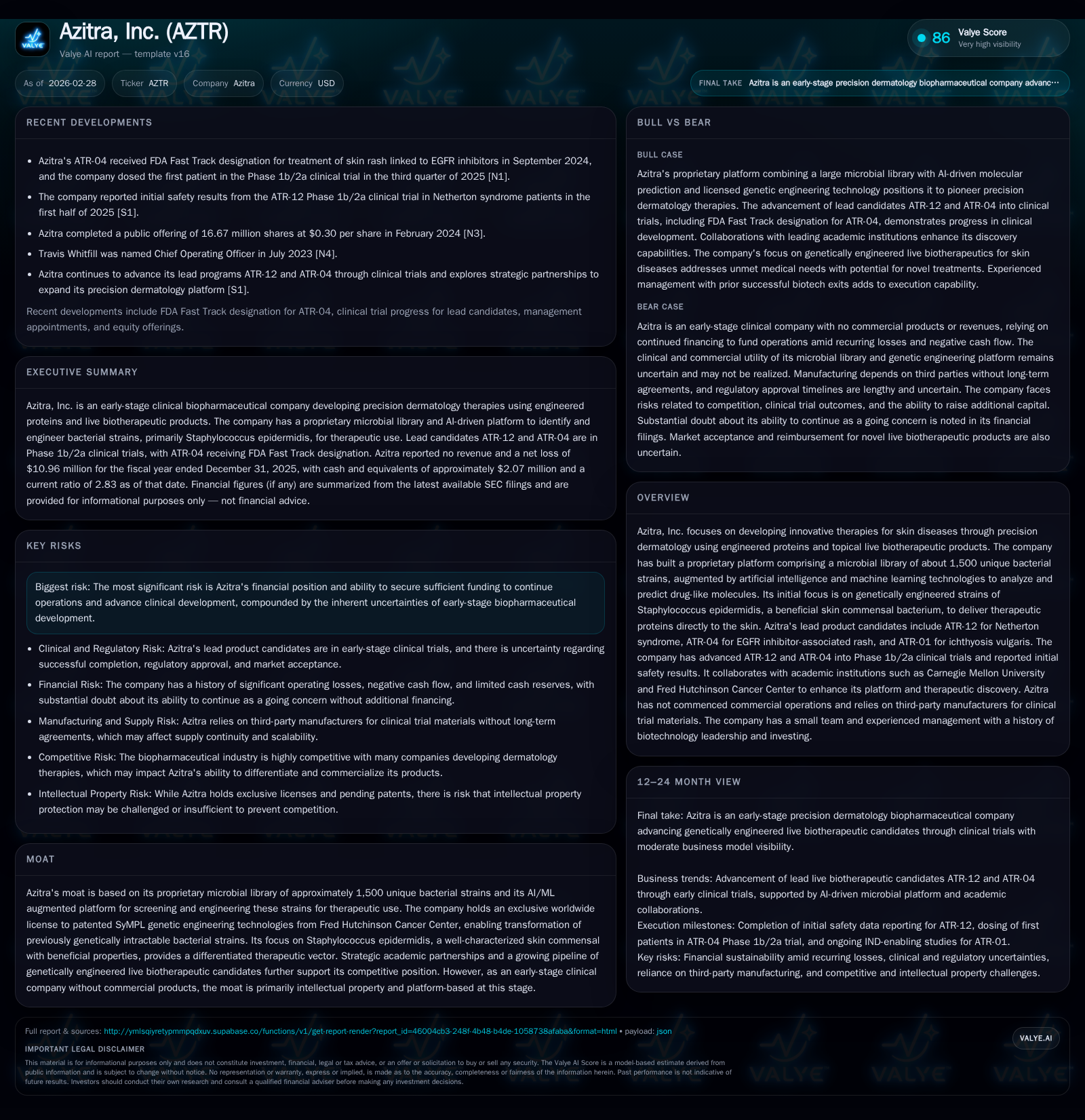
Azitra, Inc. is pioneering genetically engineered bacterial therapies targeting rare and treatment-resistant skin diseases leveraging a proprietary microbial library enhanced by AI-driven drug discovery. Its lead candidates ATR-12 and ATR-04 have progressed into early-phase clinical trials with orphan designations and initial safety data reported, underscoring scientific validation. However, financials reveal zero revenues by FY2025 and over $11 million net losses annually, reflecting the heavy development investment characteristic of early-stage biopharma. Limited cash on hand intensifies funding risk, highlighting the importance of clinical milestones and capital raises for long-term viability.
From Concept to Clinic: Historical Growth and Platform Development
Founded in early 2014, Azitra has cultivated a distinct niche at the intersection of microbiome science and precision dermatology. The company’s core asset is a microbial strain library of approximately 1,500 unique bacterial species isolated primarily from skin commensals. This library provides a rich substrate for identifying bacterial vectors with therapeutic potential in cutaneous diseases. Augmented by artificial intelligence (AI) and machine learning (ML) methodologies, Azitra screens these strains for drug-like molecules that can be genetically engineered to deliver targeted proteins directly to the skin.
Financially, revenues have been minimal given the early clinical nature of operations. In FY2023, total revenues were $686K but diminished precipitously to $7.5K in FY2024 before dropping to zero in FY2025 [F1]. This trajectory reflects a strategic pivot away from any ancillary grant or service income toward full focus on clinical pipeline maturation. Concurrently, operating losses ballooned from roughly -$7.6M in FY2023 to nearly -$11M by FY2025 as R&D expenses swelled alongside expensive platform development efforts [F1].
Historical performance (annual)
| FY | Rev ($) | Net ($mm) | CFO ($mm) | OpInc ($mm) | Rev YoY | Net YoY |
|---|---|---|---|---|---|---|
| 2025 | 0 | -11 | -11 | -11 | -100.0% | -22.2% |
| 2024 | 7500 | -9 | -10 | -11 | -98.9% | +20.5% |
| 2023 | 686000 | -11 | -7 | -8 |
Source: SEC companyfacts cache [F1].
Capital returns and efficiency (annual)
| FY | FCF ($mm) | ROE% |
|---|---|---|
| 2025 | -11 | -288.2 |
| 2024 | -10 | -157.4 |
| 2023 | -7 | -387.3 |
Source: SEC companyfacts cache [F1].
This table encapsulates Azitra's financial evolution through the recent three fiscal years [F1].
Clinical Pipeline Focus: Lead Candidates and Trial Progress
Azitra’s lead programs center on genetically modified strains of Staphylococcus epidermidis, chosen due to their well-characterized roles as beneficial skin commensals capable of delivering therapeutic proteins safely via topical application. The flagship candidate ATR-12 targets Netherton syndrome—a rare autosomal recessive disorder marked by chronic skin barrier dysfunction with significant unmet medical need. The U.S. FDA granted Pediatric Rare Disease designation to ATR-12 in 2019.
On regulatory progress frontiers, FDA notification allowed commencement of a Phase 1b study in early 2023 evaluating ATR-12’s safety in Netherton syndrome patients [S1]. Subsequently ATR-04 has progressed similarly into Phase 1b/2a trials targeting epidermal growth factor receptor inhibitor (EGFRi)-associated rash—a prevalent dermatologic toxicity affecting up to 90% of patients on EGFR inhibitors with no currently approved targeted treatments ; the candidate manifests potential to reduce dose modifications related to rash severity.
Interim safety readouts from these trials have been communicated but detailed efficacy data remain pending [S1]. Both candidates benefit from orphan drug designation status reflecting their status addressing underserved populations—a de-risking factor enhancing regulatory incentives.
Technological Moat: The Microbial Library and Genetic Engineering Platform
Azitra’s sustainable competitive advantage stems from its expansive microbial strain repository combined with proprietary technological capabilities allowing genetic manipulation of traditionally recalcitrant bacterial species. Central here is the exclusive global license to SyMPL genetic engineering technology from Fred Hutchinson Cancer Center enabling transformation of bacterial strains previously considered genetically intractable; this capability extends capacity beyond typical plasmid-based approaches prevalent in microbiome R&D.
The integration of AI/ML tools enables high-throughput screening and predictive analytics across multi-dimensional datasets associated with phenotypic traits relevant for drug development—streamlining candidate optimization cycles . Such synergy between wet-lab microbial science and computational biology positions Azitra uniquely within the nascent live biotherapeutical product field focusing on dermatology—where precise surface colonization patterns and microenvironmental interactions dictate therapeutic outcomes unlike traditional small molecules or biologics.
Navigating Early-Stage Biopharma Risks and Regulatory Complexities
As an early-stage entity without commercial throughput or approved products—and only initial Phase 1b/2a data—the company remains highly vulnerable to common biotech risks encompassing trial failures or delays; challenges scaling manufacturing especially through third-party contract organizations; shifting regulatory landscapes across multiple jurisdictions; complex reimbursement environments pressured by increasing drug price scrutiny; patent defense uncertainties; plus geopolitical factors such as tariffs raise supply chain cost risks [S1], [S2], [S4]–[S6].
Particularly impactful are U.S. healthcare laws governing pharmaceutical sales practices including anti-kickback statutes which require strict compliance efforts [S5], as well as FDA post-marketing obligations like REMS that could arise post approval imposing usage restrictions [S7]. Reimbursement considerations globally add further layers where cost-effectiveness dossiers may be mandatory prior to formulary inclusion restricting market access even if regulatory approval is attained [S6], [S23].
Rare disease patient recruitment challenges also amplify clinical execution risk given limited pools per indication compounded by individualized responses anticipated with live microbial therapeutics requiring careful trial designs.
Financial Snapshot: Operating Losses, Capital Structure, and Cash Position
Azitra recorded no revenue during FY2025 after negligible amounts in previous years due to exclusive focus on pre-commercial clinical development activities [F1]. Consequently operating income remained deeply negative—approximately $-11 million annually since FY2024—with net losses aligned similarly reflecting substantial R&D investments required at this stage.
Operating cash flows mirror this sustained burn exceeding $11 million recently indicating ongoing financing needs alongside modest capital expenditures related presumably to laboratory infrastructure or specialized equipment growth.
At end-FY2025 Azitra held about $2 million in cash equivalents against current liabilities approximating $1 million translating into a current ratio near a comfortable 2.83x—providing some short-term coverage buffer albeit nominal absolute reserve levels warrant caution [F1]. Total equity increased over earlier periods driven likely by financing rounds injecting capital yet still implies a negative return on equity exceeding -280%, underscoring foundational loss-making status inherent with early-stage biopharma research models.
Overall liquidity appears strained relative to ongoing cash burn which could precipitate funding necessity within upcoming quarters unless offset by infusions or partnerships.
Capital Allocation Strategies: Funding Rounds, Cash Burn, and Absence of Dividends/Buybacks
Consistently negative free cash flow generated highlights Azitra’s prioritization on deploying capital toward pipeline advancement rather than shareholder returns—with no dividends declared nor share repurchase activity undertaken historically or recently reported [F1], [S28].
This profile aligns with typical early-stage biotech where reinvestment focuses intensively on clinical studies encompassing patient enrollment costs; regulatory filings; GMP manufacturing scale-up; quality controls; clinician engagement initiatives; plus technology platform refinement.[F1]
Liquidity management remains critical as disclosed risks emphasize sufficiency of funding as paramount operational risk that could impair developmental progression if not adequately addressed through equity or partnership financing strategies given absence of product revenues at foreseeable horizons.[S1],[S28]
What Comes Next: Key Milestones and Industry Catalysts to Monitor
While explicit guidance regarding forthcoming milestones is absent from filings, primary catalysts for monitoring include interim analyses or top-line results from ongoing Phase 1b/2a trials assessing safety—and preliminary signals of efficacy—for ATR-12 and ATR-04 which will materially influence investor sentiment and partner interest.
Regulatory feedback loops following these readouts may facilitate accelerated approvals pathways particularly owing to orphan designations holding strategic value. Additionally watchpoints include possible new collaborations or licensing deals that could provide both validation and capital support while enabling commercial supply chain readiness contingent on later-stage successes.
Given emerging scientific promise coupled with entrenched development risks typical in live biotherapeutic modalities for dermatology—a relatively novel class—strategic progression hinges heavily on navigating this inflection period efficiently.
Conclusion: Balancing Innovation Potential Against Operational and Financial Constraints
Azitra occupies a compelling technological niche harnessing genetically engineered microbial vectors for dermatological disease intervention—a field representing paradigm shift beyond conventional APIs toward live biologics precision-engineered at the strain level. The proprietary microbial repository combined with exclusive transformation licensing forms a defensible intellectual property moat underpinning this innovation frontier.
Nonetheless the company’s journey typifies quintessential early-stage biotech challenges: significant operating losses persist without revenue generation while limited cash reserves elevate execution risk absent successful capital raises or partnerships. Clinical proof points emerging from lead candidates will be decisive in validating therapeutic hypotheses driving future value creation prospects.
Investors should weigh Azitra’s promising scientific foundation against inherent developmental uncertainties accentuated by financial sustainability questions typical prior to commercial launch phases.
This report was prepared solely for informational purposes based on publicly available SEC filings and company disclosures as of February 28, 2026. It does not constitute investment advice or recommendations.
Disclaimer: This is research-only, informational analysis and not investment advice. It may include AI-generated interpretation and general industry context. Always verify important details using primary sources.

Comments