
Banc of California's Post-Merger Growth and Capital Strategy Reflects Relationship Banking Focus
Following its 2023 merger with PacWest Bancorp, Banc of California advances its regional presence with growth in deposits, loan portfolio diversification, and capital allocation discipline.
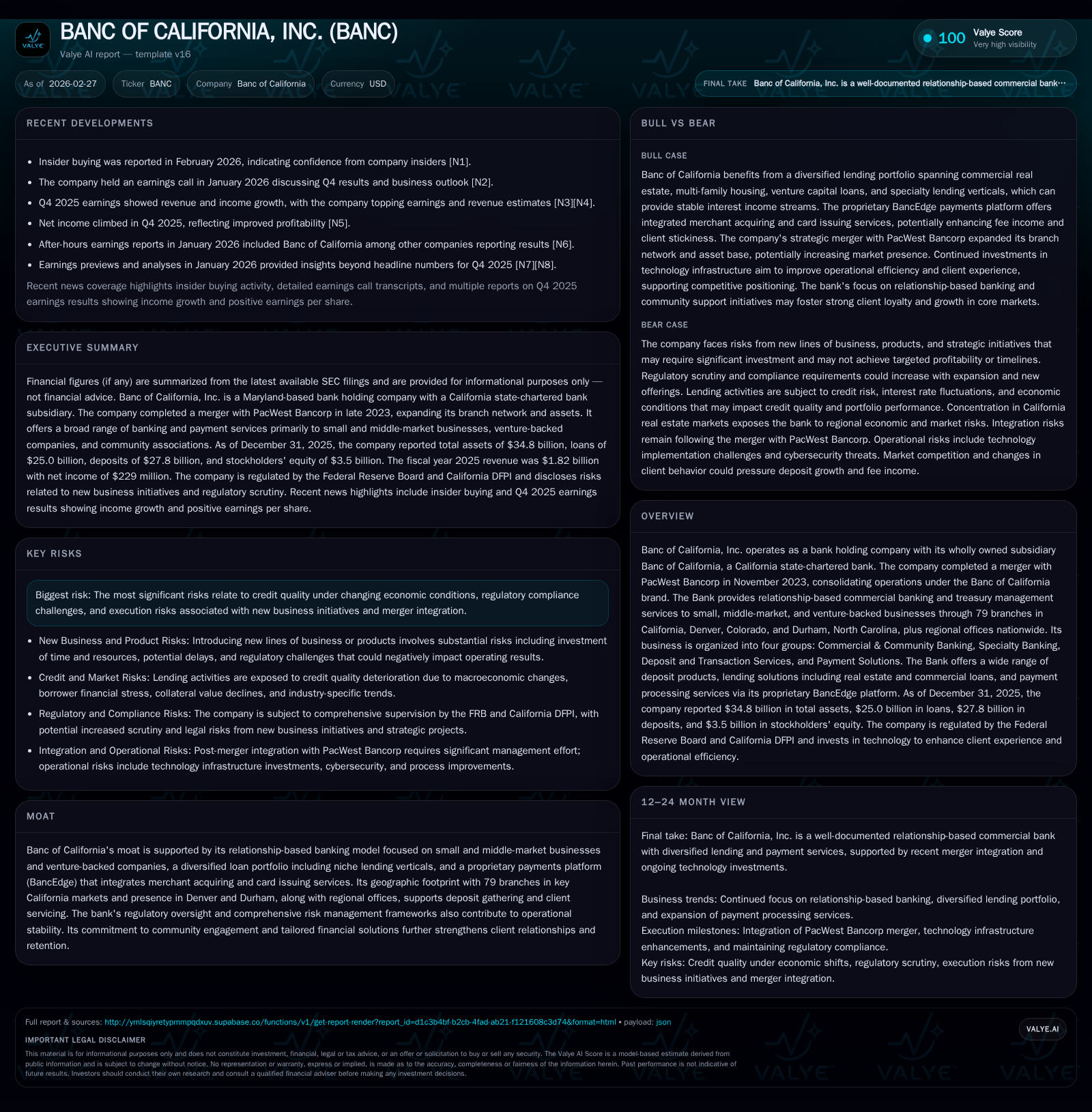
Banc of California, Inc. solidified its footprint through the November 2023 merger with PacWest Bancorp, expanding its branch network and geographic reach notably within California, Denver, and Durham. The bank emphasizes relationship-driven commercial banking segments including venture-backed businesses and niche lending verticals aided by its proprietary payments platform BancEdge. Fiscal 2025 saw top-line decline modestly by 3.8% but net income rebounded sharply by over 80%, supported by robust credit quality management and integration synergies post-merger. Liquidity remains ample with diversified funding sources and comprehensive risk frameworks. Capital allocation highlights include a stock repurchase program initiated in early 2025 and a consistent dividend policy declared in early 2026. Forward growth will hinge on successful strategic execution while navigating regulatory compliance risks and macroeconomic pressures.
Company Overview and Post-Merger Positioning
Banc of California, Inc., operating primarily through its wholly owned subsidiary Banc of California (the Bank), is a relationship-focused commercial bank headquartered in Los Angeles. The transformative merger with PacWest Bancorp finalized on November 30, 2023 marked a pivotal expansion—the combined entity retained the Banc of California brand while broadening its footprint to 79 branches across key Californian markets plus Denver, Colorado, and Durham, North Carolina [S1][S8].
The merger was accounted for as a reverse acquisition with PacWest as the acquirer for accounting purposes though Banc of California remained the legal parent. Financial results post-November 2023 reflect consolidated operations [S1]. A successful $400 million equity raise accompanied the transaction to bolster the capital base.
Historical Financial Performance
The company’s revenue reached approximately $1.82 billion for FY2025 representing a decline of about 3.8% from $1.89 billion in FY2024 [F1]. This slight contraction masks substantive underlying shifts including loan portfolio realignment, deposit base stabilization, and prudent margin management post-merger integration.
Net income rebounded dramatically from $126.9 million in FY2024 to $229 million in FY2025 (+80.5%), reversing losses experienced in 2023 when write-downs related to merger adjustments weighed heavily on results [F1]. This improvement reflects both enhanced operational efficiencies achieved through consolidation efforts and maintaining credit discipline under evolving economic conditions.
Operating cash flow surged over twofold to approximately $256 million in FY2025 up from $77 million the prior year driven by improved earnings quality and effective working capital deployment [F1]. Capital expenditures increased moderately to about $21 million as investments were made in technology upgrades critical for supporting new business lines like payment solutions.
Historical performance (annual)
| FY | Rev ($mm) | Net ($mm) | CFO ($mm) | Capex ($mm) | Rev YoY | Net YoY |
|---|---|---|---|---|---|---|
| 2025 | 1819 | 229 | 256 | 21 | -3.8% | +80.5% |
| 2024 | 1890 | 127 | 77 | 13 | +24.1% | +106.7% |
| 2023 | 1523 | -1899 | 136 | 15 | -1670.3% | |
| 2022 | 121 | 136 | 4 |
Source: SEC companyfacts cache [F1].
Capital returns and efficiency (annual)
| FY | Buybacks ($mm) | FCF ($mm) | ROE% |
|---|---|---|---|
| 2025 | 0 | 235 | 6.5 |
| 2024 | 64 | 3.6 | |
| 2023 | 121 | -56.0 | |
| 2022 | 75 | 132 | 12.6 |
Source: SEC companyfacts cache [F1].
Note: Dividend amount not detailed explicitly; buybacks paused after Q3-25 completion per filings.
Business Model and Growth Drivers
Banc of California organizes its operations into four main segments: Commercial & Community Banking (CCB), Specialty Banking, Deposit & Transaction Services, and Payment Solutions [S8]. Its client base centers on small-to-middle-market firms including venture-backed startups—a segment less penetrated by large national banks—supporting a moat based on deep relationship banking.
Loan products span real estate mortgages (commercial and construction), asset-based lending, SBA loans, equipment finance, media & entertainment financing, warehouse lending for mortgage originators, and niche verticals such as homeownership associations via SmartStreet™, an innovative digital management platform [S8]. Complementing lending is the proprietary payments processing platform BancEdge which integrates merchant acquiring and card issuing capabilities enhancing fee generation.
Deposit gathering benefits from a wide branch network strategically located in high-growth California markets plus expansion into Denver and Durham allows access to new entrepreneurial ecosystems particularly attractive for venture banking.
Key growth catalysts include loan book expansion aligned with regional economic recovery trends; cross-selling payment services leveraging BancEdge technology; further penetration into specialized industry niches; and targeted deposit acquisitions focused on noninterest-bearing accounts supporting stable low-cost funding [S8][N2][N3].
Liquidity Profile & Funding Structure
The bank maintains a strong liquidity position managed via both primary (on-balance sheet assets like cash equivalents and marketable securities) and secondary (secured borrowing capacity at the Federal Home Loan Bank (FHLB) and Federal Reserve Bank of San Francisco (FRBSF)) sources.
As of late-2025 quarters, primary liquidity hovered around $4.4 billion representing roughly 13% of total assets while secured borrowing capacity across FHLB/FRBSF totaled over $10 billion . Brokered deposits are managed carefully due to cost sensitivity but remain a component supplementing core granular relationship deposits.
Maintaining cash reserves allows cushioning against deposit volatility amid competitive pressures or macro uncertainties while supporting anticipated loan demand [S6][S11]. The Management Finance Committee continuously monitors liquidity metrics aligned with risk appetite parameters.
Capital Allocation & Shareholder Returns
Following post-merger capital raising activities totaling $400 million equity infusion in November 2023 [S1], Banc of California has emphasized disciplined capital deployment.
A notable initiative is the stock repurchase program authorized initially at $150 million in March-25 then expanded to $300 million by April-25 covering common stock plus preferred depositary shares [S20][S23][S28]. Through Q3-25 roughly $185 million was deployed repurchasing over thirteen million shares at an average price near $13.60 per share demonstrating commitment to returning excess capital amid favorable valuation levels [F1].
Dividend policy remains intact with quarterly common dividends set at $0.12 per share declared early-2026 [S3][N8], balancing shareholder returns while preserving capital adequacy for growth investments.
Return on equity approximated at about 6.5% for FY2025 aligns with steady earnings recovery while leaving room for operational leverage improvements alongside loan portfolio growth [F1].
Risks & Challenges
Risks articulated prominently include those related to credit quality given potential macroeconomic headwinds affecting borrowers primarily concentrated in commercial real estate or venture-backed enterprises [S16]. Maintaining rigorous underwriting standards is critical amid uncertain interest rate environments.
Regulatory compliance poses challenges especially given increasing oversight by FRB/DFPI covering consumer protections, anti-money laundering scrutiny relating to fintech partnerships such as those underpinning payment processing offerings like BancEdge [S16][N9]. Cybersecurity threats have grown more complex particularly with AI-enabled fraud methodologies requiring sustained investments in defense capabilities.
Integration risks associated with the PacWest acquisition persist although management reports progressing toward synergy targets without material disruption so far [N1]. Delays or cost overruns on technology initiatives could impair competitive positioning.
Outlook & Monitoring Points (Analysis)
While explicit company forecasts post-FY25 are not provided publicly yet monitoring indicators will include:
- Loan growth rates particularly within Specialty Banking production verticals,
- Deposit mix shifts emphasizing growth in low-cost core deposits versus brokered,
- Efficiency ratios improvement tracking expense synergies,
- Credit quality metrics including nonaccrual loans ratio trajectory,
- Regulatory feedback especially concerning fintech oversight,
- Capital return program progression including potential future buyback authorizations or dividend adjustments.
Success will depend heavily on continued execution strength integrating new platforms like SmartStreet™ alongside deepening client relationships across geographic hubs extending beyond legacy footprints.
This analysis is intended solely for informational purposes regarding Banc of California’s recent performance trends and industry context as reported through public disclosures up to February 27, 2026. It does not constitute investment advice or recommendations.
Disclaimer: This is research-only, informational analysis and not investment advice. It may include AI-generated interpretation and general industry context. Always verify important details using primary sources.

Comments