
Concrete Pumping Holdings: Scaling National Lead Through Fleet Optimization and Waste Management Integration
Concrete Pumping Holdings leverages its expansive equipment fleet and integrated waste services to reinforce market leadership amid construction cyclicality.
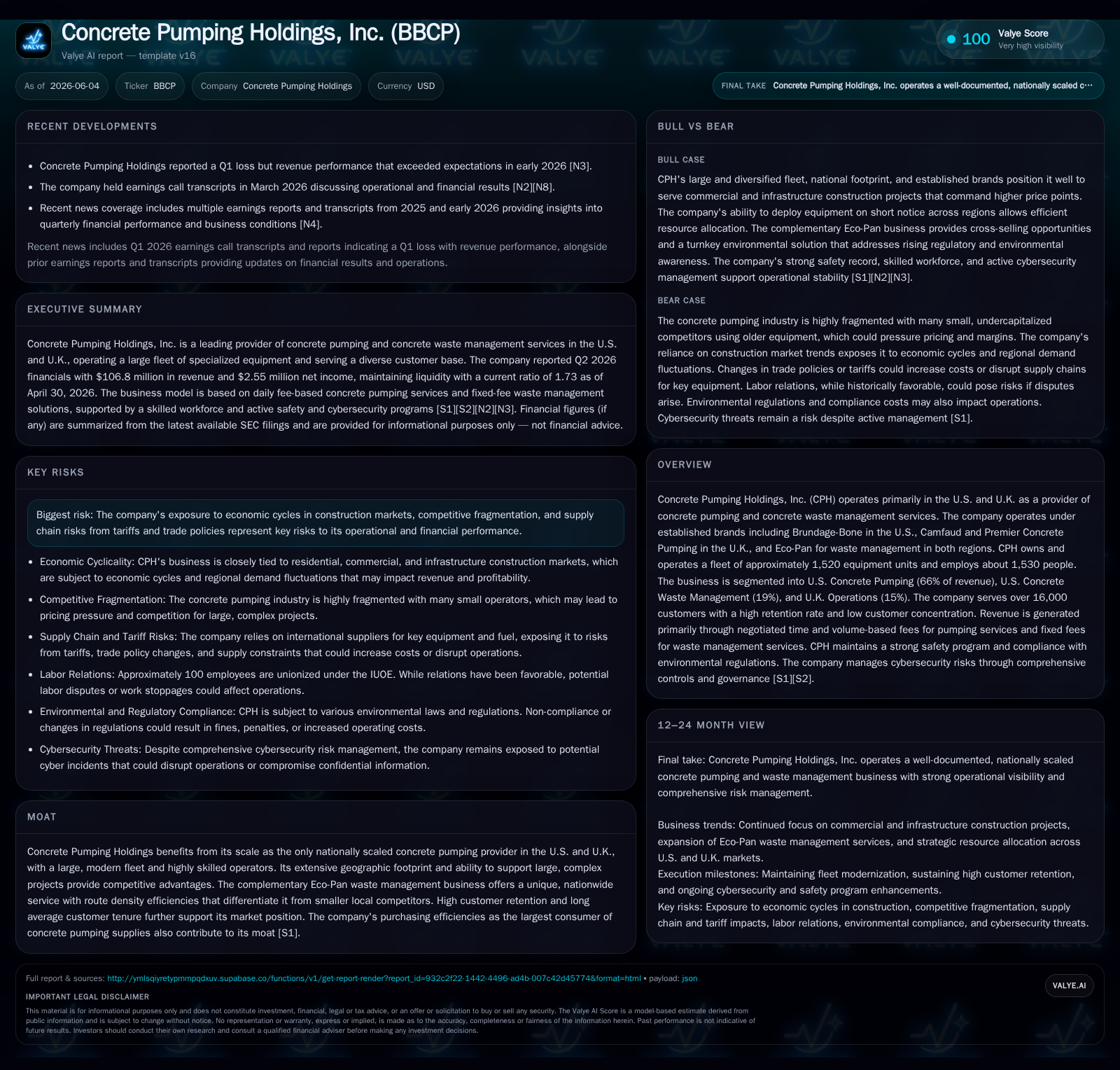
In its second quarter fiscal 2026 filings, Concrete Pumping Holdings (CPH) reaffirmed stable operating execution anchored by its unmatched national footprint in the U.S. and U.K. concrete pumping markets. The company’s dual focus on fleet modernization and waste management route density continues to bolster customer retention and pricing power, distinguishing it from fragmented regional peers. Despite broader construction sector cyclicality, CPH’s diverse customer base, technical specialization, and cross-segment integration underpin resilience and growth opportunities.
Quarterly Operating Update: Key Takeaways from Q2 FY2026
Business Model and Revenue Drivers: High-Specialization Fleet Services Plus Waste Management
CPH generates revenues primarily via two complementary streams: specialized concrete pumping services billed on negotiated time-and-volume bases and concrete waste management billed on fixed fees under the Eco-Pan brand ([S1], [S8]). The company’s pumping segment requires truck-mounted boom pumps operated by extensively trained personnel capable of precisely delivering ready-mix concrete across complex sites—a service that commands premium pricing especially on infrastructure and large commercial projects.
Eco-Pan’s concrete washout management offers a turnkey solution encompassing watertight container delivery/pickup, environmental disposal compliance, and site-specific usage fees ([S1]). Its fixed-fee pricing facilitates predictable revenues while multiple pan pickups per truck route optimize cost efficiency through route density advantages unique in the market. This contrasts with simpler local competitors lacking comparable scale or service breadth.
Across these lines of business, CPH serves more than 16,000 customers diversified across commercial, infrastructure, and residential end markets with low customer concentration—the top ten clients represent less than 10% of revenue but average over 25 years’ relationship tenure ([S7]). Such long-standing relationships underpin recurring revenue streams and confer structural switching costs.
Industry Structure and Competitive Position: From Fragmented Local Players to National Scale Economies
The concrete pumping industry remains highly fragmented in both the U.S. and U.K., dominated by numerous small regional players typically operating fewer than ten pumps apiece ([S9]). By contrast, CPH is the only nationally scaled provider spanning approximately 95 U.S. locations with around 1,000 boom pumps plus an additional ~370 units servicing the U.K. market ([S7], [S9]). This scale enables substantial purchasing efficiencies (including bulk fuel procurement and capital equipment sourcing from major pump manufacturers like Schwing and Putzmeister) that competitors cannot easily replicate ([S28]).
Similarly, the Eco-Pan waste management operations benefit from route density—multiple pan collections per truck trip increase asset productivity—delivering higher profit margins compared to smaller local waste operators offering more limited service footprints ([S1], [S7]). This multi-pronged national presence allows CPH to quickly allocate operators and equipment in response to geographic demand shifts or project timing nuances.
Operational Strengths: Fleet Modernization, Skilled Operators, and Route Density Efficiencies
Maintaining a modern fleet averaging about eight years old ensures CPH’s capacity to handle technically demanding projects requiring placing booms ranging from 20 to over 65 meters ([S7]). The company employs approximately 880 highly skilled operators trained rigorously not only in concrete placement but also in mechanical upkeep; this training depth produces superior service quality versus fragmented competitors reliant on less-experienced labor pools ([S7]).
Route density is a critical profitability driver within Eco-Pan’s waste management business; trucks equipped for multiple pan pick-ups reduce fuel consumption per job site visit while maximizing truck utilization ([S8]). This operational sophistication contributes directly to securing tighter gross margins relative to industry norms.
Growth Drivers: Geographic Expansion, Targeted Market Penetration, and Service Integration
CPH continues to expand geographic reach organically as well as through strategic acquisitions such as the recently closed April 2026 Templant Hire Limited deal in the U.K. market ([S22]). These transactions enhance local market presence while adding complementary equipment or operational competency.
Incremental participation in residential construction projects supplements core commercial/infrastructure segments showing greater cyclical resilience. Cross-selling Eco-Pan washout services into existing pumping client accounts leverages installed customer relationships yielding higher wallet share per project. Given robust customer retention rates above 90% for top-tier accounts ([S7]), this upsell opportunity is scalable.
Operationally, margin expansion prospects stem from improved fleet throughput during construction upswings alongside sustainable price adjustments achievable due to CPH's specialized capabilities versus commoditized providers.
Risks and Constraints: Construction Cyclicality, Supply Chain Challenges, and Competitive Fragmentation
Consistent with prior disclosures ([S2]), cyclical headwinds in underlying construction activities remain a pivotal risk affecting pumping volume utilization and overall demand during economic slowdowns. Additionally, supply chain vulnerabilities related chiefly to capital equipment deliveries continue given global trade uncertainties impacting core suppliers.
Competitive dynamics remain fragmented with many small operators competing primarily on price; however, CPH’s differentiated scale advantages mitigate direct margin erosion risk. No new material legal or cybersecurity issues arose during the latest filing period ([S2], [S3], [S4]).
Outlook: What Investors Should Watch Next
Near-term indicators to track include Q3 fiscal volume trends across commercial infrastructure segments signaling recovery or softness in backlog conversion. Monitoring incremental penetration rates of Eco-Pan services into existing geographies will provide clarity on cross-segment growth traction.
Management commentary around pricing strategies responding to input cost inflation or wage pressures will also be insightful given labor skill specialization requirements. Lastly, potential future bolt-on acquisitions could offer opportunistic boosts to regional cluster density or capability sets enhancing competitive barriers.
Financial Snapshot: Liquidity, Debt Profile, and Capital Allocation Considerations
As of April 30, 2026, Concrete Pumping Holdings held approximately $38.7 million in cash against total debt just over $425 million resulting in net debt near $387 million ([F1]). While leverage reflects investment in fleet scale expansion financing capital-intensive equipment purchases prevalent in this asset-heavy sector, consistent cash flow generation supports manageable debt servicing.
Capital expenditures prioritizing modernizing fleets alongside disciplined working capital management align well with continuing strategic growth initiatives without material balance sheet stress evident at quarter-end ([F1], [S2]).
This analysis reflects data as of the company's most recent quarterly filing dated June 4th, 2026. It focuses exclusively on publicly disclosed information without forward-looking projections or investment research views.
Disclaimer: This is research-only, informational analysis and not investment advice. It may include AI-generated interpretation and general industry context. Always verify important details using primary sources.

Comments