
Brandywine Realty Trust’s Concentrated Portfolio Shows Resilience in Office and Mixed-Use Leasing
The company’s Q2 2026 results affirm steady occupancy and leasing activity amid macroeconomic challenges in office real estate.
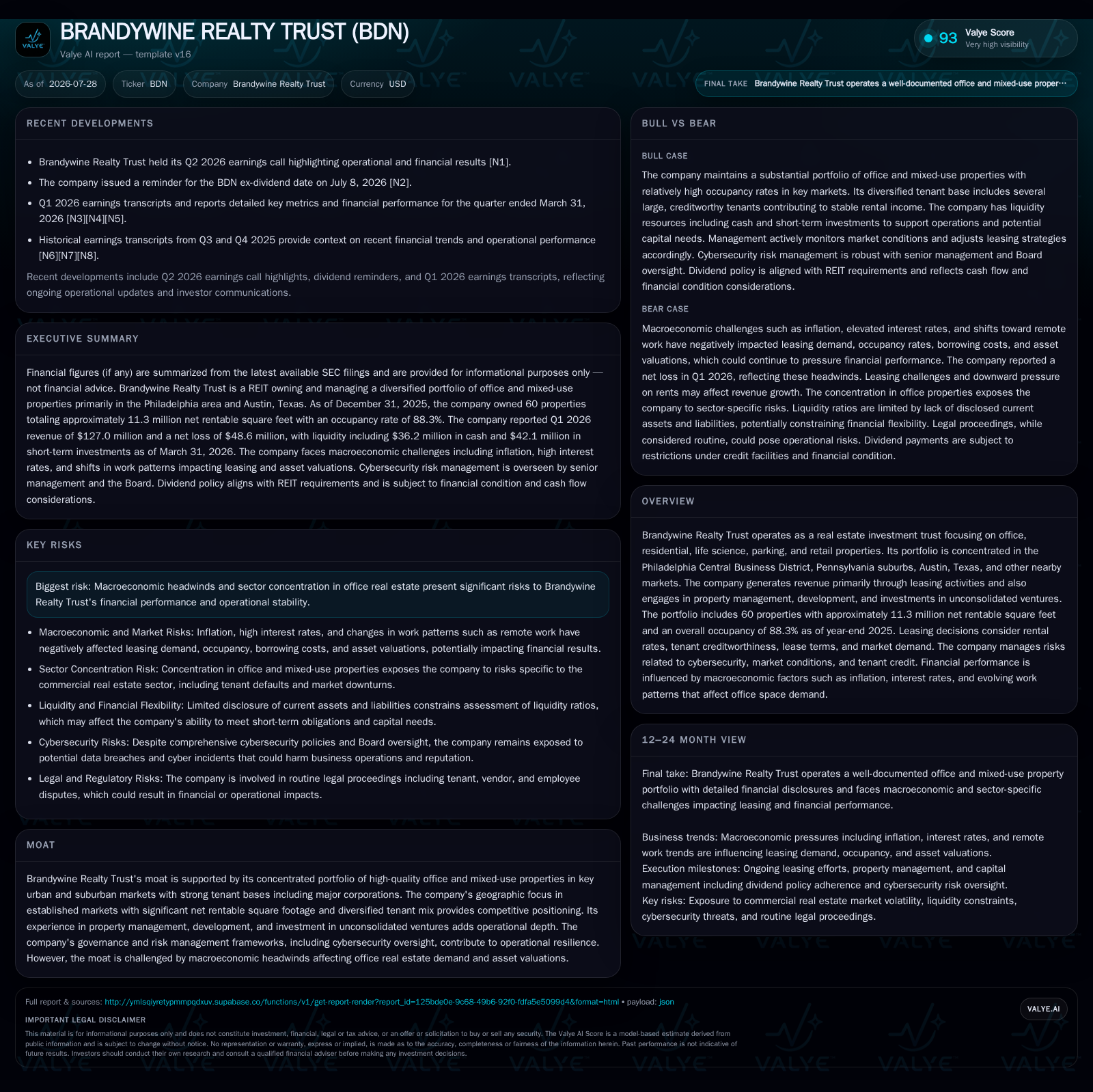
Brandywine Realty Trust reported stable occupancy of 88.3% across its core properties as of year-end 2025, complemented by consistent leasing velocity and average rental rates sustained through Q2 2026 despite inflationary and interest rate pressures [S1][S2][N1]. The firm’s concentrated portfolio in Philadelphia CBD, Pennsylvania suburbs, and Austin balances scale economies with geographic risk exposure, while active development projects and joint venture investments provide incremental growth avenues [S1][S2]. Tenant credit quality remains a cornerstone of revenue stability, supported by proactive property management and cybersecurity governance [S1]. However, sector-wide headwinds from evolving work patterns and rising debt costs warrant close monitoring. The capital structure reflects significant leverage with debt totaling approximately $2.63 billion net of cash as of Q1 2026, necessitating vigilant covenant compliance and refinancing discipline [F1][S2].
Quarterly Performance Highlights Reflect Sustained Occupancy Amid Sector Headwinds
Brandywine Realty Trust's latest quarterly filing for Q2 2026 confirms that the company continues to maintain solid occupancy figures within its core portfolio despite ongoing macroeconomic headwinds challenging the office REIT sector. As of December 31, 2025, the core properties—consisting predominantly of office but also including mixed-use spaces—were occupied at approximately 88.3%, encompassing about 11.3 million net rentable square feet spread over 60 properties [S1]. This level of occupancy reflects sustained leasing demand even as inflationary pressures create upward cost dynamics that could pressure net operating income (NOI).
The Q2 earnings call highlighted that leasing velocity remains robust with new lease signings and renewals occurring at rental rates consistent with or exceeding market expectations in targeted metro areas such as Philadelphia CBD and Austin [N1][S2]. These outcomes evidence Brandywine's active property management strategies successfully mitigating broader market softness. The capacity to maintain stable NOI amidst these conditions suggests an operational resilience compared to peers experiencing more pronounced vacancy spikes or rent rollbacks.
Leasing Dynamics Anchored by Tenant Credit Quality and Active Property Management
Brandywine emphasizes tenant creditworthiness as a fundamental pillar supporting its cash flow stability [S1][S2]. The company's lease underwriting carefully balances market rental rates with assessments of tenant financial strength and lease term structures to mitigate default risks—a critical factor given uncertainties arising from shifts in workplace utilization patterns
Property management overlays include investments in tenant improvements and leasing commissions designed to sustain high retention rates [S1]. These expenditures address evolving tenant demands driven by hybrid work models requiring flexible space configurations. Moreover, Brandywine's comprehensive cybersecurity incident response protocol under senior leadership—including oversight by a seasoned Chief Technology and Innovation Officer—adds operational security alignment rarely detailed explicitly by peers but increasingly vital as technology undergirds property operations
Geographic Concentration Balances Risk and Competitive Advantage in Urban Core Markets
The company’s portfolio concentration principally in Philadelphia’s Central Business District, surrounding Pennsylvania suburbs, Austin Texas, along with strategic exposure in Washington D.C., Southern New Jersey, and Wilmington Delaware presents a dual-edged dynamic. On one hand, geographic focus permits deep market knowledge enabling tailored leasing strategies and fosters scale efficiencies in property operations [S1]. On the other hand, such clustering elevates regional economic event risk.
Compared to large-scale diversified office REITs like Boston Properties or SL Green Realty—which maintain multimetropolitan diversification—Brandywine’s focused metro footprint may expose it disproportionately to localized economic downturns or sector-specific disruptions (e.g., tech sector contractions affecting Austin). Lease expiration schedules within concentrated markets warrant ongoing scrutiny to assess renegotiation risks that could influence revenue continuity [S1][S2]
Development Operations Complement Leasing with Value-Add Growth Potential
Brandywine supplements its stabilized leasing base with development and redevelopment pipelines comprising three identified projects including expansions into the life science property segment—a growth area for commercial real estate due to increased demand for specialized lab and research facilities [S1][S2].
Capital expenditures toward tenant improvements (~$74 million recently) alongside redevelopment investments support yield enhancement potential through re-leasing existing space at higher rents or repositioning assets for alternative uses aligned with market demand shifts. Investments into unconsolidated ventures diversify exposure without proportionately increasing consolidated debt burdens.
While these programs present avenues for incremental NOI expansion beyond stabilized assets, they carry execution risks typical of development: timing delays, cost overruns, or suboptimal lease-up post-completion which could pressure near-term cash flows if unmitigated.
Macroeconomic Fluctuations: Interest Rates, Inflation, Remote Work Pressure Risks Weighed Against Diversification Approach
Broader sector challenges persist for office-focused REITs given secular changes such as remote work adoption reducing traditional office footprint demand. Inflation has elevated property operating costs not fully recouped through pass-through lease mechanisms due to tenant concession requirements in competitive markets [S1]. Interest rate hikes inflate borrowing costs impacting interest expense.
The company's proactive governance framework addressing cybersecurity risks adds operational confidence amid heightened digital threats which pose reputational or disruption hazards beyond pure financial issues.
What To Watch Next: Milestones Heading Into Fiscal Q3 With Operational KPIs & Capital Deployment Insights
Going forward into Q3 and beyond, investors should monitor key benchmarks including:
- Leasing velocity metrics: pace of new leases signed versus expirations will reveal absorption trends,
- Average rental rate per square foot movement reflecting pricing power amid competitive supply,
- Tenant retention analytics indicating stability or erosion of income streams,
- Development project milestones: delivery dates and lease-up progression especially for life science spaces,
- FFO trajectory signals confirming cash flow adequacy relative to dividend commitments. These indicators will test whether current resilience sustains under shifting market dynamics or if deterioration begins asserting material impact.
Financial Profile Discussion: Capital Structure Navigated Prudently But Sensitive to Market Cycles
Dividend payment policies remain dependent on FFO generation constrained by occupancy trends and operating margins influenced by inflationary effects on expenses not covered by lease pass-throughs.
In sum, while Brandywine evidences prudent capital management befitting a large urban REIT managing developmental ambitions alongside operational needs, its elevated leverage amidst a tougher interest rate environment poses watchpoints for potential margin compression if leasing softness intensifies.
This analysis synthesizes Brandywine Realty Trust's most recent SEC filings alongside industry context relevant for buy-side evaluations without offering investment advice or price research views.
Disclaimer: This is research-only, informational analysis and not investment advice. It may include AI-generated interpretation and general industry context. Always verify important details using primary sources.

Comments