
Becton Dickinson Refocuses After Spin-Offs: Margin Structure, Debt Pressure, and Innovation Risks Shape the Next Chapter
Following the spin-offs of its Biosciences/Diagnostics and Diabetes Care units, Becton Dickinson emerges as a more focused medical device specialist.
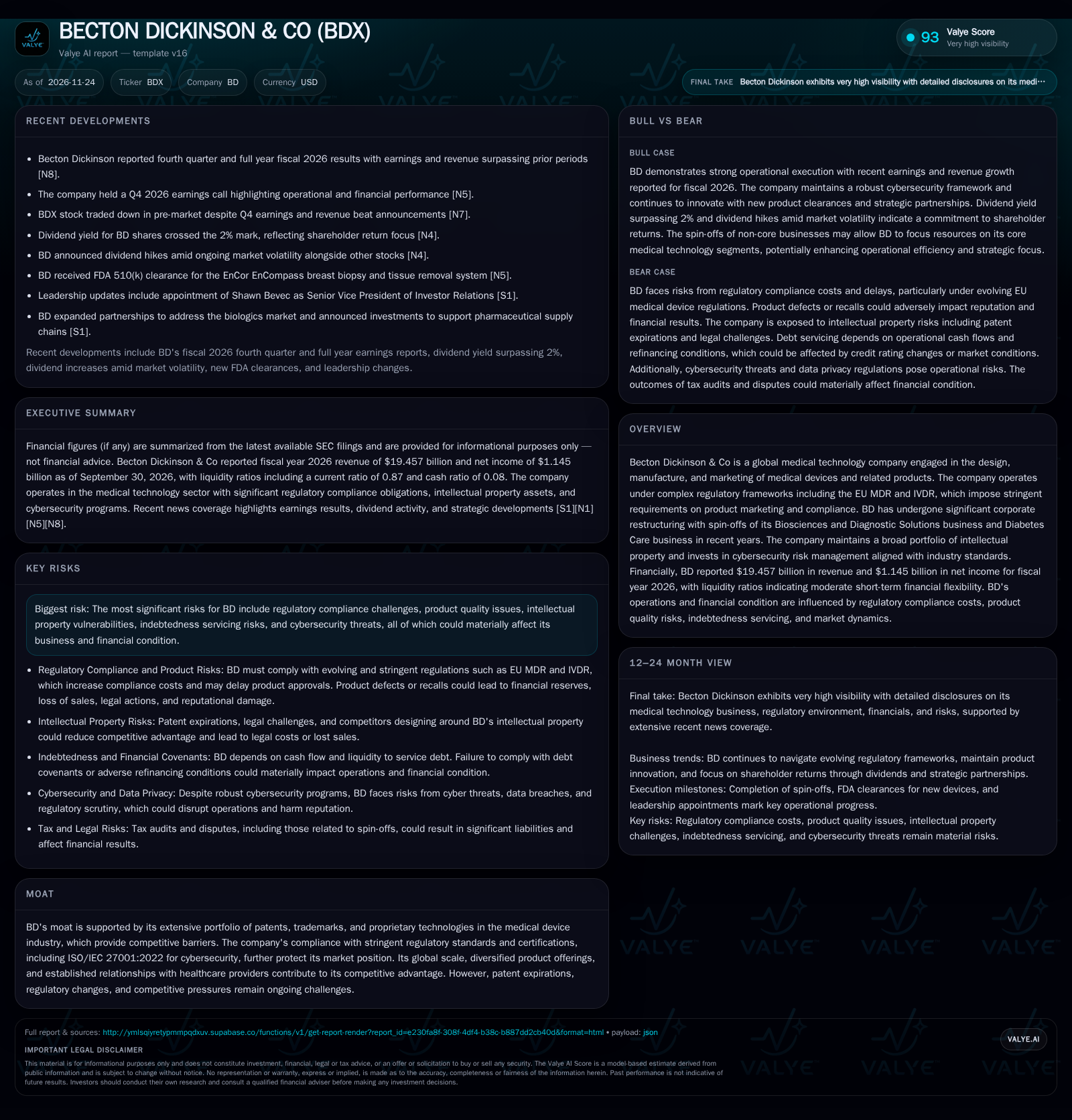
Becton Dickinson (BD) reported $19.457 billion in FY2026 revenue and $1.145 billion in net income, completing major spin-offs to sharpen its medical technology focus. While operational execution remains strong, product risks, patent cliffs, and balance sheet constraints weigh on future flexibility. The company’s ability to sustain growth will depend on new product momentum, cost discipline, and successful refinancing in a tightening credit environment. [S1] [N8]
Becton Dickinson’s recent strategic realignment—marked by the spin-off of its Biosciences/Diagnostics and Diabetes Care businesses—positions the company as a more concentrated medical device leader. With nearly $20 billion in annual revenue but only a 5.9% net margin, BD’s future will be shaped by its ability to sustain innovation, manage product and regulatory risks, and address balance sheet constraints. The next phase will test whether divestitures and operational focus can translate into improved profitability and resilience, or whether structural headwinds will erode its competitive edge.
Spin-Offs, Earnings Beat, and Balance Sheet Strain Define BD’s Latest Phase
Becton Dickinson reported fiscal year 2026 revenue of $19.457 billion and net income of $1.145 billion, translating to a net margin of roughly 5.9% [S1]. This performance followed two significant corporate actions: the February 2026 spin-off of its Biosciences and Diagnostic Solutions business and the earlier April 2022 spin-off of its Diabetes Care segment, both structured as tax-free transactions [S1]. Operationally, BD exceeded consensus expectations in both earnings and revenue for Q4 and full-year 2026 [N8]. [S1] The company’s reliance on operating cash flows for debt servicing underscores a key vulnerability, especially as refinancing needs approach in a potentially less favorable credit environment [S1].
How BD’s Core Devices Business Generates—and Constrains—Profits
BD’s post-spin-off profile is that of a diversified medical device manufacturer, with revenue streams spread across syringes, infusion systems, surgical instruments, and other hospital/clinical supplies. The company’s pricing power is historically supported by proprietary technologies, regulatory clearances, and embedded customer relationships in hospitals and labs. However, the medical device sector is characterized by high fixed costs—R&D, regulatory compliance, manufacturing scale—offset by the potential for significant operating leverage as volumes grow.
After divesting its Biosciences/Diagnostics and Diabetes Care businesses, BD is more exposed to the core device market, which tends to have moderate gross margins and significant exposure to input cost inflation, pricing pressure from group purchasing organizations, and reimbursement constraints. The company's net margin of under 6% suggests that, despite scale, profitability is only modest after accounting for SG&A, R&D, and interest costs.
Capital allocation is another pressure point. Ongoing investment in product development, regulatory compliance, and manufacturing automation is required to maintain relevance and defend market share.
In addition to the inherent cost structure challenges, BD’s profitability is influenced by the dynamic interplay between innovation cycles and reimbursement landscapes. Medical devices often require substantial upfront R&D investment with uncertain payoffs, and reimbursement rates set by government and private insurers can limit pricing flexibility. If reimbursement policies tighten or shift toward value-based purchasing, BD’s ability to pass through cost increases may be constrained, pressuring margins further. Conversely, successful innovation that demonstrably improves clinical outcomes could justify premium pricing and offset reimbursement pressures, but this requires alignment with evolving healthcare payment models.
Defensive Moats Under Strain: IP, Regulatory Hurdles, and Aggressive Rivals
BD’s competitive advantages are rooted in its broad IP portfolio, manufacturing scale, and long-term relationships with healthcare providers. These create barriers to entry, particularly in regulated device categories where switching costs and clinical inertia work in BD’s favor. However, the expiration of legacy patents and ongoing legal challenges increase the risk of generic or lower-cost competitors designing around BD’s technologies.
The company also faces mounting regulatory compliance costs, especially with evolving standards such as the EU MDR and IVDR. These not only increase the cost of doing business but can delay new product launches or force additional investments in post-market surveillance. Meanwhile, aggressive competitors—ranging from large diversified device firms to focused disruptors—are targeting both price-sensitive and premium device markets, often leveraging digital health and data integration as differentiation. BD’s ability to defend premium pricing or capture volume growth will depend on the perceived clinical value, reliability, and integration of its offerings in an era of cost-conscious healthcare systems.
If Innovation and Operational Focus Deliver: Margin Expansion and Renewed Growth
The most favorable scenario for BD is one where the spin-offs enable sharper operational focus, freeing up management bandwidth and capital to invest in high-return device franchises. If the company successfully accelerates new product approvals, leverages its IP to sustain premium pricing, and automates manufacturing to reduce unit costs, operating leverage could meaningfully improve margins. Strategic partnerships—such as those targeting the biologics and pharmaceutical supply chain—may open higher-growth, higher-margin adjacencies.
Confirmation would come from sustained above-market revenue growth in core device categories, margin expansion despite inflationary pressures, and clear evidence of new product adoption in hospital and outpatient settings. Additional signs would include successful debt refinancing on favorable terms and a gradual improvement in liquidity ratios as cash flow from operations increases. Conversely, if innovation cycles stall or new launches fail to gain traction, the anticipated benefits of post-spin-off focus may not materialize.
Most Likely: Steady Revenue, Cyclical Margin Pressure, and Tight Capital Management
The most plausible trajectory is a period of stable-to-modest revenue growth, with BD leveraging its installed base and customer stickiness to maintain share but facing margin headwinds from rising compliance and input costs. The company’s capital allocation prioritizes incremental product upgrades, regulatory compliance, and targeted partnerships rather than transformative M&A.
Any improvement in working capital efficiency or successful cost-containment initiatives could provide modest upside, but absent a step-change in innovation or market expansion, outsized gains are unlikely.
How Regulatory, Product, or Debt Shocks Could Trigger a Downturn
BD is vulnerable to a confluence of risks that could materially erode value. A major product recall or adverse regulatory event—such as delayed approvals under EU MDR/IVDR—could result in lost sales, legal liabilities, and reputational damage. Simultaneously, if patent cliffs accelerate commoditization or competitors rapidly gain share, pricing and volume could deteriorate more quickly than cost reductions can offset.
The company’s balance sheet amplifies these risks. Evidence of downside would include sequential revenue declines, margin compression, covenant breaches, or guidance reductions tied to regulatory, product, or legal setbacks.
Signals That Will Determine Whether BD’s Refocus Succeeds or Stalls
Sustained revenue growth in core device franchises, particularly in categories exposed to new product launches and biologics partnerships, would validate post-spin-off strategic focus.
Gross and operating margin trends, especially in the face of input cost inflation and regulatory compliance burden, will reveal whether BD is achieving operational leverage or facing structural headwinds.
Evidence of successful debt refinancing, including terms and covenants, would reduce downside risk and support future investment.
Frequency, scale, and impact of product recalls or regulatory findings; a spike would signal elevated operational risk or quality control lapses.
Patent litigation outcomes and the pace of IP expirations should be tracked, as these directly affect pricing power and competitive barriers.
Customer retention and contract renewal rates—if disclosed—would help test the stickiness of BD’s installed base and relationship-driven moat.
Disclaimer: This is research-only, informational analysis and not investment advice. It may include AI-generated interpretation and general industry context. Always verify important details using primary sources.

Comments