
Semtech’s Strategic Refocus: Integration, Divestiture, and the Economics of Data Center and IoT Leadership
Semtech’s Q3 swing to profitability and strength in data center and LoRa segments highlight its operational momentum, but integration hurdles from Sierra Wireless and the divestiture of its cellular module business pose execution risks. The company’s next phase will be defined by its ability to concentrate on higher-margin opportunities while navigating sector volatility and internal transformation.
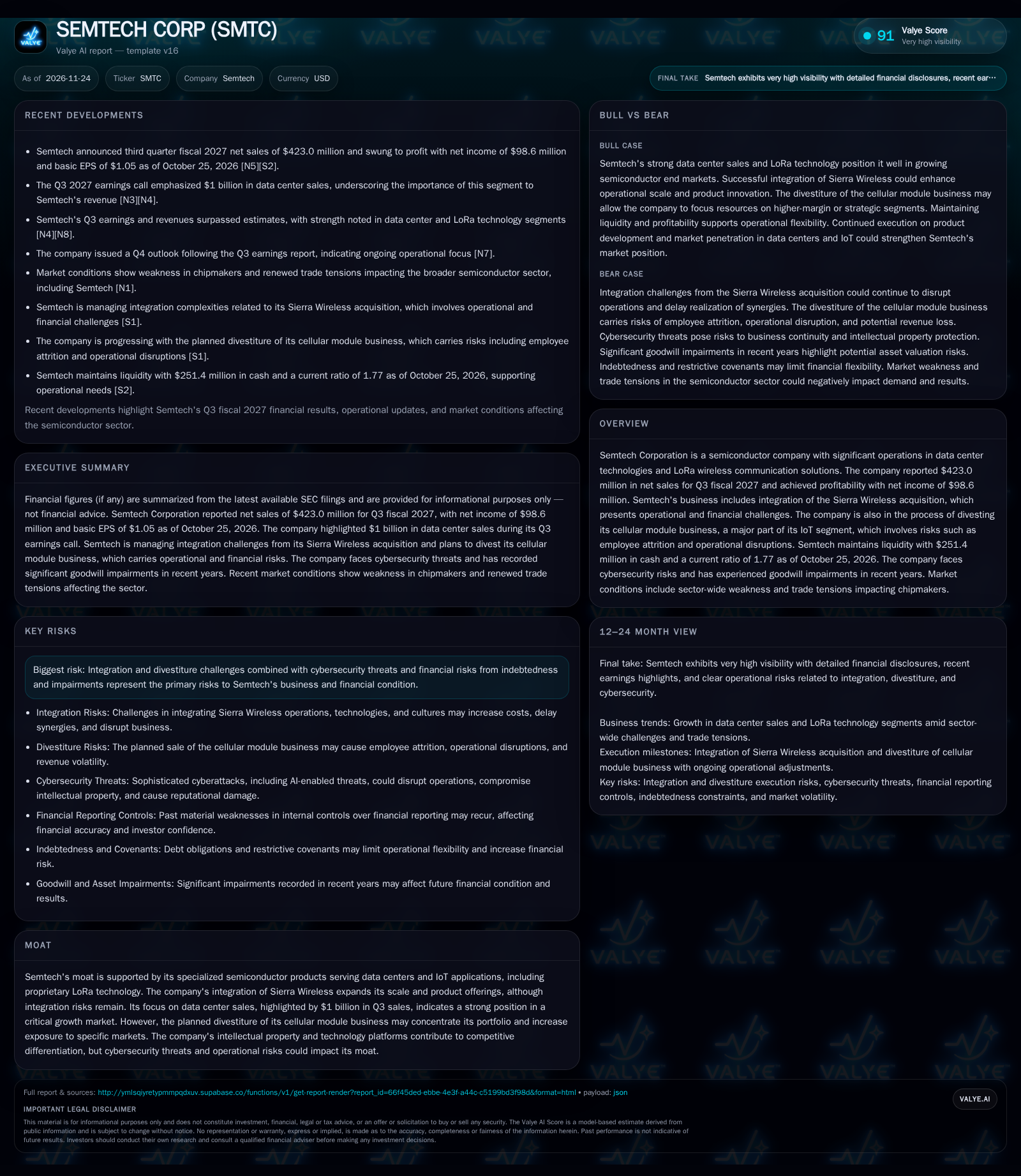
Semtech reported Q3 net sales of $423.0 million and a return to profitability, driven by data center and LoRa technology performance. The company is managing integration challenges from its Sierra Wireless acquisition and is in the process of divesting its cellular module business, which could reshape its IoT segment. Execution on integration and divestiture will be pivotal for the company’s future trajectory. [S2] [N4] [N5] [N8]
Semtech’s recent financial results mark a turning point: the company swung to profitability in Q3 2027 with $423 million in sales, propelled by strong demand in data center and LoRa technology. Yet this operational momentum coincides with a period of major internal change. Semtech is still integrating the Sierra Wireless acquisition—a process fraught with operational and cultural complexities—while actively divesting its cellular module business, a significant part of its IoT operations. As sector-wide headwinds and trade tensions weigh on chipmakers, Semtech’s next chapter will depend on its ability to streamline its portfolio, realize integration synergies, and mitigate risks tied to restructuring and market volatility. [N4] [N5] [N8] [S2]
Recent Profitability and Strategic Portfolio Moves Reshape Semtech’s Near-Term Outlook
Semtech reported net sales of $423.0 million in Q3 fiscal 2027, achieving net income of $98.6 million and reversing prior losses. This performance was driven by outperformance in data center and LoRa technology segments, which have become central to the company’s strategic focus. [N4] [N5] [N8]
The company is in the midst of integrating Sierra Wireless, a process that has introduced operational and financial complexities, and is actively divesting its cellular module business—a significant part of its IoT Systems and Connectivity segment. This divestiture aims to sharpen strategic focus but brings risks of employee attrition and operational disruption. [S1] [S2]
The company reported cash and liquidity metrics for the period; these figures do not by themselves establish operating runway, investment capacity, financial flexibility, or financing capacity. However, recent goodwill and intangible asset impairments, along with ongoing financial reporting and cybersecurity risks, underscore the fragility of its recovery. [S2]
How Data Center and IoT Mix Shape Semtech’s Margin and Capital Structure
Semtech’s business model depends on a mix of high-value semiconductor sales to data centers and proprietary wireless solutions (notably LoRa) for IoT applications. Data center sales typically offer higher volume, but pricing power can be cyclical and sensitive to end-market demand. LoRa technology, as a differentiated offering, may command premium pricing, especially when embedded in ecosystem partnerships or unique use cases.
The integration of Sierra Wireless expands Semtech’s IoT portfolio but also brings higher fixed costs and operational complexity. In principle, scaling the combined platform could improve gross margins and operating leverage if integration costs are controlled and cross-selling is successful. However, the planned divestiture of the cellular module business removes a substantial part of the IoT Systems and Connectivity segment, likely reducing revenue base but potentially raising blended margins if the divested business was lower margin or more commoditized.
Goodwill and asset impairments suggest that prior capital deployed—particularly for acquisitions—has not fully translated into lasting earnings power. Indebtedness and restrictive covenants could further constrain capital allocation flexibility, especially if integration or divestiture costs escalate. [S2]
Specialization in LoRa and Data Center Tech: Semtech’s Edge and Its Limits
Semtech’s competitive advantage is anchored in its proprietary LoRa technology and established relationships in the data center semiconductor market. LoRa offers long-range, low-power wireless communication, which is highly valued for industrial IoT, smart cities, and agricultural applications. This specialization can increase switching costs for customers who have built infrastructure around LoRa, but the pace of standardization and the entry of competing low-power wireless protocols (such as NB-IoT, LTE-M, or emerging 5G-based solutions) represent ongoing threats.
In data centers, Semtech competes against larger, diversified semiconductor manufacturers and connectivity solution providers. Differentiation here is often based on performance, reliability, and integration with cloud and networking platforms. The company’s ability to maintain or expand share will depend on sustained innovation and execution, particularly as hyperscale customers have increasing bargaining power.
The planned divestiture of the cellular module business may sharpen Semtech’s competitive focus but could also leave it more exposed to concentrated end markets, increasing sensitivity to sector cycles and customer consolidation. The integration of Sierra Wireless could enhance scale and product breadth if successfully executed, but integration risks could erode competitive gains.
Unlocking Value Through Focus: If Integration Succeeds and Divestiture Reallocates Capital
If Semtech executes a smooth integration of Sierra Wireless—realizing operational synergies, retaining key talent, and leveraging cross-selling opportunities—the company could achieve durable margin expansion and accelerate innovation in both data center and IoT segments. The successful divestiture of the cellular module business could further concentrate resources on higher-margin, differentiated technologies, potentially lifting blended gross margins and improving return on invested capital.
Upside would be confirmed by evidence of sustained revenue growth in core segments post-divestiture, margin improvement, and a stable or growing pipeline of design wins in LoRa and data center applications. Additional confirmation would come from new product launches, ecosystem partnerships, or customer retention metrics showing resilience after the portfolio reshuffle.
Falsification would come from persistent integration costs, loss of key personnel, or a decline in core segment sales after the divestiture, suggesting that scale or portfolio breadth was more critical to customer relationships than anticipated.
Operational Restructuring Brings Mixed Outcomes Amid Market Headwinds
The most plausible outcome is a period of operational turbulence as Semtech manages both integration and divestiture. Revenue may stabilize or decline modestly as the company sheds the cellular module business and absorbs associated disruption. Gross margins could improve slightly if the divested segment was lower margin, but integration costs and potential customer attrition may partially offset these gains.
The company’s liquidity and current asset position should be sufficient for near-term operations, but capital allocation is likely to remain conservative given recent impairments and sector volatility. Market-wide chipmaker weakness and renewed trade tensions could limit demand growth or compress pricing, particularly in the data center segment.
Evidence for this scenario would include flat or slightly declining revenue with stable or modestly improving margins, continued disclosure of one-time integration and restructuring charges, and management commentary focused on stabilization rather than aggressive expansion.
Integration Failure and Divestiture Disruption Compound Market Weakness
In a negative scenario, integration of Sierra Wireless proves more costly and disruptive than planned, resulting in operational inefficiencies, loss of key personnel, and missed synergies. The divestiture of the cellular module business could trigger customer defections, supply chain interruptions, or unexpected revenue declines if transition plans falter.
Coupled with sector-wide chip demand weakness and heightened trade tensions, these internal disruptions could lead to a pronounced drop in revenue and profitability. Impairments may continue, and restrictive debt covenants could limit Semtech’s ability to invest in recovery or defend market share.
Downside would be confirmed by a sustained decline in core segment sales, repeated impairment charges, negative operating cash flow, or covenant breaches. Additional warning signs would include management turnover and increased disclosure of cybersecurity incidents or internal control weaknesses.
Milestones That Will Define Semtech’s Restructuring and Market Position
Progress on the divestiture of the cellular module business, including transaction structure, buyer profile, and any disclosed financial terms.
Post-divestiture revenue and margin trends in core segments (data center and LoRa), if disclosed, to assess the impact of portfolio reshaping.
Integration costs and realized synergies from the Sierra Wireless acquisition, with updates on employee retention and operational disruptions.
Disclosure of new design wins, major customer renewals, or ecosystem partnerships in data center and IoT markets.
Incidence and impact of additional goodwill or intangible asset impairments, which would signal ongoing asset valuation risk.
Management commentary on debt covenants and capital allocation capacity, particularly in the context of restructuring expenses.
Cybersecurity incident disclosures or updates on internal control remediation efforts.
Sector-wide chip demand trends and the impact of trade tensions on Semtech’s end markets.
Disclaimer: This is research-only, informational analysis and not investment advice. It may include AI-generated interpretation and general industry context. Always verify important details using primary sources.

Comments