
Comtech’s Strategic Divestiture: Financial Reset or New Uncertainty?
Comtech Telecommunications is selling its satellite and space communications business to Gilat, aiming to reset its financial trajectory and operational focus. While the transaction could provide much-needed capital and strategic clarity, it introduces significant risks around execution, organizational stability, and core business viability.
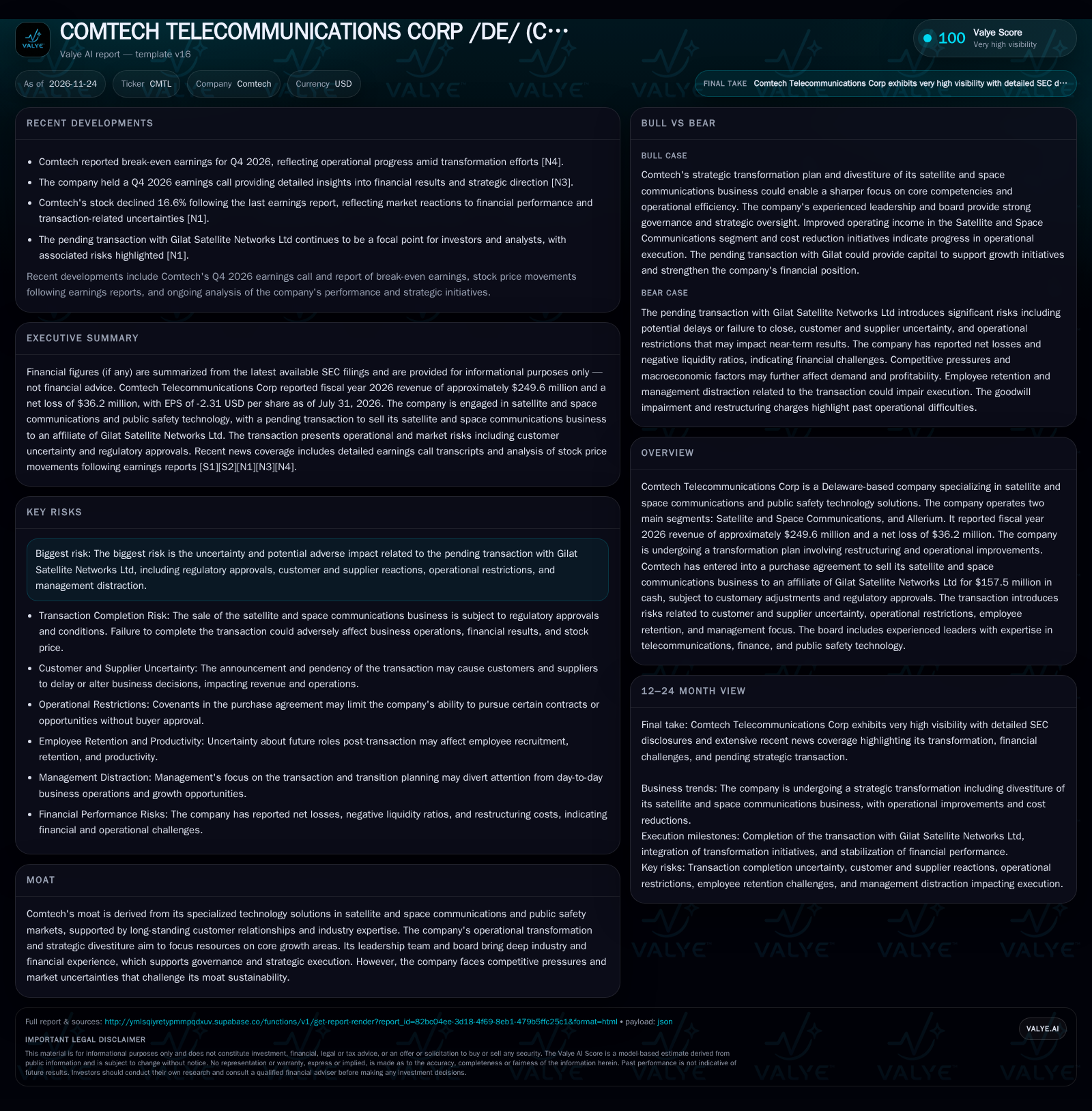
Comtech Telecommunications is undergoing a major transformation by selling its satellite and space communications business to Gilat for $157.5 million, following a period of losses and operational restructuring. [S1] [N1]
Comtech Telecommunications stands at a pivotal juncture after years of financial underperformance and strategic realignment. The planned sale of its satellite and space communications business to Gilat Satellite Networks for $157.5 million represents both an opportunity to reset its balance sheet and a source of new uncertainty. With liquidity stretched and the company only recently reporting break-even quarterly results, the outcome of this transaction—and Comtech’s ability to refocus on remaining core operations—will likely define its trajectory over the next several years.
Transaction with Gilat Reshapes Comtech’s Near-Term Outlook
Comtech has entered a definitive agreement to sell its satellite and space communications business to an affiliate of Gilat Satellite Networks Ltd for a base purchase price of $157.5 million in cash, subject to adjustments and regulatory approvals. This transaction follows a period of operational restructuring, including a $79.6 million goodwill impairment in fiscal 2025 and ongoing cost-reduction efforts. [S1] [N1]
How the Sale Could Reset Comtech’s Profit Model
Comtech’s business model historically relied on specialized technology solutions for satellite, space communications, and public safety markets. The capital intensity and project-based nature of satellite communications likely drove substantial fixed costs and lumpy revenue recognition. The sale of this segment to Gilat could reduce fixed overhead, free up working capital, and potentially improve operating leverage if the remaining Allerium and public safety technology businesses are less capital-intensive.
The transaction’s proceeds, if realized, could be deployed to pay down liabilities, invest in higher-return projects, or fund restructuring. The economics of the remaining business are uncertain: if the Allerium and public safety segments offer higher recurring revenue or software-like margins, Comtech could transition to a more sustainable, less cyclical profit model. Otherwise, the company may struggle to achieve meaningful operating leverage or fund innovation without additional capital.
A critical consideration in assessing the financial reset potential lies in the capital allocation strategy post-sale. If Comtech prioritizes debt reduction and balance sheet repair, it may improve credit metrics and reduce financing costs, thus enhancing potential financial flexibility. However, this conservative approach could limit immediate investments in innovation or market expansion, potentially slowing growth. Conversely, allocating a significant portion of proceeds toward R&D or strategic initiatives could accelerate product development and competitive positioning but might increase near-term cash burn and risk if returns are delayed or uncertain. The optimal balance depends on the remaining business’s capital intensity and growth opportunities, which if insufficiently robust, could constrain the company’s ability to capitalize on the divestiture.
Divestiture Alters Competitive Dynamics in Core Markets
Comtech’s planned exit from satellite and space communications fundamentally alters its competitive landscape. While the company’s historical moat rested on specialized technical capabilities and long-term customer relationships in government and commercial satellite markets, relinquishing this segment narrows its addressable market and shifts its focus to public safety and Allerium-related offerings.
This transition exposes Comtech to a new set of competitors—potentially including established public safety technology firms, diversified communications equipment providers, and emerging cloud-based or software-centric players. The company’s ability to differentiate on technology, integration, or service could be challenged if it lacks scale or unique intellectual property in these segments. Customer switching costs in public safety can be high if solutions are mission-critical, but only if Comtech retains differentiated offerings and execution capability post-divestiture. The realignment may also erode legacy customer relationships, reducing barriers for competitors to encroach on Comtech’s remaining business.
The shift in competitive dynamics also implicates supply chain and partnership ecosystems. By exiting satellite and space communications, Comtech may lose leverage with certain suppliers or technology partners specialized in that domain, potentially impacting cost structures or innovation pipelines in its remaining segments. Conversely, focusing on public safety and Allerium-related markets might open opportunities to forge new alliances with software vendors, system integrators, or cloud service providers, enabling a pivot toward more software-centric or recurring revenue models. The company’s ability to navigate these ecosystem changes will be crucial, as failure to maintain or build strategic partnerships could erode its competitive advantage and market relevance.
If the Gilat Deal Closes Smoothly, Comtech Could Reinvest for Growth
The most favorable outcome would see the Gilat transaction close on schedule, with Comtech receiving the full $157.5 million (subject to adjustments) and successfully deploying proceeds to stabilize its balance sheet. Freed from the capital intensity and volatility of the satellite segment, management could focus on optimizing the remaining business, investing in product development, and pursuing tuck-in acquisitions or new partnerships in public safety technology.
Evidence for this scenario would include: (a) timely transaction completion and regulatory approval, (b) clear communication of a new strategic growth plan, (c) improving operating margins and revenue growth in the Allerium and public safety segments, and (d) positive customer/employee retention trends post-divestiture. If Comtech can demonstrate a transition to a higher-margin, recurring-revenue model and use proceeds to reduce leverage or fund innovation, its valuation and competitive position could improve.
Transition Period Brings Volatility as Company Refocuses
The most plausible outcome is a bumpy transition as Comtech works to close the Gilat deal and reorient its business. The company may face ongoing liquidity constraints, with much of the sale proceeds allocated to paying down current obligations or restructuring costs rather than fueling growth. Customer and employee uncertainty could lead to modest attrition, while operational restrictions tied to the deal may limit management’s flexibility in the interim.
Under this scenario, Comtech’s financial results would remain volatile for several quarters, with break-even or modestly negative earnings as the company adjusts. Confirmation would come from interim updates showing transaction progress, retention of key customers and staff, and early signs of stabilization in the remaining business. Conversely, missed deadlines, unexpected costs, or further revenue declines would indicate execution risk.
Deal Delay or Failure Exposes Liquidity and Execution Risks
Operational restrictions could further constrain the company’s ability to pursue new business or strategic pivots, deepening organizational uncertainty.
Evidence for this downside would include regulatory or antitrust complications, public customer losses, employee departures, or negative working capital trends. In this scenario, management distraction and deteriorating business momentum could force emergency measures, including restructuring, fire-sale asset disposals, or dilutive capital raises. The risk of value destruction would rise sharply if the transaction stalls or collapses.
Moreover, a failed or delayed transaction could exacerbate internal morale challenges, leading to a talent drain that disproportionately affects critical functions such as product development, sales, and customer support. This attrition could create a negative feedback loop, where diminished capabilities further impair operational execution and customer retention, accelerating revenue declines. Additionally, if the divestiture does not yield anticipated liquidity improvements, Comtech might face heightened pressure from creditors or investors, potentially resulting in restrictive covenants or the need for dilutive capital raises. Such financial strain could limit strategic flexibility and force suboptimal decisions, undermining long-term viability.
Milestones to Gauge Comtech’s Post-Divestiture Viability
Timing and regulatory progress of the Gilat transaction: Delays or adverse developments would signal elevated risk.
Net cash proceeds from the sale and allocation between debt repayment, restructuring, and reinvestment: A useful metric would be detailed post-transaction cash flow disclosure.
Retention of key customers and contracts in the Allerium and public safety segments: Any reported losses or renewals would help test the thesis.
Employee retention and turnover rates, particularly among technical and sales staff: If disclosed, this would indicate organizational stability.
Quarterly operating income and margins in the remaining business post-divestiture: Sustained improvement would confirm operational progress.
Updates on restructuring costs and any additional impairment or write-downs: These would reveal the completeness and cost of the transformation.
New business wins or partnerships in the public safety or technology segment: Announcements here would indicate success in repositioning.
Liquidity trends and access to external financing, if required: Any new financing events or covenant breaches would be material.
Disclaimer: This is research-only, informational analysis and not investment advice. It may include AI-generated interpretation and general industry context. Always verify important details using primary sources.

Comments