
Williams-Sonoma’s Brand Power and Margin Resilience in a Shifting Retail Landscape
Q3 2026 results show Williams-Sonoma leveraging proprietary design, brand authority, and operational discipline to deliver profit growth and margin gains, but sustaining this advantage will require navigating intense competition, consumer volatility, and evolving digital commerce dynamics.
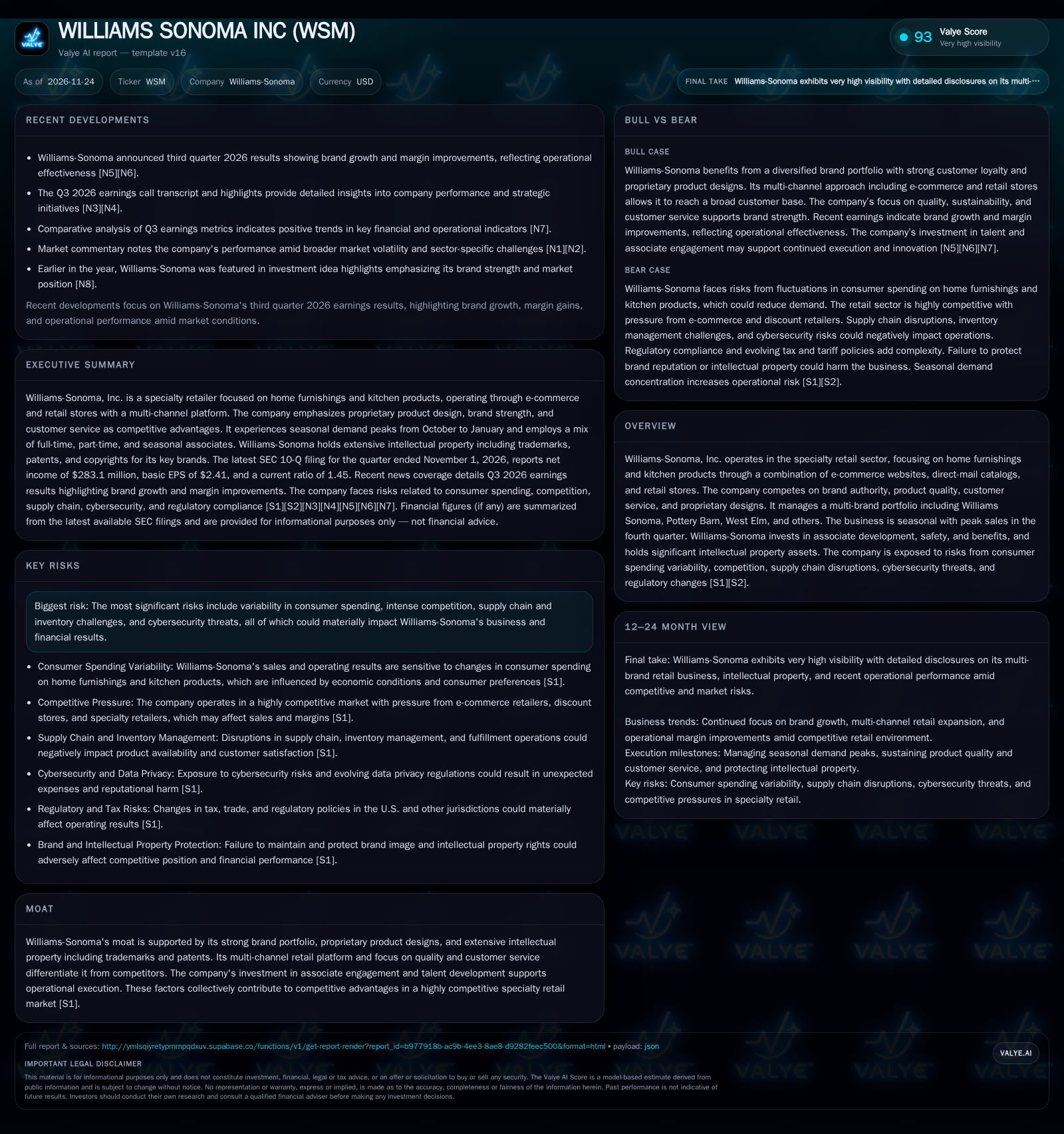
Williams-Sonoma reported Q3 2026 net income of $283.1 million and margin improvements, with brand growth and operational effectiveness cited as drivers. The company’s multi-brand, multi-channel model—centered on proprietary product design and strong IP—remains its core advantage, but risks from consumer spending shifts, competition, and supply chain disruptions persist. Watching execution through peak season and digital channel performance will be key to assessing durability of recent gains. [S2] [N5] [N6]
Williams-Sonoma’s Q3 2026 performance highlights the company’s ability to drive profit growth through a blend of proprietary product design, brand strength, and disciplined operations. Net income of $283.1 million and improved margins suggest that the company’s multi-channel retail model—spanning e-commerce, catalogs, and physical stores—remains effective even as the retail sector contends with shifting consumer behavior and heavy competition. The challenge ahead is whether Williams-Sonoma can maintain this momentum as it heads into its critical holiday season, facing both macroeconomic headwinds and the relentless evolution of digital commerce. [S2] [N5] [N6]
Recent Earnings Underscore Profitability and Brand Momentum
Williams-Sonoma reported Q3 2026 net income of $283.1 million and basic EPS of $2.41, with recent news attributing these results to brand growth and margin gains [S2] [N5] [N6]. This performance comes as the company enters its peak selling season, when both revenue and operational complexity rise sharply. The company’s cash and equivalents stood at approximately $991.6 million, and the current ratio was 1.45 as of the latest filing [S2]. The company reported cash and liquidity metrics for the period; these figures do not by themselves establish operating runway, investment capacity, financial flexibility, or financing capacity.
Recent earnings calls and market commentary emphasize operational effectiveness, with management highlighting the role of proprietary design and strong brand positioning in supporting sales and margins [N3] [N4]. However, the true test will be whether these drivers can offset the perennial challenges of seasonality, intense competition, and consumer spending variability as the company moves through its most important quarter.
How Williams-Sonoma’s Multi-Channel Model Shapes Its Economics
Williams-Sonoma’s business model is built around a multi-brand, multi-channel approach, blending e-commerce, catalogs, and physical stores. Proprietary product design allows the company to capture higher margins than many retailers who rely on third-party brands, as in-house design reduces direct competition and can support premium pricing. The company’s extensive intellectual property portfolio—encompassing approximately 220 trademarks and 380 patents—protects these proprietary offerings and helps limit direct imitation [S1].
The mix of fixed and variable costs is shaped by store leases, logistics infrastructure, and seasonal labor. E-commerce and catalog channels may provide operating leverage as volumes grow, but fulfillment and last-mile logistics can erode some of these gains, especially during peak periods. Inventory management is critical: overstocking can lead to markdowns and margin compression, while stockouts can undermine customer satisfaction and future sales. Seasonality amplifies these risks, with the October-to-January period accounting for a disproportionate share of annual sales and requiring precise forecasting and agile execution.
Capital needs for Williams-Sonoma are relatively moderate compared to asset-heavy retailers, as the company can flex its labor force and leverages supplier relationships for manufacturing. However, investments in digital infrastructure, supply chain resilience, and brand marketing remain ongoing requirements to defend and extend its competitive position.
Defending Brand Authority Amid Intensifying Retail Competition
The company’s moat is rooted in brand authority, proprietary design, and customer loyalty, supported by a portfolio of recognized brands that span demographic and aesthetic niches—from Williams Sonoma’s culinary focus to Pottery Barn’s classic home furnishings and West Elm’s modern, urban sensibility [S1]. This breadth allows Williams-Sonoma to address a wide range of consumer tastes and life stages, providing some insulation from single-brand volatility.
However, the competitive environment remains unforgiving. E-commerce specialists—ranging from mass platforms to niche direct-to-consumer brands—can undercut on price or outpace on digital experience. Department stores and discount retailers create additional pricing pressure and offer one-stop convenience. While Williams-Sonoma’s proprietary products and multi-channel engagement create switching frictions, these are not insurmountable: consumers can and do shop across brands, especially in periods of economic uncertainty.
To sustain its advantages, Williams-Sonoma must continuously invest in product innovation, digital experience, and supply chain efficiency. Its intellectual property portfolio can limit direct imitation, but functional substitutes—particularly from agile online competitors—remain a threat if the company’s brand or service proposition weakens.
Margin Expansion and Digital Acceleration Drive Sustainable Outperformance
A favorable scenario sees Williams-Sonoma leveraging its proprietary design and strong brands to grow share in both core and adjacent home categories. If digital sales continue to scale, and the company can further optimize fulfillment and last-mile logistics, operating leverage may support continued margin expansion. Sustained investment in digital marketing and personalization could deepen customer loyalty and increase share of wallet, while supply chain initiatives reduce costs and improve product availability.
Evidence that would confirm this scenario includes accelerating digital revenue growth (if disclosed), rising average order values, and stable or expanding gross margins through and beyond the peak season. Positive commentary from management regarding improved inventory turnover, reduced markdown rates, and customer retention metrics would further support the case. Indicators of successful brand extension or new customer acquisition—such as traction in emerging categories or international markets—would also strengthen the upside thesis.
Balancing Seasonal Volatility with Operational Discipline
The most plausible outcome is that Williams-Sonoma maintains modest revenue and profit growth, with performance driven by a steady mix of digital and in-store sales and ongoing investment in brand and customer experience. Seasonal volatility is managed through disciplined inventory planning and workforce flexibility, limiting the risk of large markdowns or service shortfalls.
This scenario would be confirmed by stable or slightly improving operating margins, consistent inventory turns, and management reiterating guidance or expressing confidence in demand trends during earnings calls. A continued focus on proprietary designs and customer engagement would likely keep the company’s brands relevant, even as market share shifts incrementally among competitors. Falsifying evidence would include a sharp divergence in digital versus store performance, unexpected inventory build-ups, or management signaling more cautious outlooks in response to macro headwinds.
Consumer Weakness and Execution Missteps Erode Brand Premium
In an adverse scenario, a downturn in consumer spending—particularly in discretionary home categories—would hit Williams-Sonoma’s revenue and force promotional activity, pressuring margins. If inventory planning misses the mark, the company could face either excess stock and heavy markdowns or stockouts that drive customers to competitors. Supply chain disruptions, whether from logistics bottlenecks or supplier issues, could exacerbate these problems.
Digital channel underperformance, whether from increased competition or execution gaps in personalization and customer experience, would further threaten growth. This scenario would be confirmed by declining same-store sales, margin compression from higher promotions, and negative management commentary on demand or operational challenges. Rising inventory days, unexpected increases in SG&A, or reports of supply chain delays would also signal downside risk.
What Will Reveal Williams-Sonoma’s Staying Power in Specialty Retail?
Progression of digital sales growth and mix, if disclosed, particularly through the peak holiday season.
Inventory turnover rates and levels, especially at quarter-end, as a gauge of demand forecasting and operational discipline.
Gross and operating margin trends amid promotional intensity and potential supply chain cost pressures.
Customer retention and repeat purchase rates, if disclosed, to assess brand loyalty and cross-brand engagement.
Management commentary on supply chain resilience, fulfillment speed, and product availability during earnings calls.
New brand or category launches, and early traction in emerging segments or international markets.
Labor cost trends and seasonal hiring patterns, as signals of operational efficiency and ability to flex resources.
Disclaimer: This is research-only, informational analysis and not investment advice. It may include AI-generated interpretation and general industry context. Always verify important details using primary sources.

Comments