
Raymond James Financial’s Growth Engine: Wealth Management Scale, Fee-Based Momentum, and Retention Dynamics
Raymond James Financial has reached record revenues and net income in fiscal 2026, propelled by expanding wealth management assets, advisor recruiting, and strategic acquisitions. Yet, its multi-segment model faces persistent counterforces: market-driven volatility, fierce competition for top advisors, and the integration demands of recent asset management deals.
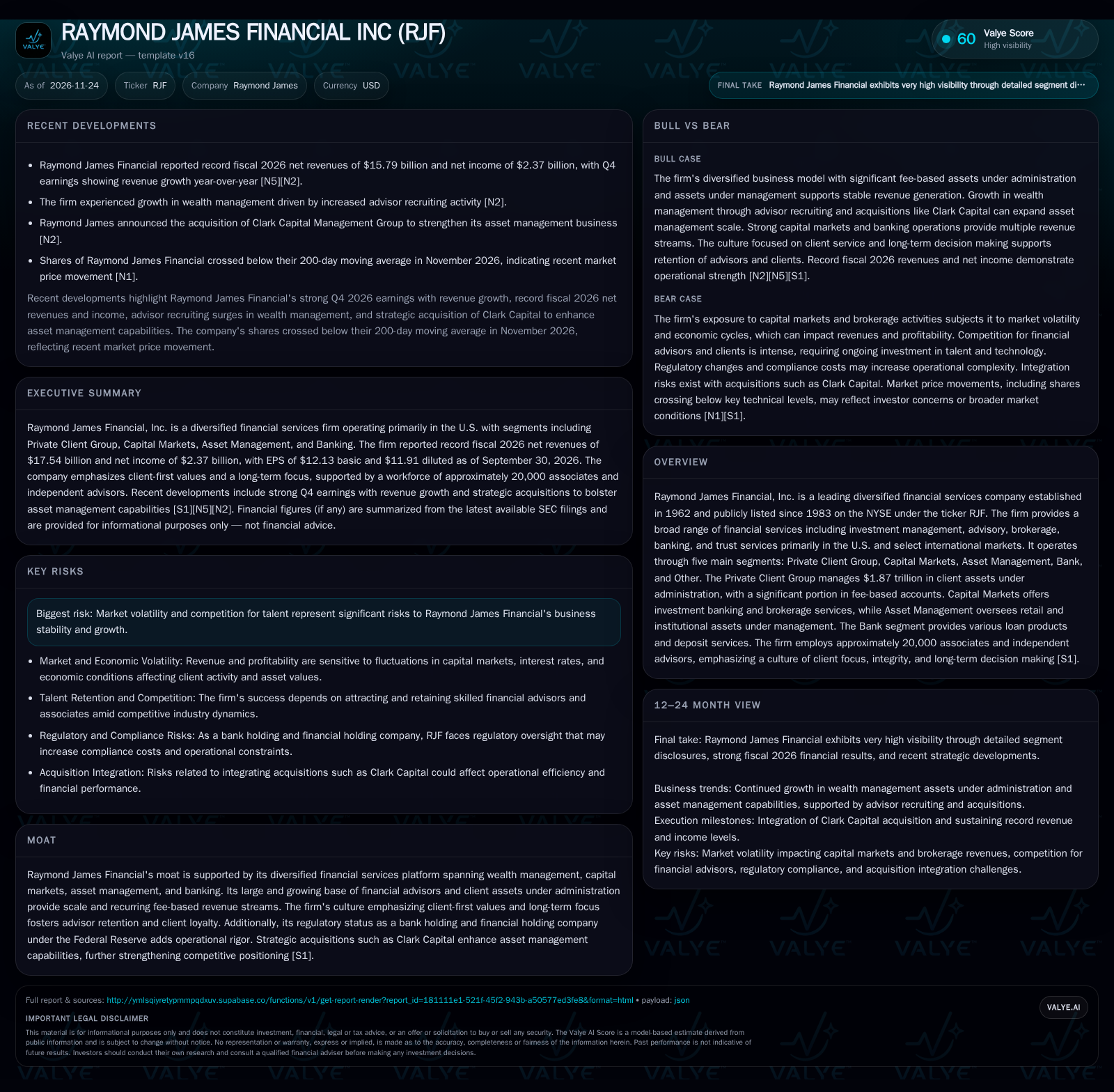
Raymond James Financial posted record fiscal 2026 revenues and net income, with wealth management asset growth and advisor recruiting as primary drivers. The firm's broad platform—spanning private client, capital markets, asset management, and banking—offers revenue diversity, but exposes it to market volatility, talent wars, and regulatory complexity. Future performance will hinge on sustaining advisor growth, integrating acquisitions, and navigating cyclical headwinds without eroding its client-first culture or operational discipline. [S1] [N2] [N5]
Raymond James Financial enters fiscal 2027 with momentum: record revenues, expanding client assets, and a growing advisor base. Its multi-segment model—anchored by the Private Client Group, Capital Markets, Asset Management, and Bank—enables revenue diversification and operational scale. The key question is whether this breadth, underpinned by a client-first culture and recent strategic acquisitions, can consistently offset the persistent headwinds of market volatility, talent retention battles, and regulatory demands. The firm's performance over the next cycle will reveal whether its growth engine is built for resilience or remains vulnerable to the same cyclical forces shaping the broader wealth management and financial services landscape.
Current Landscape Marked by Record Revenues and Expanding Advisor Ranks
Raymond James Financial reported record fiscal 2026 net revenues of $15.79 billion and net income of $2.37 billion, underscoring strong operational performance and positive momentum across its business segments [N5] [N2]. Assets under administration in the Private Client Group have reached $1.87 trillion, with a significant share in fee-based accounts—an important driver of recurring revenue stability [S1]. Growth in wealth management is being propelled by increased advisor recruiting activity, expanding both the client base and assets managed [N2]. The company has also completed strategic acquisitions in asset management, such as Clark Capital, aiming to further scale its platform [S1]. However, the recent decline in share price below the 200-day moving average suggests that market participants may be cautious about future growth or macroeconomic risks [N1].
How Raymond James Translates Scale into Segment Profitability
Raymond James generates revenue from a diverse mix of fee-based advisory, brokerage commissions, investment banking, asset management fees, loan interest, and deposit spreads. The Private Client Group—anchored by its large network of financial advisors and independent contractors—produces stable, recurring fee revenue, particularly from managed accounts. Fee-based assets under administration provide a buffer against transaction-driven volatility, though market declines can still reduce asset-based fees. The Capital Markets segment is more cyclical, with revenues tied to deal flow, trading volumes, and market sentiment. Asset Management contributes via management fees from both retail and institutional clients, offering operating leverage as AUM grows. The Bank segment adds net interest income from loan and deposit products, but is exposed to interest rate cycles and credit risk.
Operating leverage is achievable when Raymond James can grow assets and revenues without commensurate increases in fixed costs—particularly through technology investments, scalable platforms, and advisor productivity gains. However, the business remains exposed to compensation-driven variable costs, as retaining and recruiting top advisors often requires higher payouts and incentives. Capital needs are moderate compared to traditional banks, but regulatory capital requirements, potential acquisition outlays, and technology investments remain ongoing funding priorities.
Maintaining Market Position Amidst a Fragmented Wealth Management Field
Raymond James’s competitive set includes national wirehouses, independent broker-dealers, regional banks, and fintech-enabled advisory platforms. Its key advantages lie in its scale, diversified service offering, advisor-centric culture, and strong brand in the high-net-worth and mass-affluent segments. The firm’s client-first ethos and long-term orientation have historically supported advisor retention and client loyalty, reducing churn relative to some larger competitors.
However, the competitive environment is relentless: rivals aggressively recruit advisors with upfront bonuses, higher payouts, and technology investments. The rise of digital platforms and robo-advisors increases price transparency and compresses fee margins, especially for commoditized investment products. Regulatory burdens are rising across the industry, increasing compliance costs and making it harder for smaller firms to compete—though larger players like Raymond James may be better positioned to absorb these costs.
Strategic acquisitions, such as Clark Capital, can bolster asset management scale and product breadth, but also introduce integration risks and require careful execution to realize synergies without disrupting culture or client relationships.
Growth Potential Rooted in Advisor Efficiency and Fee Asset Gains
The most favorable scenario for Raymond James involves sustained growth in fee-based client assets, fueled by continued successful recruitment of high-producing advisors and smooth integration of recent asset management acquisitions. If the firm can leverage its platform to deepen wallet share with existing clients—cross-selling banking, lending, and advisory services—revenue per advisor could rise, enhancing operating leverage.
Evidence that would confirm this upside includes accelerating net new asset flows, rising fee-based asset ratios, higher advisor retention rates, and expanding margins within the Private Client and Asset Management segments. Additionally, successful integration of acquired businesses with minimal client attrition and realization of cost or revenue synergies would support the thesis.
This scenario may be further strengthened if Raymond James can deploy technology to boost advisor efficiency and client experience, offsetting competitive margin compression and cementing its value proposition in a crowded field.
Revenue Mix Offers Cushion Against Economic Cycles
The most plausible outlook is that Raymond James continues to grow assets under administration and management at a moderate pace, with advisor recruiting and retention offsetting industry churn. Fee-based revenues remain stable or grow modestly, while episodic volatility in capital markets and investment banking activity creates year-over-year revenue swings.
Revenue and earnings resilience are supported by the firm’s multi-segment structure: when market-driven segments soften, recurring advisory and asset management fees provide ballast. However, cost pressures—especially compensation and regulatory compliance—keep margin expansion modest. Integration of recent acquisitions proceeds without major disruption, but does not yield outsized synergies.
This base case would be confirmed by steady, if unspectacular, quarterly growth in client assets, advisor headcount, and fee-based revenues, along with stable operating margins and limited client attrition.
Revenue Risks Arise from Market Volatility and Advisor Turnover
A negative scenario unfolds if equity and fixed income markets experience a sharp downturn, reducing asset values and transaction activity across the Private Client and Capital Markets segments. This would compress fee-based revenues and curtail new client flows, while also dampening investment banking and trading income. In parallel, if competitors successfully poach key advisor teams or if retention incentives escalate industry-wide, Raymond James could face rising compensation costs and potential loss of high-value books of business.
Integration missteps with recent acquisitions—such as Clark Capital—could trigger client attrition, loss of advisor confidence, and distraction from core operations. Regulatory changes or enforcement actions could further increase costs or restrict certain business lines.
Evidence supporting this scenario would include declining assets under administration, falling advisor headcount, negative net asset flows, margin compression, or a spike in integration-related expenses and client complaints.
Factors Influencing the Stability of Raymond James’s Growth Trajectory
Net new asset flows by segment—if disclosed—would help assess whether advisor recruiting and retention are translating into actual client asset growth.
Fee-based assets as a proportion of total client assets, which would indicate the stability and predictability of revenue streams.
Advisor headcount and retention rates, since departures of high-producing teams can have an outsized impact on both revenue and culture.
Integration progress and client retention following acquisitions, particularly Clark Capital—updates on realized synergies, costs, and any client/advisor attrition would be revealing.
Segment-level operating margins, especially for Private Client and Asset Management, to determine if scale and technology investments are translating into improved profitability.
Regulatory and compliance expense trends, given rising industry costs and the potential for new rules to impact margins.
Market-sensitive revenue streams (e.g., capital markets, investment banking) as a share of total revenues, to gauge exposure to cyclical downturns.
If disclosed, digital adoption and advisor productivity metrics, which would signal whether technology investments are enhancing client experience and operational efficiency.
Disclaimer: This is research-only, informational analysis and not investment advice. It may include AI-generated interpretation and general industry context. Always verify important details using primary sources.

Comments