
Construction Partners, Inc.: Scaling Sunbelt Infrastructure Amid Funding and Input Cost Crosswinds
Recent acquisitions and a swelling project backlog underscore Construction Partners, Inc.’s drive for regional leadership in civil infrastructure. Yet, the company’s fate remains tightly linked to public funding cycles and volatile petroleum-based input costs, challenging its ability to convert scale into steady margin growth.
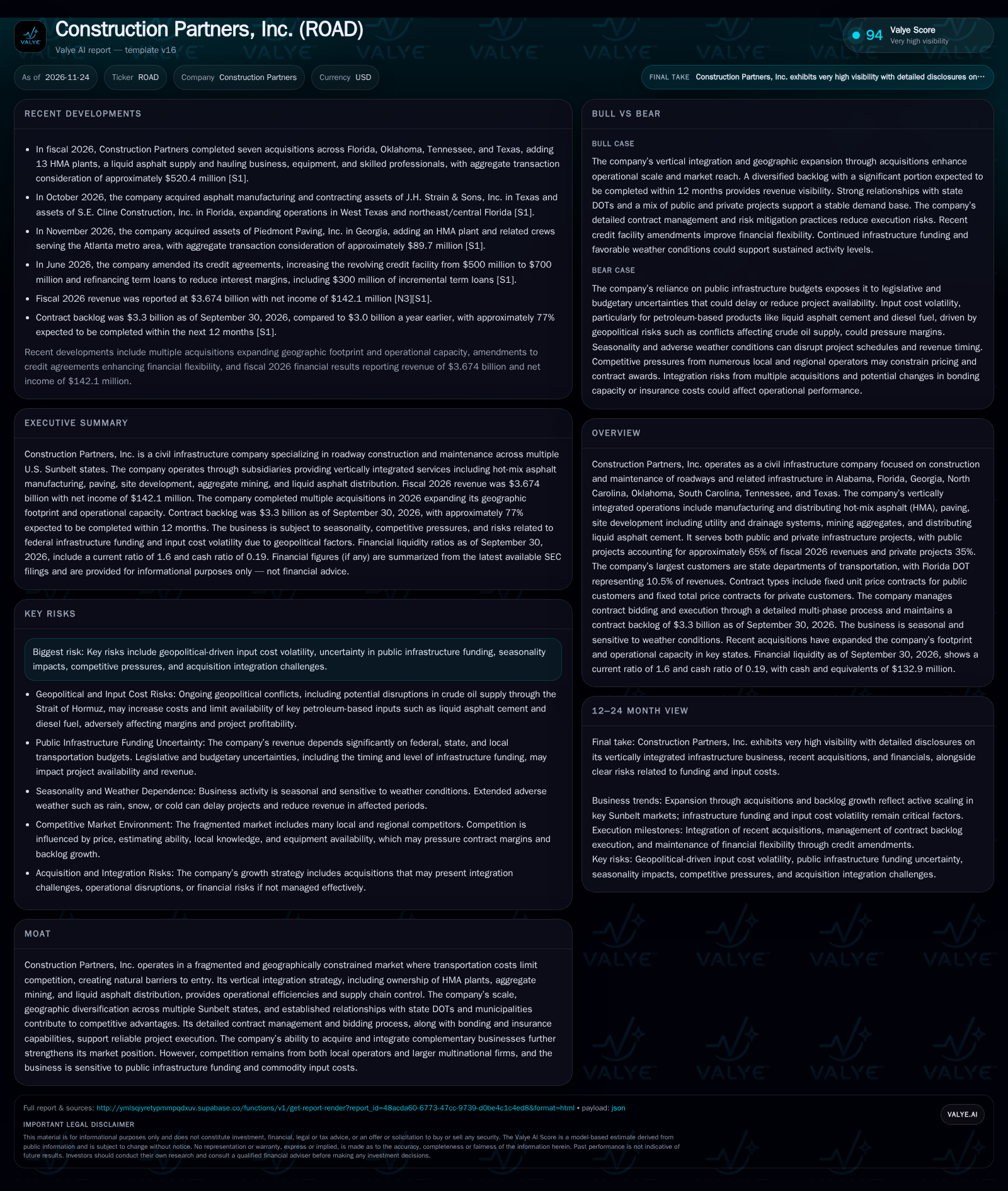
Construction Partners, Inc. is aggressively expanding its Sunbelt presence through acquisitions, adding production assets and skilled labor while growing its contract backlog to $3.3 billion. The company’s vertically integrated model aims to buffer some margin volatility, but exposure to federal and state infrastructure funding cycles and petroleum-based input costs remains high. Execution on recent acquisitions and backlog conversion will be pivotal as funding reauthorization and input cost risks loom large over the next 12–24 months. [S1] [N3]
Construction Partners, Inc. is pursuing scale and operational leverage in the U.S. Sunbelt’s infrastructure market, leveraging a string of recent acquisitions and a growing backlog. The company’s vertically integrated approach—spanning hot-mix asphalt production, paving, site development, and aggregate mining—aims to secure supply chain control and pricing flexibility. However, with 65% of revenue tied to public funding and a cost base vulnerable to petroleum price shocks, the company’s ability to translate scale into durable margin gains will be tested by both policy cycles and global commodity dynamics. The next phase will hinge on the execution of recent acquisitions, backlog conversion, and the evolving landscape for infrastructure funding and input costs. [S1] [N3]
2026 Outlook: Acquisitions, Backlog Growth, and Funding Developments
In fiscal 2026, Construction Partners, Inc. completed seven acquisitions across Florida, Oklahoma, Tennessee, and Texas, adding 13 hot-mix asphalt (HMA) plants, a liquid asphalt supply and hauling business, and skilled professionals. These deals, totaling approximately $520.4 million, were followed by further asset purchases in Texas, Florida, and Georgia, including the $89.7 million acquisition of Piedmont Paving, Inc. in November 2026. These moves significantly expanded the company’s operational footprint and production capacity in the Sunbelt, particularly in growth corridors such as Atlanta and West Texas. [S1] [N8]
The company’s contract backlog stood at $3.3 billion as of September 30, 2026, up from $3.0 billion the prior year, with 77% expected to be completed within 12 months. This backlog offers near-term revenue visibility but remains dependent on the pace and continuity of public infrastructure funding. [S1]
Publicly funded projects comprised about 65% of fiscal 2026 revenue, with state departments of transportation (DOTs)—notably Florida DOT at 10.5%—as the company’s largest customers. This underscores the company’s exposure to government budget cycles and legislative appropriations. [S1]
Financially, Construction Partners reported fiscal 2026 revenue of $3.674 billion and net income of $142.1 million. The company reported cash and liquidity metrics for the period; these figures do not by themselves establish operating runway, investment capacity, financial flexibility, or financing capacity. [N3] [S1]
Profitability Drivers: Vertical Integration and Contract Mix Dynamics
Construction Partners’ business model is anchored in vertical integration—owning and operating HMA plants, aggregate mines, and liquid asphalt distribution assets. This structure aims to provide better control over input costs, project scheduling, and quality, potentially reducing reliance on third-party suppliers and insulating margins from some external shocks. However, petroleum-based products like liquid asphalt cement and diesel fuel remain key cost drivers, and most raw materials are still procured on the spot market, exposing the company to price volatility. [S1]
Revenue is generated from a mix of fixed unit price contracts (public customers) and fixed total price (lump sum) contracts (private customers), with design-build contracts used occasionally. This contract structure determines risk allocation: while unit price contracts offer some volume flexibility if quantities change, lump sum contracts can expose the company to cost overruns if input prices spike. Subcontractor costs are managed via firm quotations and price escalators for longer projects, but cost inflation may not be fully passed through, especially on existing backlog. [S1]
Operating leverage is a central feature: higher volumes—enabled by acquisition-driven scale and a robust backlog—can improve margin absorption of fixed costs (plant operations, equipment, skilled labor). However, seasonality and weather can disrupt this leverage, as can sudden spikes in fuel or material costs.
Competitive Landscape: Local Scale and Supply Chain Advantages in Fragmented Markets
The civil infrastructure market in the Sunbelt is highly fragmented, with competition ranging from small local contractors to large regional and multinational firms. Transportation costs for heavy materials like HMA and aggregates naturally constrain the geographic reach of competitors, giving local scale operators—like Construction Partners—an edge in logistics and responsiveness. [S1]
The company’s competitive advantages include vertical integration, a broad regional footprint, and established relationships with DOTs and municipalities. These factors support stronger bid pipelines and project execution reliability. However, barriers to entry are moderate: while scale and bonding capacity matter, local expertise and relationships remain critical, and smaller firms can compete effectively on price and agility in specific markets. [S1]
Competitive pressure is most acute on price, project management, and estimating ability. The company’s recent acquisitions may provide cost synergies and expand aggregate sourcing, but integration risks and the need to maintain local market knowledge persist. In addition, public agencies’ ability to terminate contracts for convenience, while rarely exercised, remains a latent risk.
Margin Expansion Potential with Stable Funding and Input Costs
A favorable scenario emerges if federal and state infrastructure funding remains robust—either through timely reauthorization or supplemental programs—supporting project flow and backlog conversion. In this case, Construction Partners’ expanded capacity and regional coverage would allow it to capture a larger share of new awards, translating backlog into higher revenues and operating leverage.
If input costs for petroleum-derived materials stabilize or decline, the company’s vertical integration could further enhance gross margins by capturing more value from internal supply and reducing third-party markups. Successful integration of recent acquisitions would unlock synergies and drive down per-unit costs.
Evidence confirming this scenario would include: continued growth in backlog and new project awards; stable or rising gross margins despite revenue mix shifts; positive updates on acquisition integration and asset utilization; and public budget appropriations for infrastructure at or above current levels. Conversely, a sharp drop in backlog, margin compression despite stable revenue, or delays in integrating new assets would challenge the upside thesis.
Growth Outlook Influenced by Policy and Commodity Volatility
The most plausible outcome is a period of steady, acquisition-fueled growth punctuated by the realities of public funding cycles and input cost volatility. Construction Partners is likely to convert much of its current backlog into revenue over the next 12 months, supporting incremental margin growth if integration execution remains on track.
However, uncertainties around the reauthorization of federal infrastructure funding and unpredictable fuel/asphalt prices will create periodic margin pressure. The company’s contract management process and vertical integration should buffer some shocks, but not eliminate them. Seasonality and weather disruptions will continue to cause quarter-to-quarter variability.
This scenario would be confirmed by consistent backlog conversion rates, modest improvements in margin metrics, and stable financial leverage. Watchpoints include changes in public funding levels, input cost trends, and the pace and quality of acquisition integration.
Risks of Margin Pressure and Project Delays from Funding or Cost Challenges
The downside risk centers on a confluence of public funding delays or reductions and a spike in petroleum-based input costs due to geopolitical disruptions (e.g., conflict affecting crude oil supply). In this scenario, the company could face project slowdowns, margin compression, and underutilization of recently acquired capacity.
Fixed-price contracts may become loss-making if input prices rise sharply after award, and public agencies could delay or cancel projects as budgets tighten. Integration challenges or missteps with recent acquisitions could compound these pressures, leading to higher operating costs and working capital strain.
Downside evidence would include: backlog shrinkage or deferrals; sequential margin declines; negative commentary on funding visibility from management; or impairment charges related to underperforming acquired assets.
Construction Partners’ Trajectory Hinges on Key Milestones and Market Changes
Backlog conversion rate—specifically the percentage of the $3.3 billion backlog recognized as revenue over the next four quarters—will test project execution and demand continuity.
Gross margin trends as new acquisitions are integrated and input costs fluctuate would help determine the effectiveness of vertical integration and cost control.
Updates on federal and state infrastructure funding authorizations, including the reauthorization or extension of the Infrastructure Investment and Jobs Act, will be a leading indicator for public project flow.
Acquisition integration progress—measured by asset utilization, workforce retention, and realized cost synergies—if disclosed, would clarify whether scale is delivering expected benefits.
Input cost indices for liquid asphalt cement and diesel fuel should be monitored as leading indicators for potential margin risk.
Weather-related project delays or seasonality impacts, especially in new markets, could affect quarterly revenue timing and utilization.
Bonding and insurance capacity—any changes in terms or availability could signal shifts in risk perception or potential financial flexibility.
Any commentary or disclosure on contract renegotiations, termination for convenience, or liquidated damages claims would indicate shifting risk allocation or execution issues.
Disclaimer: This is research-only, informational analysis and not investment advice. It may include AI-generated interpretation and general industry context. Always verify important details using primary sources.

Comments