
GAP Inc.: Profitability Gains Meet Lowered Outlook as Brand Relevance and Retail Dynamics Collide
GAP Inc. posted a notable Q3 profit surge and modest sales growth, yet tempered its full-year expectations amid an intensely competitive retail landscape. With a reported liquidity position and operational discipline, the company’s next phase hinges on execution in brand differentiation, omni-channel integration, and sustained consumer engagement.
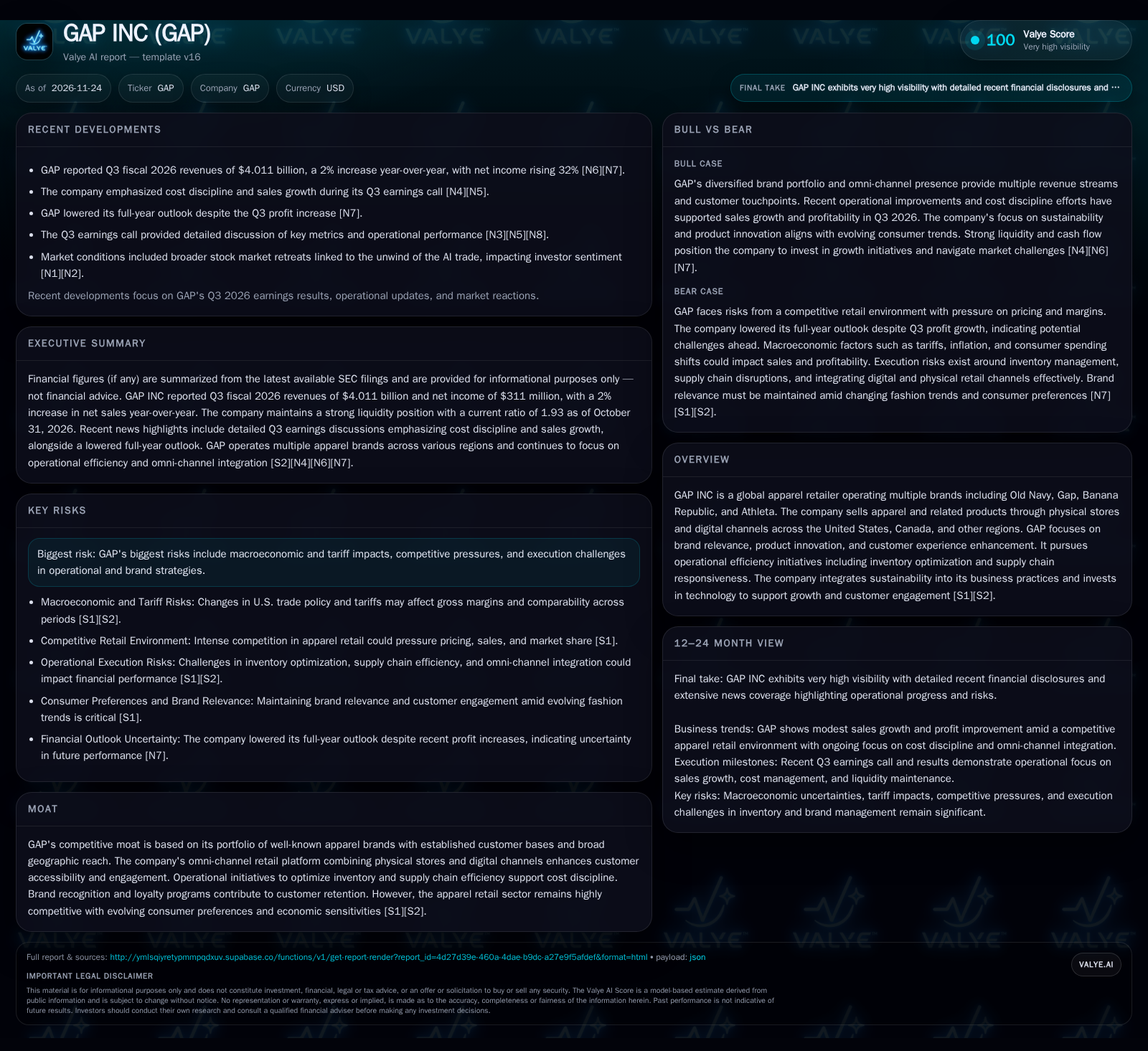
GAP Inc. reported a 32% year-over-year profit increase and 2% net sales growth in Q3 2026, underpinned by cost discipline and operational efficiency, but lowered its full-year outlook due to ongoing macro and competitive pressures. The company’s reported liquidity position and multi-brand presence provide strategic options, but future performance will depend on navigating fashion cycles, inventory management, and effective digital-physical integration. Key milestones ahead include confirming sustained margin improvements, sales momentum, and tangible progress in omni-channel and brand innovation initiatives. [S2] [N4] [N6] [N7]
GAP Inc. enters the end of 2026 at a strategic crossroads. The company’s Q3 results showed a sharp profit recovery and modest sales growth, buoyed by cost-focused operational execution. Yet, management’s decision to lower the full-year outlook despite these gains signals the persistent challenges of fashion retail: highly competitive dynamics, changing consumer tastes, and macroeconomic uncertainty.
Profit Rebound and Lowered Guidance: Reading the Signals from Q3
GAP Inc. reported Q3 fiscal 2026 revenues of $4.011 billion, up 2% year-over-year, and net income of $311 million, reflecting a 32% profit increase versus the prior year [S2] [N6] [N7]. This performance was attributed to operational cost discipline and sales growth initiatives discussed in the company’s recent earnings call [N4] [N5]. Despite the strong quarterly profit, management lowered its full-year outlook, highlighting persistent uncertainty in the retail environment [N7]. As of October 31, 2026, GAP’s cash and cash equivalents stood at $2.578 billion, with a current ratio of 1.93 and a cash ratio of 0.92 [S2]. The combination of short-term profit gains and longer-term caution sets the stage for a thesis centered on execution risk, margin sustainability, and the effectiveness of GAP’s multi-brand, omni-channel strategy.
How GAP Makes—and Could Lose—Money: Revenue Streams, Margins, and Leverage
GAP’s economics hinge on its ability to move large volumes of apparel through both owned stores and digital channels, with revenue driven by a mix of value (Old Navy), mid-market (Gap), premium (Banana Republic), and athleisure (Athleta) brands [S1] [S2]. The company’s gross margin is sensitive to product mix, markdowns, and supply chain costs, with fixed costs (rent, labor, logistics) creating significant operating leverage. Recent cost discipline and inventory optimization efforts contributed to the Q3 profit surge, suggesting a temporary margin expansion as supply chain headwinds eased and promotional intensity was managed [N4] [N6]. However, apparel retail is structurally exposed to volatile fashion cycles, high fixed costs, and the risk of inventory obsolescence. Capital needs remain moderate; barring major expansion or restructuring, most cash flow is allocated to working capital, store refreshes, digital investments, and potentially shareholder returns. The key question is whether GAP can sustain recent efficiency gains without sacrificing top-line momentum, especially as consumer demand and competitive intensity fluctuate.
A critical factor in GAP’s profitability trajectory lies in its capacity to balance inventory levels with consumer demand fluctuations. Apparel retailers often face the challenge of forecasting fashion trends and consumer preferences months in advance, which can lead to excess stock or stockouts. Excess inventory typically results in markdowns that compress gross margins, while stockouts can lead to lost sales and diminished customer loyalty. Therefore, GAP’s investment in data analytics and demand forecasting tools could be pivotal in enhancing inventory precision. If the company can leverage real-time sales data and predictive analytics effectively, it may reduce the risk of obsolescence and markdown-driven margin erosion, thereby stabilizing profitability across seasons.
Brand Portfolio and Omni-Channel Play: Strengths and Strategic Vulnerabilities
GAP’s moat rests on its diverse portfolio of established brands, nationwide store footprint, and integrated online presence [S1] [S2]. This structure provides cross-demographic reach and multiple touchpoints for customer acquisition and retention. However, the apparel sector’s low switching costs and fickle consumer preferences mean that brand relevance must be continuously earned. Fast fashion, specialty, and e-commerce competitors—ranging from digitally native vertical brands to global giants—exert pressure on pricing, product development cycles, and marketing spend. GAP’s investments in supply chain responsiveness and sustainability initiatives may drive incremental loyalty, but these are now table stakes in the industry. The company’s ability to differentiate through design, value proposition, and customer experience will determine its share of wallet. The omni-channel model could theoretically could support larger baskets and retention, but only if digital and physical channels are seamlessly integrated and inventory is tightly managed.
The competitive landscape also raises questions about GAP’s agility in responding to rapid fashion cycles and emerging consumer segments. While a diversified brand portfolio offers breadth, it may also dilute focus and slow decision-making compared to more nimble, digitally native competitors. The ability to accelerate design-to-shelf timelines and customize assortments regionally can be a differentiator in maintaining brand relevance. If GAP can streamline product development processes and empower localized merchandising strategies within its brands, it may better capture shifting consumer tastes and reduce the risk of inventory misalignment. Conversely, failure to enhance speed and flexibility could exacerbate competitive disadvantages in an industry where responsiveness increasingly dictates market share.
What Would a Sustainable Turnaround Look Like for GAP?
A durable bull case for GAP would involve sustained low-single-digit sales growth and stable or improving gross margins, powered by operational efficiencies, successful inventory management, and effective brand positioning across all banners. Evidence of this scenario would include continued positive year-over-year sales, further margin improvement without excessive promotional activity, and visible growth in digital and omni-channel sales (if disclosed). Early signals might be strong holiday season results, higher conversion rates online and in-store, and customer engagement metrics that reflect brand relevance. This upside would be reinforced if GAP can demonstrate that cost discipline is structural rather than episodic, and if its investments in technology and sustainability yield measurable improvements in customer loyalty and share gains in core segments. Confirmation would come from sequential quarterly profit growth, upward revisions to guidance, and expanding free cash flow.
Another dimension of a sustainable turnaround involves monetizing omni-channel synergies beyond mere sales growth. For example, integrating inventory systems across physical and digital channels can enable flexible fulfillment options such as buy-online-pickup-in-store (BOPIS) or ship-from-store, which may increase customer convenience and reduce shipping costs. Enhanced customer data integration across channels could also facilitate personalized marketing and loyalty programs, driving higher lifetime value. If GAP can successfully harness these capabilities, it may improve not only top-line growth but also operational efficiency and customer retention. These improvements, however, depend on effective technology investments and organizational alignment, which, if lacking, could limit the potential benefits of omni-channel integration.
Operational Progress, but Structural Headwinds Persist
The most plausible near-term path is one of modest revenue growth and episodic margin gains, offset by ongoing competitive and macroeconomic pressures. GAP may continue to see incremental improvements from cost initiatives and supply chain optimization, but these could be partially eroded by discounting, fashion misses, or shifts in consumer spending. The company is likely to maintain a conservative stance on guidance and capital allocation, prioritizing liquidity and operational flexibility. Evidence supporting this scenario would be flat to modestly rising sales, stable but not expanding margins, and management commentary focused on risk management and incremental progress rather than transformational change. Falsification would be a sharp reversal in sales, margin compression due to heavy promotions, or any indication that inventory or supply chain issues are resurfacing.
When Cost Discipline Isn’t Enough: Scenarios of Margin Erosion and Lost Relevance
The bear case for GAP centers on renewed sales declines, gross margin compression from aggressive discounting, and failure to keep pace with consumer trends. If macroeconomic or competitive pressures intensify—leading to inventory buildups, increased promotions, or store traffic declines—recent profit gains could quickly reverse. Additional warning signs would include negative same-store sales, rising inventory days, and management lowering guidance further or signaling operational challenges. If digital and omni-channel investments fail to drive incremental revenue or customer engagement, fixed costs could become a drag, exacerbating operating leverage on the downside. Evidence would be visible in deteriorating quarterly results, missed sales targets, and negative cash flow trends.
Milestones That Will Determine Whether GAP’s Momentum Is Real or Fleeting
Same-store sales growth by brand and channel, if disclosed, would help validate underlying demand and brand relevance.
Gross margin performance and promotional intensity trends, especially during holiday and back-to-school periods, will indicate whether margin gains are structural.
Inventory turnover and days inventory outstanding, if reported, would reveal execution quality in supply chain and merchandising.
Digital sales growth and omni-channel participation rates, if disclosed, would provide evidence of successful customer engagement and integration.
Quarterly updates to full-year guidance and management commentary on demand visibility will signal confidence in operational progress.
Cash flow from operations and capital allocation decisions (buybacks, dividends, digital investments) will clarify financial discipline and flexibility.
External macro indicators—consumer spending trends, tariff developments, and apparel sector health—should be tracked as context for demand and margin risk.
Customer satisfaction and brand engagement metrics, if available, would help test the effectiveness of product innovation and marketing initiatives.
Disclaimer: This is research-only, informational analysis and not investment advice. It may include AI-generated interpretation and general industry context. Always verify important details using primary sources.

Comments