
Advasa Holdings: Platform Ambition Meets Disclosure Gaps and Execution Questions
Advasa Holdings, newly listed on Nasdaq, aims to scale its daily payment platform with global partnerships, USDC and real-world asset integration, and ambitious medium-term goals. However, persistent losses, limited operational disclosure, and shareholder transition dynamics raise critical questions about the path to sustainable value creation.
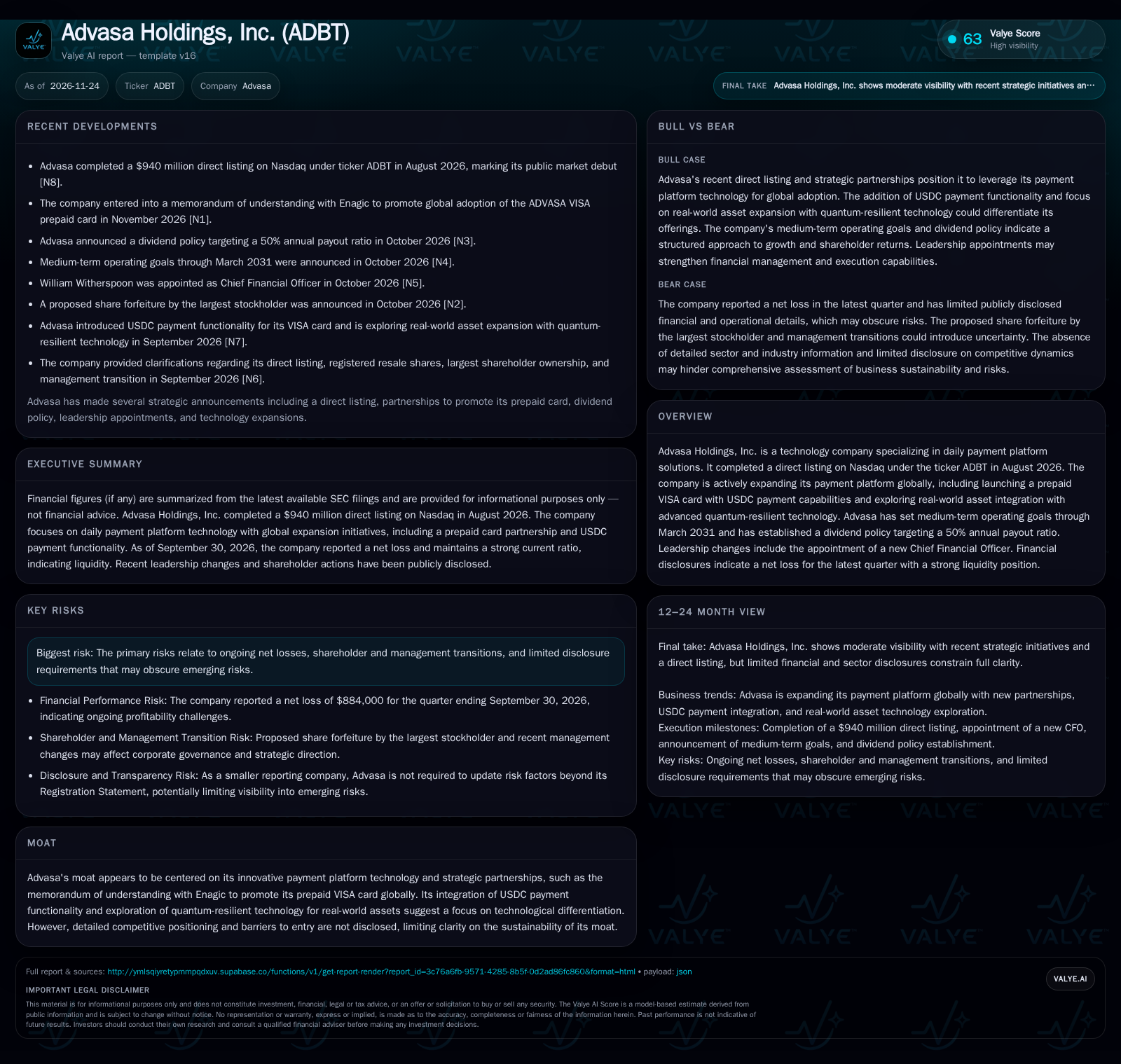
Advasa Holdings, Inc. The cited source reports dividend-related activity; that disclosure alone does not establish dividend-policy continuity, management confidence, or a material constraint on capital flexibility. Despite reported liquidity position, the company remains unprofitable and faces uncertainties from limited disclosure, evolving management, and a pending share forfeiture by its largest stockholder. The thesis hinges on Advasa proving it can translate partnerships and technology into commercial traction and stable cash flows while navigating governance and transparency risks. [S1] [N1] [N2] [N3] [N4] [N7] [N8]
Advasa Holdings, Inc. (ADBT) is attempting to carve out a differentiated position in the global payment platform space, leveraging its Nasdaq direct listing to pursue aggressive expansion, technological innovation, and shareholder-friendly policies. Recent moves include a high-profile partnership to launch a prepaid VISA card with USDC functionality and stated ambitions to integrate real-world assets using quantum-resilient tech. Yet, Advasa's persistent losses, evolving leadership, and unusually high dividend target—set against a backdrop of limited operational and competitive disclosure—suggest that the company’s execution risk remains high. The coming quarters will test whether Advasa can convert its platform strategy and partnerships into durable, profitable growth, or if governance and transparency gaps will undermine its potential. [N1] [N2] [N3] [N4] [N7] [N8]
Recent Listing, Platform Initiatives, and Unresolved Losses Define the Starting Point
Advasa Holdings made its public market debut via a $940 million direct listing on Nasdaq in August 2026, a significant event that both validates its ambitions and opens new capital-raising possibilities. The company has since announced a memorandum of understanding with Enagic to promote worldwide adoption of its ADVASA VISA prepaid card, a partnership that could help accelerate international reach. In parallel, Advasa has rolled out USDC (USD Coin) payment functionality for its card and indicated plans to explore real-world asset (RWA) integration using quantum-resilient technology, signaling a push to differentiate in the competitive fintech landscape. Despite these milestones, Advasa reported a net loss of $884,000 for the quarter ending September 30, 2026, and reported liquidity-ratio trends of just 0.1, though its current ratio stands at 5.4. The company’s recent leadership changes and a proposed share forfeiture by its largest shareholder introduce additional uncertainty regarding governance and strategic continuity. [S1] [N1] [N2] [N3] [N4] [N7] [N8]
How Advasa’s Platform Could Monetize: Volume, Margins, and Dividend Ambition
Advasa’s core business model is based on its daily payment platform, anchored around the ADVASA VISA prepaid card—which now supports USDC payments. In principle, revenue streams could arise from transaction fees, interchange revenue, card issuance, and potential subscription or SaaS charges to enterprise partners. The addition of USDC functionality positions Advasa to capture both traditional fiat and digital asset transaction volumes, potentially appealing to a broader, more global user base. However, the actual mix of users, transaction types, and revenue contribution from each stream is not disclosed.
The company’s cost structure likely includes fixed technology development, regulatory compliance, and customer acquisition costs, with variable costs tied to transaction processing and card issuance. If Advasa can achieve scale, significant operating leverage may emerge given the high fixed-cost, low marginal-cost nature of digital payment platforms. The company reported cash and liquidity metrics for the period; these figures do not by themselves establish operating runway, investment capacity, financial flexibility, or financing capacity. The cited source reports dividend-related activity; that disclosure alone does not establish dividend-policy continuity, management confidence, or a material constraint on capital flexibility.
Differentiation Through Technology: Can USDC and Quantum-Resilient Ambitions Break Through?
Advasa is attempting to differentiate itself in a crowded payments market through several strategic levers: the global partnership with Enagic, USDC integration for its VISA card, and a stated intent to incorporate quantum-resilient technology for real-world asset applications. These initiatives could appeal to fintech-savvy users and enterprise partners seeking advanced security and digital asset compatibility. However, the payments sector is marked by intense competition from both traditional financial institutions and digital-native fintechs—many of which have larger user bases, broader ecosystems, and regulatory scale advantages.
Without current disclosure of user growth, transaction volumes, or retention metrics, it is unclear if Advasa’s platform is gaining meaningful traction or if its technology provides material switching costs or network effects. A successful integration of quantum-resilient infrastructure could provide a future-proofing edge, but execution hurdles are high, and the timeline for meaningful commercial impact remains uncertain. The company’s moat, if any, will depend on its ability to forge sticky B2B/B2C relationships and deliver a product suite that competitors cannot easily replicate.
From Ambitious Platform to Profitable Ecosystem: What Would Validate a Bullish Thesis
The most favorable outcome for Advasa would involve translating its technology and partnerships into rapid user and transaction growth—particularly through the Enagic relationship and USDC-enabled card adoption. If the company can demonstrate accelerating card issuance, rising transaction volumes, and growing cross-border or digital asset payment flows, it could quickly build scale that unlocks operating leverage. Success in integrating quantum-resilient technology and real-world asset functionality could further differentiate the platform, attracting institutional partners and high-value users.
Confirmation of this scenario would require disclosure of robust user growth, expanding transaction volume, positive gross margins, and early signs of recurring revenue. Strategic wins—such as new enterprise partnerships or regulatory approvals in key markets—would further validate commercial momentum.
Execution Unfolds Slowly as Platform Seeks Commercial Validation
The most plausible near-term outcome is that Advasa continues to invest in platform development and international expansion, but growth in user adoption and transaction volumes remains modest while the company works through operational, regulatory, and commercial hurdles. Operating losses persist as fixed costs remain high and revenue ramps gradually. The announced partnership with Enagic and the USDC feature may generate initial traction, but competitive pressures and the need to establish trust and compliance infrastructure could slow uptake.
Evidence for this scenario would include continued net losses, stable or modestly improving liquidity metrics, and only incremental updates on user or transaction growth. Progress would likely be measured in small wins—such as pilot programs, regulatory clearances, or new product launches—rather than explosive growth.
Governance and Cash Strains Erode Confidence Before Platform Gains Traction
The adverse scenario for Advasa is that ongoing net losses, cash burn, and limited operational transparency erode investor and partner confidence before the platform achieves scale. The proposed share forfeiture by the largest stockholder and management transitions could signal instability or internal discord, potentially undermining both governance and execution. If the company fails to generate meaningful user or transaction growth, or if competitive offerings outpace Advasa in digital asset integration and cross-border payments, revenue may stagnate while costs remain elevated.
Lack of progress on disclosed medium-term goals, or evidence of customer or partner churn, would further suggest that Advasa’s technology and commercial strategy are falling short of market demands.
Milestones and Metrics That Will Clarify Advasa’s Platform Trajectory
Quarterly disclosure of active card users, transaction volumes, and average transaction values—if disclosed—would provide critical insight into platform adoption and user engagement.
Gross margin trends and revenue composition broken out by transaction type (fiat, USDC, RWA)—if available—would clarify the economic viability of Advasa’s business model.
Updates on the commercial rollout and user uptake of the Enagic partnership and ADVASA VISA prepaid card would help test international growth ambitions.
Progress reports on quantum-resilient technology integration and real-world asset functionality would indicate whether Advasa can deliver on its innovation claims.
Management and board stability—particularly in the wake of the proposed share forfeiture and CFO transition—remain important for governance and strategic continuity.
Regulatory milestones, including licenses or approvals in target international markets, would signal readiness for broader expansion.
Transparency in risk disclosures and operational updates, beyond minimal SEC requirements, would help reduce information asymmetry and build investor confidence.
Disclaimer: This is research-only, informational analysis and not investment advice. It may include AI-generated interpretation and general industry context. Always verify important details using primary sources.

Comments