
My Size, Inc.: Integrated Fashion Tech Platform at a Strategic Crossroads
My Size, Inc. leverages an integrated portfolio spanning AI-driven sizing, e-commerce, and recommerce, now facing a pivotal test of execution as regulatory tailwinds, cross-selling ambitions, and acquisition risks converge. Recent Nasdaq compliance and revenue growth provide a platform, but sustained profitability and strategic focus remain open questions.
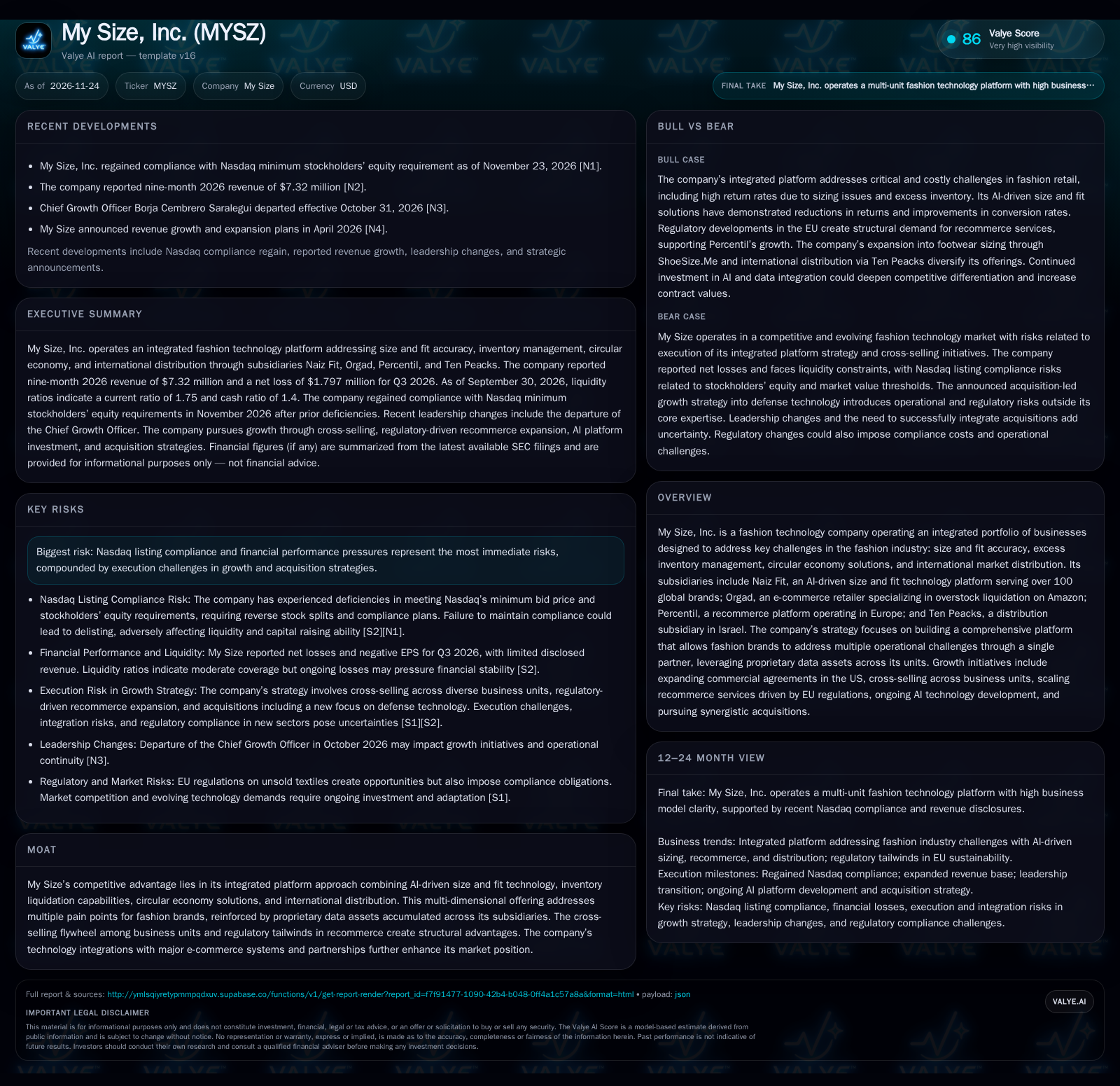
My Size, Inc. operates a multi-pronged fashion technology platform, combining AI-powered size and fit solutions, overstock liquidation, and circular economy recommerce. Recent developments include $7.32 million in nine-month 2026 revenue, Nasdaq compliance restoration, leadership transition, and an expanded acquisition strategy. The company stands to benefit from EU sustainability mandates and proprietary data flywheels, but persistent losses, cross-unit integration challenges, and forays outside core fashion tech into defense technology introduce significant execution and financial risks. Sustained improvement hinges on margin expansion, effective cross-selling, and disciplined acquisition integration.[S1] [S2] [N1] [N2] [N3]
My Size, Inc. stands at a critical juncture as it seeks to scale a unique, integrated fashion technology platform spanning AI-driven sizing, e-commerce overstock management, and European recommerce. With $7.32 million in revenue for the first nine months of 2026, recent Nasdaq compliance restoration, and regulatory tailwinds in the EU, the company has clear structural opportunities. Yet persistent losses, leadership turnover, and a pivot toward non-core acquisitions pose real questions about execution, focus, and the sustainability of its business model. The next phase will test whether My Size’s platform synergies and regulatory catalysts can overcome operational and financial headwinds.[S1] [N1] [N2] [N3]
Recent Revenue Growth, Compliance Milestones, and Platform Expansion
My Size, Inc. reported nine-month 2026 revenue of $7.32 million, reflecting continued traction across its business units, including AI-powered sizing (Naiz Fit), e-commerce overstock sales (Orgad), and European recommerce (Percentil).[N2] The company restored compliance with Nasdaq’s minimum stockholders’ equity requirement in November 2026 after prior deficiencies, preserving access to public markets and investor confidence.[N1] Notably, the company has expanded its AI fit technology through Naiz Fit’s acquisition of ShoeSize.Me, deepening its presence in footwear sizing and broadening its data asset base.[S1] However, the departure of Chief Growth Officer Borja Cembrero Saralegui at the end of October 2026 introduces uncertainty around business development continuity and the execution of cross-unit growth initiatives.[N3]
How My Size’s Multi-Unit Model Seeks Profitable Scale
My Size’s business model is built on the interplay between its SaaS B2B fit technology (Naiz Fit), inventory liquidation (Orgad), managed recommerce (Percentil), and regional distribution (Ten Peacks).[S1] Naiz Fit generates recurring revenue from fashion and footwear brands via AI-powered fit and size recommendation software, likely structured as multi-year or annual SaaS contracts—though contract specifics are undisclosed. Orgad monetizes excess inventory through e-commerce channels, a business with low gross margins but high volume potential, dependent on efficient SKU and supply chain management. Percentil’s recommerce business benefits from both transaction fees and inventory ownership, with margin expansion hinging on operational leverage as volumes scale and as regulatory mandates push brands toward managed resale.
The platform aspires to create flywheel effects by cross-selling services (e.g., using Naiz Fit insights to funnel unsold stock into Orgad or Percentil), thereby enhancing customer lifetime value and data asset accumulation. However, persistent net losses—$1.797 million in Q3 2026 with negative EPS—highlight the challenge of covering fixed platform and development costs with current revenues.[S2] Margins are likely constrained by the capital intensity of recommerce and the logistical costs of inventory management. The company’s ongoing investment in AI and data integration, while a potential differentiator, adds to near-term expense pressure. Capital needs are further complicated by the announced pivot toward acquisition-led growth, including forays into defense technology, which could require additional financing and introduce integration drag if not managed with discipline.[S2]
Integrated Platform as Differentiator—But Execution and Focus Are Key
My Size positions itself as a comprehensive partner for fashion brands, offering solutions that address sizing, inventory, recommerce, and distribution under one roof.[S1] This breadth is a potential advantage over single-point competitors in fit tech (e.g., traditional sizing platforms), pure-play recommerce operators, or inventory liquidators. The proprietary data assets accumulated from consumer measurements, sales, and resale activity could, if effectively integrated, become a defensible moat—enabling more accurate sizing, better inventory matching, and superior cross-selling.
However, the competitive landscape remains intense. Large e-commerce platforms, digital sizing startups, and established recommerce players each have scale and technology advantages. The value of My Size’s integration hinges on actual customer adoption of multiple services and demonstrable improvements in return rates, conversion, or resale velocity. Moreover, recent moves into defense technology acquisitions risk diluting focus, potentially undermining the credibility of the company’s integrated fashion tech proposition. The loss of key personnel, such as the Chief Growth Officer, could also erode execution velocity and customer relationship continuity.[S1] [N3]
Cross-Unit Synergies and Regulatory Catalysts Drive Profitable Expansion
The most favorable scenario sees My Size successfully leveraging its integrated platform to become the preferred partner for brands navigating sizing accuracy, inventory liquidation, and regulatory-driven recommerce. In this scenario, Naiz Fit’s AI-driven solutions continue to reduce return rates and improve conversion for major clients, deepening wallet share and driving stickier SaaS revenue. The acquisition of ShoeSize.Me enables further penetration into footwear, expanding the addressable market and data advantage.[S1]
Percentil’s recommerce business captures a surge in demand as the EU’s Ecodesign for Sustainable Products Regulation bans the destruction of unsold textiles, pushing brands toward compliant resale solutions.[S1] Orgad benefits from increased overstock flows, while the platform’s data flywheel enhances cross-selling and customer retention. Ongoing AI investment yields measurable improvements in personalization and operational efficiency, supporting margin expansion. Synergistic acquisitions in adjacent verticals (if executed with discipline) could accelerate scale without overwhelming management bandwidth.
Confirmation would come from accelerating revenue growth, rising gross margins, stable or improving customer retention, and evidence of cross-unit customer adoption. A reduction in quarterly net losses or a path to breakeven would further validate the thesis.
Incremental Platform Progress Amid Margin Pressure and Execution Hurdles
The most plausible trajectory is one of gradual progress: My Size sustains moderate revenue growth as regulatory and market trends support recommerce and sizing solutions, but persistent cost pressures and integration complexity limit near-term profitability. Cross-selling across business units proceeds, but adoption is uneven, with some brands using only one or two platform offerings. The company continues to invest in AI and data integration, but the payoff in terms of improved margins or customer lock-in is incremental rather than transformative.
Periodic leadership changes and the need to juggle multiple business models slow the pace of platform optimization. The announced shift toward acquiring defense technology businesses introduces distraction risk, but the core fashion tech units remain intact. Liquidity is managed through cost controls and selective financing, but the company does not achieve sustained profitability. Evidence supporting this scenario would include continued revenue growth with fluctuating or modestly improving margins, ongoing net losses, and limited improvement in cross-unit customer metrics.
Strategic Drift and Integration Risks Undermine Platform Potential
In a negative scenario, My Size’s multi-pronged strategy becomes a liability rather than an advantage. Failure to execute effective cross-selling leads to siloed business units, diluting data synergies and undermining the value proposition to brands. The foray into defense technology acquisitions proves a distraction, straining management focus and exposing the company to unfamiliar regulatory and operational risks.[S2]
Leadership instability (as signaled by the Chief Growth Officer’s departure) disrupts business development, and key brands reduce or discontinue contracts. Regulatory tailwinds for recommerce are offset by compliance costs or increased competition from better-capitalized players. The company risks falling out of Nasdaq compliance again, limiting access to capital and further damaging market credibility. Confirmation would come from declining revenues, increasing losses, customer attrition, or renewed listing deficiencies.
Factors That Will Determine Whether My Size’s Platform Approach Succeeds
Quarterly revenue and gross margin trends by business unit—particularly evidence of margin improvement in Orgad and Percentil.[N2] [S2]
Net loss trajectory and cash burn rate, as well as any disclosures around breakeven timing or financing needs.[S2]
Adoption rates of Naiz Fit and cross-selling success—specifically, the number of brands using multiple My Size offerings (if disclosed).
Retention rates or contract renewals among major Naiz Fit clients, especially after the Chief Growth Officer’s departure (if disclosed).
Incremental revenue or cost savings attributable to the ShoeSize.Me integration and expanded footwear coverage (if disclosed).
Growth in recommerce transaction volumes and the impact of EU regulatory deadlines on Percentil’s pipeline (would help test the regulatory tailwind thesis).
Disclosures or milestones related to acquisitions outside core fashion tech, including integration costs, revenue contribution, and management commentary on strategic rationale.[S2]
Nasdaq compliance status and any new notices or remediation actions—ongoing listing risk remains a structural watchpoint.[N1] [S2]
Disclaimer: This is research-only, informational analysis and not investment advice. It may include AI-generated interpretation and general industry context. Always verify important details using primary sources.

Comments