
Blue Star Foods Corp.: Sustainability Ambitions Collide with Customer Concentration
Blue Star Foods is betting on eco-friendly branding, proprietary packaging, and land-based aquaculture to carve out a niche in the crowded seafood sector.
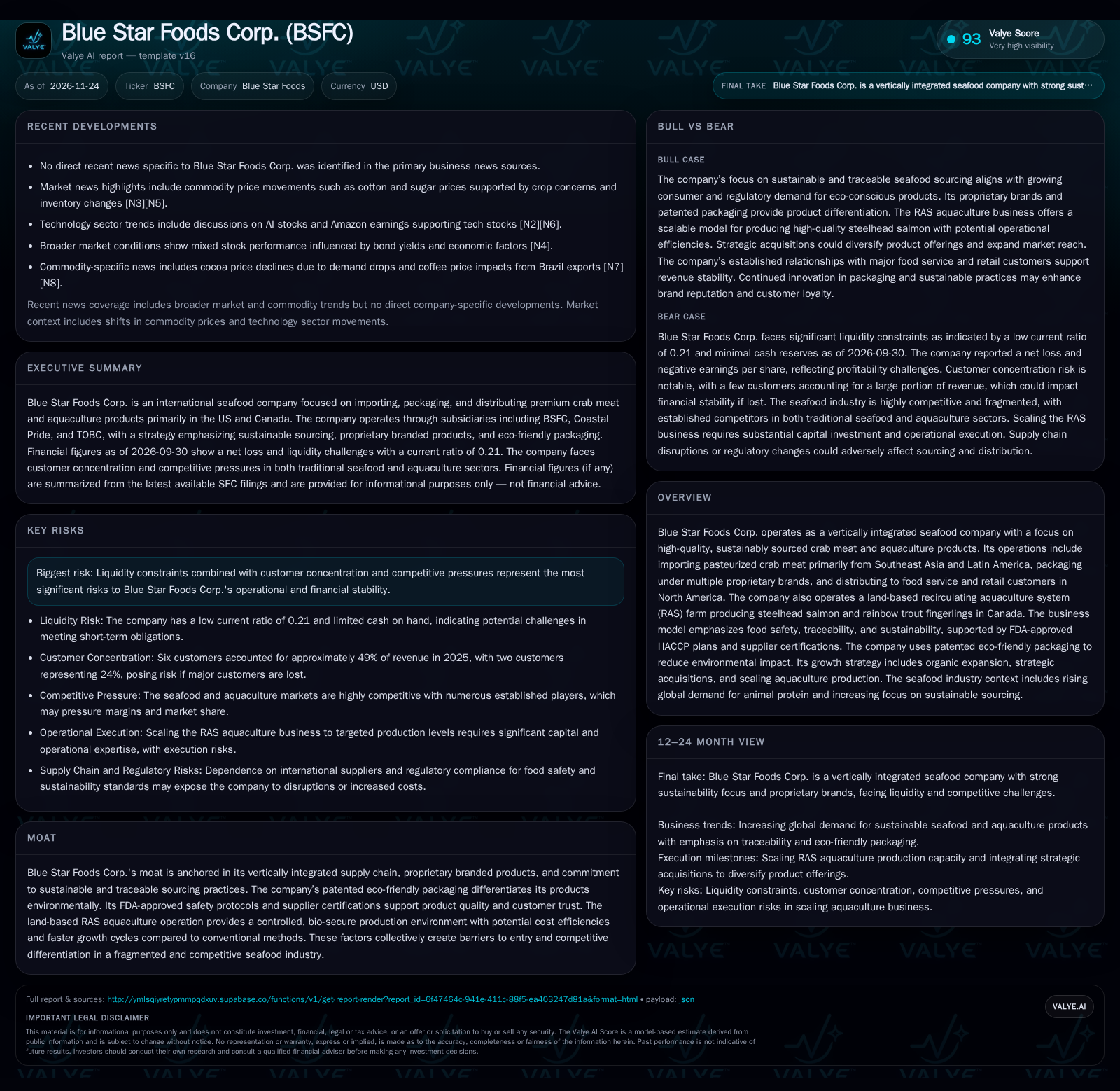
Blue Star Foods Corp. faces a high-stakes transition: while it touts sustainability, proprietary brands, and a scalable aquaculture model, its most recent financials show a severe liquidity shortfall and mounting losses. Customer concentration amplifies risk, and success hinges on execution in scaling RAS production and diversifying both product lines and revenue streams. The company's ability to withstand competitive pressures and supply chain disruptions will largely determine whether its sustainability focus translates into economic defensibility.
Blue Star Foods Corp. occupies a complex position in the evolving seafood industry: it promises vertically integrated, sustainably sourced crab and aquaculture products, leveraging both proprietary brands and patented eco-friendly packaging to stand out. With nearly half its revenue concentrated among just six customers, Blue Star’s future is as much about financial maneuvering and customer retention as it is about sustainable seafood.
Liquidity Crunch and Customer Dependency Shape the Immediate Outlook
[S2] This financial posture leaves the company with virtually no margin for operational error or unexpected shocks, raising questions about its ability to fund working capital, invest in growth, or even meet near-term obligations.
The company’s customer base is highly concentrated: in 2025, six customers represented approximately 49% of total revenue, with the top two accounting for nearly a quarter [S1]. This concentration heightens the risk that the loss of even a single key account could materially impair revenue and cash flows.
Blue Star Foods continues to emphasize sustainable sourcing, proprietary brands, and patented eco-friendly packaging as core differentiators. The company’s RAS (recirculating aquaculture system) operation in Canada remains central to its growth narrative, with ambitions to scale production and diversify species.
The interplay between liquidity constraints and customer concentration creates a precarious operational environment. In such a scenario, the company's negotiating leverage with suppliers and customers may diminish, potentially leading to less favorable payment terms or price concessions. This dynamic could exacerbate working capital pressures and restrict the company's ability to invest in critical areas such as marketing, research and development, or capacity expansion. Moreover, reliance on a limited customer base increases vulnerability to shifts in buyer preferences or purchasing strategies, underscoring the importance of strategic diversification initiatives to mitigate revenue volatility.
How the Business Could Capture Value: Branding, Mix, and Scale
Blue Star Foods’ economics hinge on a blend of traditional seafood import/distribution and vertically integrated aquaculture. The core crab meat business depends on sourcing, packaging, and brand-driven differentiation—success here relies on maintaining supply chain reliability, controlling input costs, and achieving premium pricing through sustainability credentials and patented packaging.
The RAS aquaculture business introduces a different economic profile: it is capital-intensive upfront, with significant fixed costs for facility construction, technology, and biosecurity. If scaled successfully, RAS can enable higher asset turnover, lower disease risk, and premium pricing for traceable, locally produced salmon. Margins in RAS are sensitive to biological yields, feed conversion ratios, and operational efficiency, but successful operators may realize more stable gross margins than traditional wild-caught or offshore aquaculture due to lower environmental risk and tighter supply control.
Blue Star’s route to improved profitability would likely require expanding higher-margin, branded product lines, increasing direct sales to retailers (to capture more value), and scaling RAS output to dilute fixed costs.
A critical factor influencing Blue Star Foods’ economics is the balance between fixed and variable costs within its dual business model. The traditional import and distribution segment typically exhibits lower capital intensity but may face margin compression due to commodity price fluctuations and competitive pressures. Conversely, the RAS segment demands significant upfront capital but benefits from scalability and potential operational efficiencies as production volumes increase. Achieving an optimal mix between these segments could enhance overall financial resilience, though this depends on the company's ability to manage the timing and scale of investments relative to market demand and operational execution.
Sustainability Positioning and Patented Packaging: Differentiation or Commodity Trap?
Blue Star Foods operates in a fiercely competitive market, facing both large, established seafood importers/distributors and a new wave of sustainable aquaculture ventures. Its proprietary eco-friendly packaging and certified sourcing practices provide some product-level differentiation, catering to food service and retail buyers increasingly attuned to sustainability credentials.
However, these advantages are not insurmountable. Competitors such as Tri Union Frozen Products, Phillips Foods, and Newport International in the crab segment, and Atlantic Sapphire, Nordic Aquafarms, and Pure Salmon in the RAS space, have greater scale, deeper pockets, and in some cases, direct control over distribution networks.
The company’s customer concentration further weakens its negotiating position—major buyers may exert pricing pressure or switch suppliers if Blue Star cannot consistently deliver on quality, price, or sustainability claims. While patents on packaging offer some defensibility, they may not be enough to prevent erosion of margins in the face of aggressive competition and volatile seafood commodity prices.
The sustainability narrative and patented packaging, while valuable, may face diminishing returns if competitors replicate or innovate beyond these features. The seafood market's evolving regulatory environment and consumer expectations could drive further differentiation requirements, such as enhanced traceability, carbon footprint reduction, or social responsibility certifications. Blue Star’s ability to anticipate and adapt to these trends will be pivotal in maintaining a competitive edge. Additionally, the concentration of customers amplifies the risk that larger buyers might leverage alternative suppliers with broader product portfolios or integrated supply chains, potentially eroding Blue Star’s market share and pricing power.
Scaling RAS and Diversifying Revenue: What a Turnaround Would Require
A favorable outcome for Blue Star Foods hinges on successfully scaling its RAS salmon operation while leveraging sustainability branding to win new retail and food service customers. If the company can secure fresh capital—whether through equity, debt, or strategic partnerships—it could finance expansion of aquaculture capacity, broaden its product mix, and reduce reliance on a handful of customers.
Success would be evidenced by rising RAS output volumes, improved gross margins (driven by higher-value, branded sales and operational efficiencies), and a declining share of revenue from the top six customers. New long-term supply agreements with major retailers or food service distributors would signal improved revenue visibility and customer stickiness.
Confirmation of this scenario would require public disclosure of capital raises or debt facilities, construction milestones for new RAS capacity, and quarterly financials showing both improved liquidity and a more diversified customer base.
Treading Water: Managing Tight Liquidity While Pursuing Incremental Growth
The most plausible near-term outcome is that Blue Star Foods remains in a precarious financial position, able to operate but with limited flexibility. The company may be forced to prioritize short-term cash preservation over aggressive investment, slowing RAS expansion and limiting the launch of new products.
In this scenario, the company would focus on retaining key customers, maintaining supply chain integrity, and seeking incremental gains in branded product sales. Any expansion would likely be opportunistic and funded via small-scale financing or asset-light partnerships.
Evidence for this scenario would be a continued pattern of quarterly net losses, stagnant or modestly growing revenue, and ongoing disclosure of liquidity risks in filings.
Liquidity Shock or Customer Loss Could Trigger Restructuring or Asset Sales
The loss of a major customer—given the high concentration—could accelerate this process, leading to a sudden drop in revenue and cash flow that the company is ill-equipped to absorb.
Such a scenario would likely result in emergency asset sales, divestiture of the RAS business, or a distressed capital raise, all of which could dilute existing shareholders or lead to a loss of operational control. In the most adverse case, insolvency proceedings could be triggered.
Confirmation would include missed payments, abrupt changes in management or board composition, asset sale announcements, or bankruptcy filings.
Milestones That Will Determine Whether Sustainability Ambitions Can Support a Durable Business
Quarterly updates on the current ratio and cash position—if disclosed—will be critical to gauge whether the company is stabilizing or approaching a liquidity event.
Disclosure of any new debt or equity financing rounds, or strategic investments/partnerships, would be evidence of the company’s ability to fund operations and growth.
RAS production volumes and operational milestones at Taste of BC Aquafarms: meaningful increases would indicate progress toward scaling aquaculture.
Customer concentration metrics: a declining share of revenue from the top six customers would signal improved revenue diversification.
Gross margin trends for both crab and RAS segments—if disclosed—would help test whether branded, sustainable products are translating into pricing power.
Announcements of new long-term supply agreements with large retailers or food service distributors would confirm improved customer stickiness.
Evidence of successful new product launches or expansion into new species/markets, particularly if accompanied by volume or margin data, would support the growth thesis.
Any regulatory or supply chain disruptions—such as changes in import/export rules, food safety recalls, or sourcing interruptions—should be monitored for outsized impact given the company’s thin liquidity buffer.
Disclaimer: This is research-only, informational analysis and not investment advice. It may include AI-generated interpretation and general industry context. Always verify important details using primary sources.

Comments