
Cenntro Inc.: Scaling Asset-Light EV Platforms Amid Cash Strain and Global Expansion Ambitions
Cenntro’s push to capture global electric commercial vehicle markets leverages modular design, distributed manufacturing, and regional partnerships, but sustained losses and a reported cash balance highlight the tension between scalable ambitions and near-term financial realities.
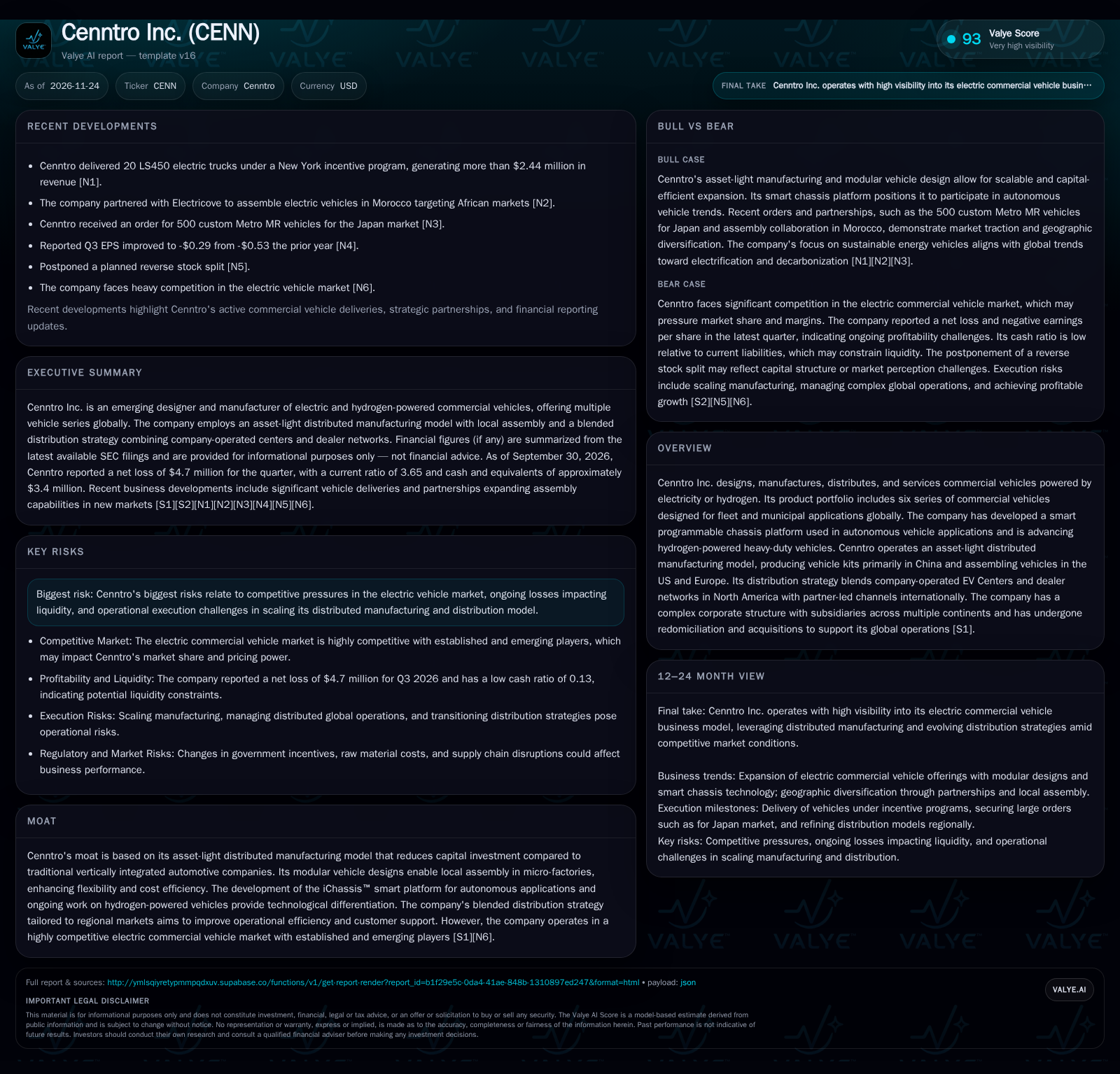
Cenntro Inc. is advancing an asset-light model to manufacture and distribute electric and hydrogen-powered commercial vehicles across global markets, recently securing notable orders and partnerships. The company's programmable iChassis™ platform and strategic shift to blended distribution could offer leverage in autonomous and diversified markets, but competition and operational complexity remain central challenges. Investors should focus on order conversion, cash burn, and evidence of margin improvement as near-term signals of viability. [S1] [S2] [N1] [N2] [N3] [N5] [N6]
Cenntro Inc. is attempting to carve a niche in the global electric commercial vehicle market by marrying flexible, asset-light manufacturing with modular vehicle platforms and a blend of direct and partner-led distribution. The interplay between Cenntro’s innovative platform ambitions, its evolving go-to-market approach, and the realities of capital constraints will likely determine whether it can transition from emerging player to durable operator in an intensely competitive landscape.
Recent Orders, Partnerships, and Liquidity Pressures Define Near-Term Outlook
Cenntro has recently delivered 20 LS450 electric trucks under a New York state incentive program, generating over $2.44 million in revenue, and secured an order for 500 custom Metro MR vehicles for the Japan market [N1] [N3]. The company has also partnered with Electricove to establish EV assembly in Morocco, targeting African markets [N2]. Despite these commercial wins, Cenntro reported a net loss of $4.7 million for Q3 2026, with cash and equivalents of $3.4 million and a cash ratio of just 0.13 [S2]. The company postponed a planned reverse stock split, signaling either market or capital structure uncertainty [N5]. The company reported cash and liquidity metrics for the period; these figures do not by themselves establish operating runway, investment capacity, financial flexibility, or financing capacity.
Asset-Light Model and Modular Platforms: Economic Promise and Practical Frictions
Cenntro’s asset-light strategy centers on producing semi-knockdown vehicle kits in China for local assembly in the US, Europe, and partner regions. This approach minimizes upfront capital expenditure and can accelerate market entry, especially in regions with high import tariffs or local content requirements. By distributing vehicles as kits or fully assembled units, Cenntro aims for cost flexibility and rapid scaling. The company’s modular iChassis™ platform, designed for third-party autonomous vehicle applications, could enable high-margin licensing or integration revenues if market adoption materializes.
However, this distributed model introduces complexity: coordinating global supply chains, ensuring assembly quality, and managing working capital across continents all present scaling risks. If Cenntro can ramp volume and improve mix toward higher-value platforms or services, fixed-cost leverage could improve. But, absent clear evidence of gross margin improvement or recurring revenue from software/platform sales, the economics remain vulnerable to demand shocks and competitive price pressure.
Navigating a Crowded EV Landscape: Differentiation and Defensibility
Cenntro operates in a fiercely competitive global market for electric commercial vehicles, contending with both established automotive OEMs and aggressive new entrants [N6]. The company’s differentiation rests on three pillars: its asset-light, distributed manufacturing model; modular vehicle series tailored for fleet and municipal applications; and the iChassis™ smart platform targeting autonomous and programmable use cases. The move to blend company-operated EV Centers with local dealer networks in North America, while relying on partner-led distribution internationally, is designed to balance control with reach.
Despite these potential advantages, the company’s defensibility is not entrenched. Larger competitors benefit from scale, brand, and broader R&D budgets. Cenntro’s modular approach may offer speed and flexibility, but it must prove durable quality, cost efficiency, and customer support across geographies. The programmable chassis could open new B2B markets if autonomous adoption accelerates, but this is still an emerging opportunity. Without clear evidence of switching costs, network effects, or proprietary technology adoption, Cenntro’s moat remains modest and largely unproven.
If Order Momentum Converts to Sustainable Scale: Pathways to Margin Recovery
In a favorable scenario, Cenntro’s recent large orders and global partnerships serve as a catalyst for volume ramp, operational leverage, and improved margins. If the 500-unit Japan order is delivered on time and followed by similar fleet contracts, and African assembly partnerships yield recurring demand, Cenntro could approach scale economies that reduce per-unit costs and improve gross margin. Successful deployment of the iChassis™ platform for autonomous commercial vehicles may create a new high-margin revenue stream, especially if third-party integrators adopt it for specialized logistics or municipal applications.
Confirmation of this scenario would require evidence of sequential revenue growth, expanding gross margin, and positive operating cash flow. Announcements of repeat orders, expansion of assembly partnerships, and commercial wins for the iChassis™ platform would further validate demand traction. If Cenntro can demonstrate a shift in revenue mix toward software, integration, or value-added services, the case for margin recovery and business model durability strengthens.
Balancing Incremental Growth with Persistent Operating Strain
The most plausible scenario is one of modest revenue growth offset by continued operating losses and intermittent liquidity pressure. Cenntro’s distributed manufacturing model and new partnerships may yield slow but steady order flow and geographic expansion, but fixed costs, margin pressure from competition, and the complexities of managing global assembly could keep the company in a loss-making position. The transition to a blended distribution model in North America could improve customer reach and aftersales support, but benefits may be gradual and contingent on effective execution.
In this scenario, evidence would include ongoing but lumpy order announcements, persistent net losses, and recurring needs for external funding or capital structure adjustments (such as reverse splits or equity raises). Absence of clear margin expansion or recurring revenue from platform/software offerings would confirm that Cenntro remains in a transitional phase, with execution risk and cash burn as persistent themes.
Liquidity Constraints and Execution Gaps Derail Expansion Ambitions
If new orders fail to convert to timely revenue or partnerships stall—due to regulatory hurdles, supply chain disruptions, or partner underperformance—the company could lose momentum in key markets. Competitive pricing pressure may further erode gross margins, deepening losses.
Evidence for this scenario would include order cancellations or deferrals, widening net losses, negative operating cash flow, and announcements of urgent financing measures or restructuring. A failure to deliver on high-profile contracts (such as the Japan order) or to establish recurring assembly volume in new regions would signal execution shortfalls. If the company resorts to repeated reverse split postponements or distressed equity issuance, confidence in its long-term viability would erode.
Thesis-Testing Benchmarks for Cenntro’s Operating and Financial Trajectory
Sequential revenue growth from large orders such as the Japan contract, and evidence of repeat business from new markets, would help test Cenntro’s ability to scale.
Gross margin trends, if disclosed, are vital for assessing whether the asset-light model is translating into improved unit economics or remains vulnerable to cost inflation and pricing pressure.
Operating cash flow and cash burn rates should be tracked each quarter to gauge whether incremental growth is offsetting fixed costs or deepening liquidity risk.
Order conversion rates and delivery timelines, especially for flagship deals, would reveal execution reliability and customer satisfaction.
The pace and terms of any new capital raises, credit facilities, or capital structure changes (such as reverse splits) will indicate external confidence and funding flexibility.
Adoption and monetization of the iChassis™ platform—measured by third-party integrations or software/service revenue, if disclosed—would clarify platform economics.
Progress in establishing recurring assembly volume or local partnerships (e.g., Morocco deal) and related regional market traction will be critical to geographic diversification.
Competitive market developments—such as new product launches or pricing moves by established EV players—should be monitored for their impact on Cenntro’s positioning and margin outlook.
Disclaimer: This is research-only, informational analysis and not investment advice. It may include AI-generated interpretation and general industry context. Always verify important details using primary sources.

Comments