
Accustem Sciences: Clinical Validation Meets Commercial Hurdles in Oncology Genomics
The company’s future hinges on regulatory approvals, payer reimbursement, and its ability to differentiate in a crowded diagnostics landscape.
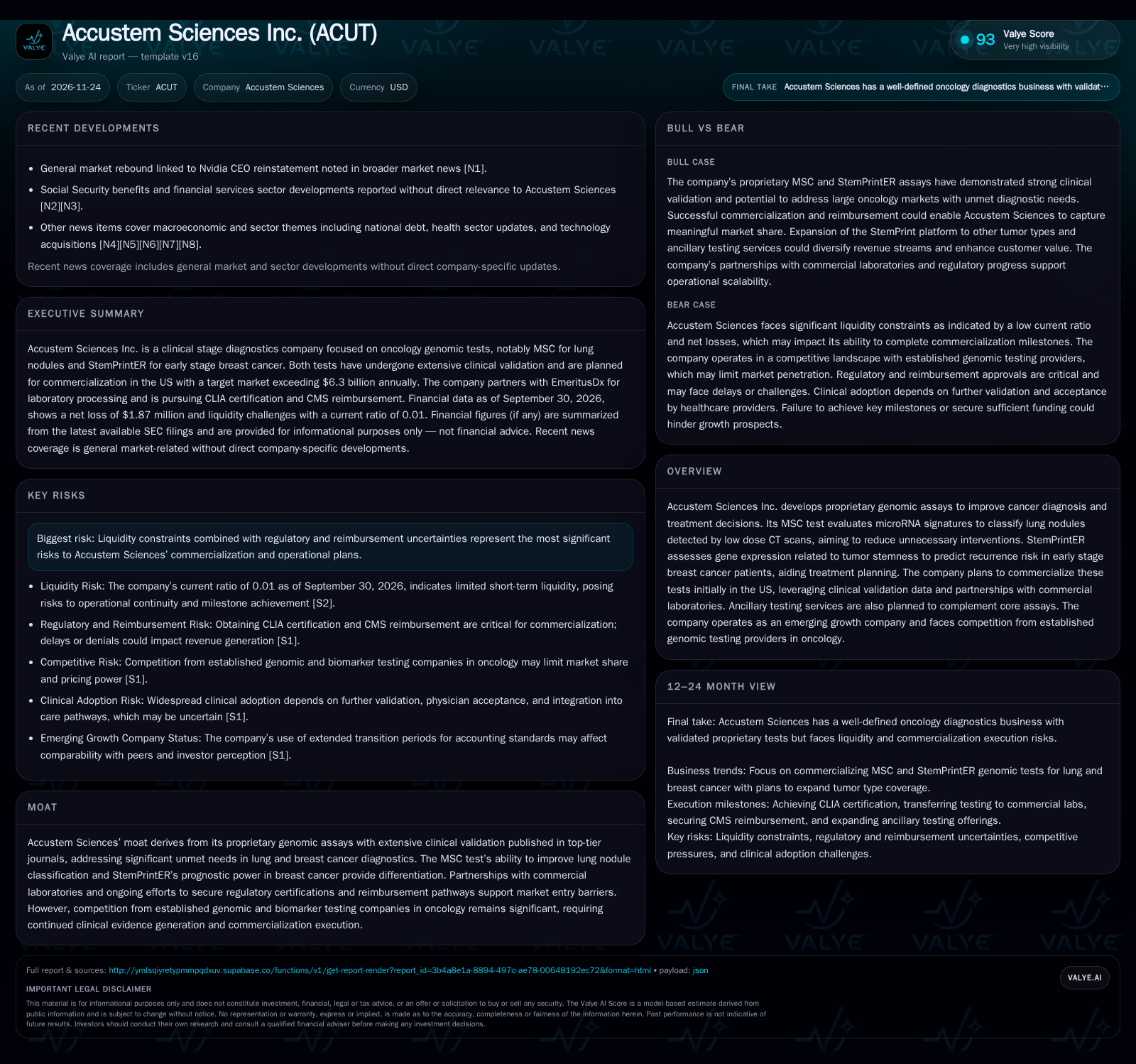
Accustem Sciences is advancing two proprietary genomic tests for oncology care—MSC for lung nodules and StemPrintER for early stage breast cancer—with extensive clinical validation and a targeted US market exceeding $6.3 billion annually. Competition from entrenched genomic testing players intensifies the challenge.
Accustem Sciences sits at the intersection of robust clinical science and acute business risk. With two proprietary genomic assays—MSC for lung nodule classification and StemPrintER for breast cancer recurrence risk—validated in thousands of patients and targeting a US market opportunity of over $6.3 billion, the company’s scientific foundation is clear. The next phase will test whether Accustem’s differentiated diagnostics can secure the approvals, payer contracts, and capital needed to thrive in a fiercely contested space.
Liquidity Crunch and Commercialization Milestones Define the Present
[S2] This acute financial stress raises the urgency of achieving near-term commercialization milestones for its two lead genomic assays: MSC for lung nodules and StemPrintER for breast cancer. Both tests have been validated in large patient cohorts and are positioned for initial US commercialization, with partnerships such as EmeritusDx established for laboratory processing [S1]. The company has filed for CMS coverage of MSC and is targeting CLIA certification, while also planning to broaden its platform with ancillary and tumor-type expansions [S1]. These facts frame a company with clear technical momentum but a precarious operational footing.
How Proprietary Assays Could Drive Revenue—If Commercial Barriers Fall
Accustem’s intended business model is service-based, deriving revenue from proprietary genomic testing ordered by healthcare providers for oncology patients. In practice, this means per-test revenue—typically ranging from several hundred to several thousand dollars in the US—conditional on reimbursement and clinical adoption. The company’s targeted serviceable market exceeds $6.3 billion annually for the initial lung and breast cancer indications [S1].
The economics of such diagnostics businesses typically exhibit high gross margins once reimbursement is secured and fixed costs—such as clinical validation, regulatory compliance, and laboratory partnerships—are absorbed. Variable costs per test are often modest, especially when leveraging partner labs, but the company must invest in sales, medical affairs, and payer engagement to drive volume. Accustem’s plan to augment proprietary assays with ancillary commodity testing could diversify revenue and improve customer stickiness, but would likely come at lower margins.
However, the capital intensity of launching a new clinical diagnostics platform is significant. Upfront investments in regulatory approval, clinical studies, and commercial infrastructure are required before meaningful revenue can be realized.
The scalability of Accustem’s service-based model hinges critically on the efficiency of its laboratory partnerships and the ability to integrate seamlessly into existing clinical workflows. If the company can demonstrate consistent turnaround times and reliable assay performance, it may reduce barriers to adoption among oncologists and pulmonologists who prioritize diagnostic speed and accuracy. Additionally, payer reimbursement is often contingent not only on clinical validity but also on demonstrated clinical utility and health economic benefit. Therefore, Accustem’s ongoing efforts to generate real-world evidence and health economic modeling will be pivotal in convincing payers to cover their tests at favorable rates. The timing and success of these activities will directly impact revenue growth trajectories and capital requirements.
Barriers and Vulnerabilities in a Crowded Oncology Diagnostics Arena
Accustem faces entrenched competition from established genomic and biomarker testing companies in both lung and breast cancer. Key competitor categories include multi-gene and RNA signature assays for lung nodule risk (e.g., Biodesix, Veracyte) and breast cancer recurrence (e.g., Agendia, Exact Sciences, Hologic) [S1]. These incumbents benefit from existing clinical adoption, payer contracts, and brand recognition.
Accustem’s differentiation rests on the breadth and scale of its clinical validation—over 5,000 patients for MSC and 3,000 for StemPrintER—as well as the proprietary nature of its signatures [S1]. If these attributes translate into superior clinical utility or cost-effectiveness, the company could carve out share, especially if it can offer faster turnaround or more actionable results. However, switching costs for clinicians and health systems are often high due to established diagnostic protocols and payer formularies. The company’s partnership approach with EmeritusDx may help accelerate market entry but does not guarantee uptake if competitors respond with pricing pressure, bundled offerings, or expanded indications.
Pathway to Market: Regulatory Wins and Early Adoption Unlock Growth
In a favorable scenario, Accustem secures CLIA certification and CMS reimbursement for MSC and StemPrintER within the next 12-18 months, validating the clinical and economic value of its assays. These milestones would enable commercial launch and payer coverage, driving test volume growth through partnerships with laboratory networks like EmeritusDx. Early clinical adopters, attracted by strong published validation and the potential to reduce unnecessary interventions (in lung nodules) or optimize treatment (in breast cancer), could establish a beachhead in key academic and community oncology centers.
Commercial traction, combined with execution of planned ancillary and tumor-type expansion, could create a diversified revenue base and improve cash flow, positioning the company to raise additional capital on more favorable terms. Confirmation of this scenario would come from announced CMS/local MAC coverage, reported test order volumes, and new lab or payer partnerships. The scenario would be falsified by regulatory or reimbursement setbacks, continued cash burn without revenue inflection, or lack of clinical uptake.
Most Likely Trajectory: Gradual Progress Amid Persistent Constraints
The most plausible path for Accustem is one of incremental progress punctuated by ongoing financial strain. The company may achieve CLIA certification and some degree of laboratory readiness, but reimbursement timelines—especially from CMS—are often protracted, and commercial test volume may ramp slowly due to entrenched competitors and the need to build clinical trust.
Ancillary testing and tumor-type expansion could augment revenue but likely at lower margins and with additional regulatory hurdles. Evidence confirming this scenario would include partial regulatory progress, modest revenue initiation, and ongoing net losses. Signs of falsification would be either a rapid commercial inflection (upside) or failure to secure key certifications or funding (downside).
Liquidity Shortfall or Regulatory Delays Force Strategic Retreat
In the adverse scenario, Accustem’s liquidity position deteriorates further before commercialization milestones are achieved. Regulatory or reimbursement setbacks—such as a denied CMS application or delayed CLIA certification—could block revenue initiation. The company may be forced to curtail operations, delay product launches, or seek distressed financing on highly dilutive terms.
Competitive pressures could intensify if incumbents accelerate innovation or lock in key labs and payers, reducing Accustem’s addressable market. In this scenario, evidence would include missed regulatory milestones, further deterioration in the current ratio, layoffs or cost-cutting measures, and potential going-concern warnings in filings. The scenario would be falsified if the company secures bridge financing, achieves a regulatory breakthrough, or announces significant commercial wins.
Milestones That Will Define Accustem’s Diagnostic Ambitions
Progress and outcome of the CLIA certification process for MSC and StemPrintER; confirmation of certification would validate readiness for commercial testing.
CMS and commercial payer reimbursement decisions for MSC and StemPrintER, especially the outcome of the Novitas Solutions application for MSC.
Reported test order volumes and revenue initiation through EmeritusDx and other lab partnerships—if disclosed—would be critical for assessing commercial traction.
Expansion of the test menu to ancillary or additional tumor-type assays; announcements or clinical validation results would indicate pipeline execution.
Updates on competitive positioning, such as head-to-head data, pricing strategies, or customer wins against entrenched genomic testing companies.
Changes in the regulatory or reimbursement landscape affecting genomic oncology diagnostics more broadly, which could shift the company’s addressable market or margin outlook.
If disclosed, customer retention or repeat ordering metrics, which would help test the stickiness and clinical utility of Accustem’s offerings.
Disclaimer: This is research-only, informational analysis and not investment advice. It may include AI-generated interpretation and general industry context. Always verify important details using primary sources.

Comments