
Bath & Body Works: Transformation, Channel Diversification, and the Margin Puzzle
Amid ongoing transformation and cost-saving efforts, Bath & Body Works is leaning into digital and wholesale growth to offset stagnant store sales. The core question is whether operational efficiencies and channel innovation can restore margin momentum in a competitive retail environment.
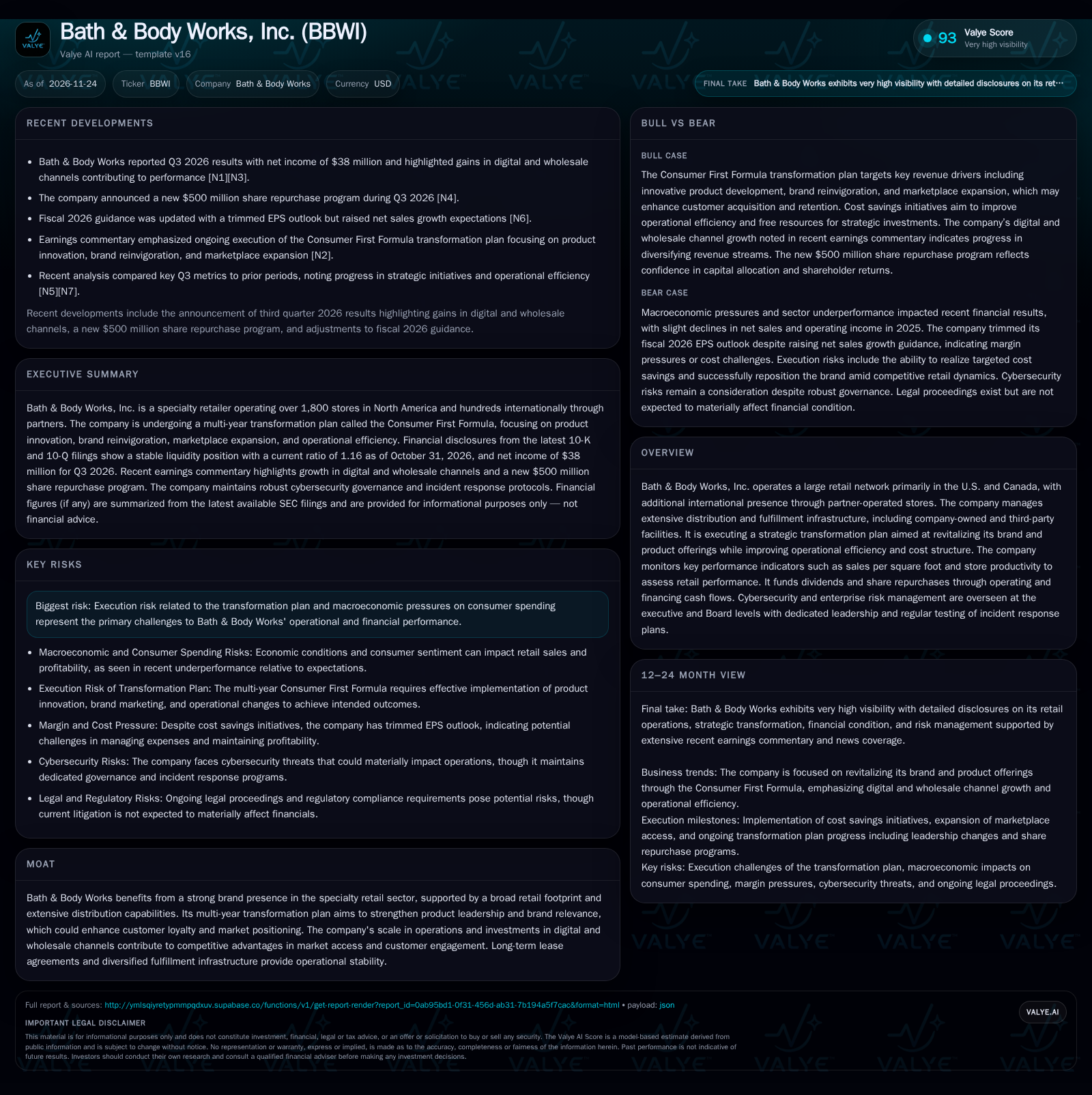
Bath & Body Works is progressing through a multi-year transformation plan focused on product innovation, brand reinvigoration, and operational efficiency. Despite a new $500 million share repurchase program and raised net sales growth guidance for 2026, margin pressures persist as evidenced by a trimmed EPS outlook and declining operating income. Gains in digital and wholesale channels provide diversification, but the company’s ability to translate efficiency and innovation into sustained profitability remains the critical test. [S1] [S2] [N3] [N4] [N6]
Bath & Body Works, Inc. faces a pivotal moment as it executes its Consumer First Formula transformation, balancing ambitious cost savings with the need to reignite revenue growth through product and channel innovation. While the company’s vast North American retail presence and international partnerships provide scale, recent financials reveal a tension between rising digital and wholesale momentum and persistent margin pressures. The effectiveness of cost initiatives and the durability of brand reinvigoration efforts will shape whether Bath & Body Works can reestablish itself as a specialty retail leader or remain pressured by sector headwinds.
Recent Earnings Highlight Channel Gains Yet Expose Margin Stress
Bath & Body Works reported net income of $38 million in Q3 2026, with a current ratio of 1.16 and cash and equivalents totaling $318 million as of October 31, 2026 [S2]. The company announced a new $500 million share repurchase program in Q3 2026, suggesting continued focus on shareholder returns [N4].
Management raised net sales growth guidance for fiscal 2026 on the back of digital and wholesale channel gains, but concurrently trimmed the full-year EPS outlook [N3] [N6]. This divergence signals that while topline prospects are improving due to diversification efforts, margin compression or cost headwinds remain unresolved. Operating income for 2025 had already declined 11% from the prior year, reinforcing the need for the ongoing Consumer First Formula transformation to deliver both growth and efficiency [S1].
How Bath & Body Works Makes—and Could Lose—Money
Bath & Body Works derives the majority of its revenue from proprietary branded personal care, fragrance, and home products sold through its extensive store network, digital platforms, and wholesale arrangements. The company’s economics hinge on a blend of volume-driven retail sales, product mix innovation, and increasingly, digital and third-party channel expansion.
Retail operations are capital-intensive, with significant fixed costs tied to store leases (typically five to ten years, staggered through 2036), distribution infrastructure, and labor. This creates operating leverage—incremental sales can boost margins if fixed costs are covered, but declining store productivity or negative comps can quickly erode profitability.
Digital and wholesale channels may offer lower marginal costs per transaction and broader reach, but often come with lower gross margins due to shipping, fulfillment, and potential channel partner discounts. The company’s $250 million cost savings plan over two years, with $175 million targeted in 2026, is designed to counteract these pressures and free up resources for reinvestment in growth [S1].
A crucial variable is product innovation and brand resonance. If successful, premiumization and new product launches could support higher average selling prices and offset promotional pressures. However, if store traffic stagnates or digital growth fails to deliver incrementally accretive margins, the earnings model could remain under pressure.
Brand Scale, Retail Density, and the Race Against Category Substitution
Bath & Body Works enjoys a strong brand and broad retail footprint, operating 1,814 stores in the U.S. and 113 in Canada as of January 2026, plus 573 partner-operated international stores [S1]. This scale provides market access, brand visibility, and the ability to test and rapidly deploy new products across geographies.
However, competition is fierce from other specialty retailers (e.g., Lush, The Body Shop), mass merchants (e.g., Target, Walmart), and increasingly from online-native brands and direct-to-consumer upstarts. The shift to digital and wholesale channels is necessary to remain relevant, but these channels also reduce traditional barriers to entry and increase pricing transparency.
Switching costs for consumers are modest in personal care and home fragrance, making brand loyalty contingent on perceived product quality, innovation, and in-store or digital experience. The Consumer First Formula’s emphasis on product innovation and marketplace expansion is a direct response to these competitive realities.
Operationally, Bath & Body Works’ fulfillment infrastructure—combining company-operated and third-party centers—provides flexibility to position inventory closer to end customers, potentially reducing delivery times and costs. This could be a differentiator if managed efficiently, but fulfillment complexity also raises execution risk.
If Innovation and Channel Expansion Restore Margin Trajectory
The bull case is that Bath & Body Works’ transformation plan succeeds in driving higher-margin growth through a combination of compelling product launches, brand reinvigoration, and digital/wholesale expansion. If cost savings targets are met—$250 million over two years, with $175 million in 2026—these funds can be redeployed into customer acquisition, digital experience, and supply chain optimization [S1].
Evidence for this scenario would include: accelerating same-store sales, rising gross and operating margins, sustained growth in digital and wholesale revenue outpacing cannibalization of store sales, and visible gains in customer engagement metrics. Successful product launches that command premium pricing or expand the addressable market would further strengthen the case.
Confirmation would also come from management raising both sales and EPS guidance, a reversal from the current pattern of raised sales but trimmed earnings outlook. External validation could include market share gains in core categories and positive third-party brand perception surveys.
Transformation Delivers Mixed Results Amid Ongoing Margin Friction
The most probable scenario is that Bath & Body Works continues to post modest sales growth driven by digital and wholesale gains, but margin recovery lags due to persistent cost inflation, promotional activity, and competitive discounting. The Consumer First Formula delivers incremental operational efficiencies and some product successes, but the pace of transformation is offset by sector headwinds and the need to invest in omnichannel capabilities.
Performance would be characterized by steady but limited net sales growth, flat or slightly declining operating margins, and continued capital return via buybacks and dividends, albeit with cautious guidance. Cost savings and efficiency gains are partially realized, but not enough to fully offset structural pressures on profitability.
Evidence supporting this scenario includes ongoing divergence between net sales and EPS guidance, margin compression in quarterly results, and management commentary emphasizing the need for further transformation or external market challenges.
Execution Slips and Margin Compression Accelerates
The bear case is that macroeconomic weakness, execution missteps, or intensifying competition prevent Bath & Body Works from achieving its cost savings and brand reinvigoration objectives. Store traffic could decline further, digital and wholesale sales may fail to deliver accretive margins, and promotional intensity could escalate, squeezing profitability.
This scenario could be triggered by unexpected increases in input or labor costs, delays or failures in product innovation, or cybersecurity incidents disrupting operations. Legal or regulatory setbacks, while not currently material, could also emerge.
What Will Prove Whether Bath & Body Works’ Transformation Is Working
Quarterly trends in same-store sales and digital/wholesale channel growth versus prior years and retail peers.
Gross and operating margin progression, especially relative to cost savings targets and promotional activity (if disclosed).
Progress reports on the $250 million cost savings initiative, with evidence of reinvestment into growth-driving initiatives.
Customer engagement and retention metrics—such as loyalty program participation, repeat purchase rates, and digital traffic—would help test the thesis.
Store productivity measures, such as sales per square foot and store-level EBITDA, if disclosed.
Changes in management’s guidance for both net sales and EPS, and whether future revisions become more positive or negative.
Any material cybersecurity incidents or regulatory/legal developments impacting operations or financials.
Disclaimer: This is research-only, informational analysis and not investment advice. It may include AI-generated interpretation and general industry context. Always verify important details using primary sources.

Comments