
Invech Holdings: Navigating Microcap Compliance Consulting Without Revenue or Liquidity
Invech Holdings, Inc. has repositioned as a microcap compliance consulting firm targeting OTC-listed companies, yet faces acute financial strain with no current revenue, no liquid assets, and a highly speculative business model. The company’s ability to secure funding or clients will determine its viability in a niche but competitive regulatory advisory space.
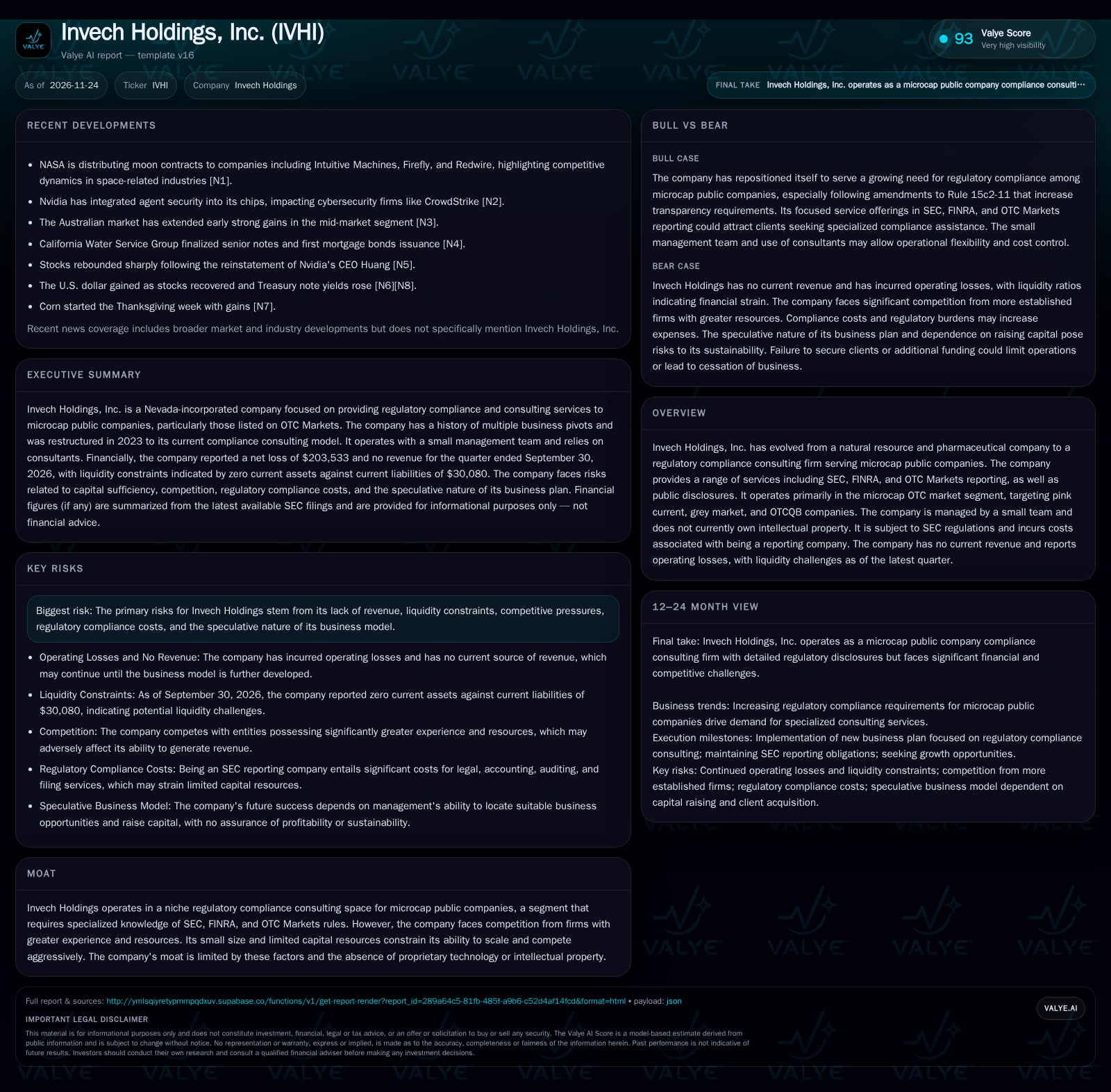
Invech Holdings has pivoted to providing regulatory compliance services for microcap OTC companies but currently reports no revenue, operating losses, and zero liquidity. The company’s future hinges on its ability to win clients or raise capital in a competitive market, with execution and solvency as near-term existential questions. [S1] [S2]
Invech Holdings, Inc. exemplifies the volatility and risk inherent in the microcap compliance consulting sector. Having exited its previous natural resource and pharmaceutical pursuits, the company now focuses on regulatory advisory services for some of the most opaque and under-resourced segments of the public markets. However, with no revenue, persistent operating losses, and no liquid assets as of September 2026, Invech’s current posture raises fundamental questions about its ability to survive long enough to capitalize on increasing regulatory scrutiny in the OTC ecosystem. The next phase for Invech will be defined by its capacity to secure paying clients or urgently needed capital amid intensifying competition and mounting compliance costs. [S1] [S2]
Acute Financial Strain Defines Invech’s Present Reality
Invech Holdings’ latest financials underscore a precarious position: the company reported zero current assets and $30,080 in current liabilities as of September 30, 2026, with a net operating loss of $203,533 for the quarter and no revenue. The basic and diluted EPS for the period was negative, confirming the absence of any operating income or buffer against ongoing costs. [S2] These facts matter because they represent not just a lack of growth, but a lack of ongoing commercial activity—raising the specter of insolvency if new funding or revenue is not secured in the immediate term.
Operationally, Invech continues to target microcap OTC-listed companies for compliance consulting, offering SEC, FINRA, and OTC Markets reporting services. The business is managed by a single executive, Rhonda Keaveney, with reliance on external consultants and contractors rather than full-time staff. [S1] The absence of intellectual property or proprietary systems further limits differentiation or defensibility in the marketplace.
Consulting Model Without Revenue: The Challenges of Scaling Regulatory Services
Invech’s intended business model is service-based, aiming to generate revenue by assisting microcap public companies with complex regulatory filings and compliance requirements. Typical economics for such services would involve project-based or retainer fees, with costs dominated by labor (consultants, legal, accounting) and minimal capital expenditure. Theoretically, a variable-cost structure could allow for scaling as client volume increases, but in practice, the absence of revenue means that fixed costs—such as regulatory compliance for Invech itself—are not being offset.
Without current clients or contracts, Invech’s model is entirely speculative; there is no evidence of pricing power, client retention, or recurring revenues. The lack of intellectual property or proprietary technology precludes premium pricing or automation-driven margin expansion. Operating leverage could only emerge if the firm secured a client base large enough to cover fixed reporting and overhead costs, but with no revenue, the risk is that costs will continue to outpace any near-term inflows. Additionally, as a reporting company, Invech faces its own compliance costs, which are significant for microcaps and contribute directly to ongoing losses.
Fragmented Market, High Competition, and Barriers to Entry
The regulatory compliance consulting market for microcap OTC companies is fragmented, with numerous small firms, legal practices, and specialized consultancies vying for business. Larger, established professional services firms offer greater resources, reputational assurance, and integrated offerings, which can be particularly attractive to companies concerned with regulatory risk.
Invech’s lack of intellectual property and reliance on consultants means it has little in the way of defensible differentiation. While its focus on the OTC and grey market niches may offer some insulation from the largest competitors, the very nature of these markets means that clients are often resource-constrained and highly price-sensitive. Switching costs are low, as compliance services are transactional and commoditized unless bundled with more strategic advisory or technology. The absence of long-term contracts or recurring revenue further weakens any potential moat.
Counterforces include regulatory changes that could increase demand for compliance but also raise the baseline for provider qualifications and technology investment—areas where Invech is currently disadvantaged.
Client Wins and Regulatory Tailwinds Could Catalyze a Turnaround
A favorable scenario for Invech would require the rapid acquisition of paying clients in the microcap OTC segment, possibly catalyzed by further tightening of SEC or FINRA disclosure rules. If the company were able to secure contracts for compliance reporting or ongoing advisory services, it could begin generating fee-based revenue, covering its fixed costs and potentially moving toward breakeven.
Confirmation of this scenario would be evidenced by the announcement of new client engagements, signed service contracts, or recognized revenue in future filings. Additional validation would come from any capital raise or strategic partnership that provides the working capital necessary to support client onboarding and delivery. Evidence that would falsify this scenario includes continued reporting of zero revenue, lack of disclosed client relationships, or further deterioration in liquidity.
Stalled Operations Amid Funding and Execution Uncertainty
Given the current absence of revenue, zero liquid assets, and the lack of announced client wins, the most plausible near-term scenario is that Invech continues to operate in a holding pattern—incurring compliance and administrative costs while seeking new funding or business opportunities. The company may attempt to raise capital through equity or debt issuances, but its lack of operating traction could make funding prohibitively expensive or dilutive.
This scenario would be confirmed by further quarters of operating losses, continued zero revenue, and no material change in the company’s client roster or service delivery. A potential falsification would be a sudden announcement of a business combination, acquisition, or pivot to another business model—though such moves would likely be driven by necessity rather than strategic intent.
Liquidity Exhaustion and Potential Cessation of Business
The negative scenario is straightforward: absent new capital or paying clients, Invech depletes its ability to meet even basic obligations, forced either into further custodianship, dissolution, or a distressed sale. With no liquid assets and ongoing operating losses, the company may be unable to pay service providers, comply with its own SEC filing requirements, or even maintain its listing.
Confirmation of this scenario would include failure to file required disclosures, auditor resignations, legal actions from creditors or contractors, or explicit statements about the inability to continue as a going concern. An extended period with no material developments or further negative balance sheet movements would also corroborate this outcome.
Milestones That Will Define Invech Holdings’ Survival Prospects
Any disclosure of signed client contracts, recognized revenue, or engagement agreements would provide evidence that the business model is gaining traction.
A capital raise—whether through private placement, public offering, or debt facility—would signal short-term survival capacity and enable operational runway.
If disclosed, metrics on client pipeline, inbound inquiries, or proposal activity would help gauge the pace of potential business development.
Quarterly filings showing a reversal of operating losses, or at least a narrowing of the loss, would indicate improved cost discipline or revenue onset.
Announcements regarding partnerships with legal, accounting, or technology firms could enhance service differentiation or expand addressable market.
Any change in regulatory environment (e.g., new SEC rules affecting microcap disclosures) could act as an external catalyst for demand—monitor for company commentary or client wins linked to such changes.
Disclosure of changes in management, auditor opinions on going concern, or missed filing deadlines would signal acute financial or operational distress.
A useful metric would be the number of repeat or multi-period client engagements, as this would indicate some level of recurring business and customer retention.
Disclaimer: This is research-only, informational analysis and not investment advice. It may include AI-generated interpretation and general industry context. Always verify important details using primary sources.

Comments