
Vystar Corp: Patented Eco-Friendly Materials Meet Severe Liquidity Constraints and Challenging Adoption Hurdles
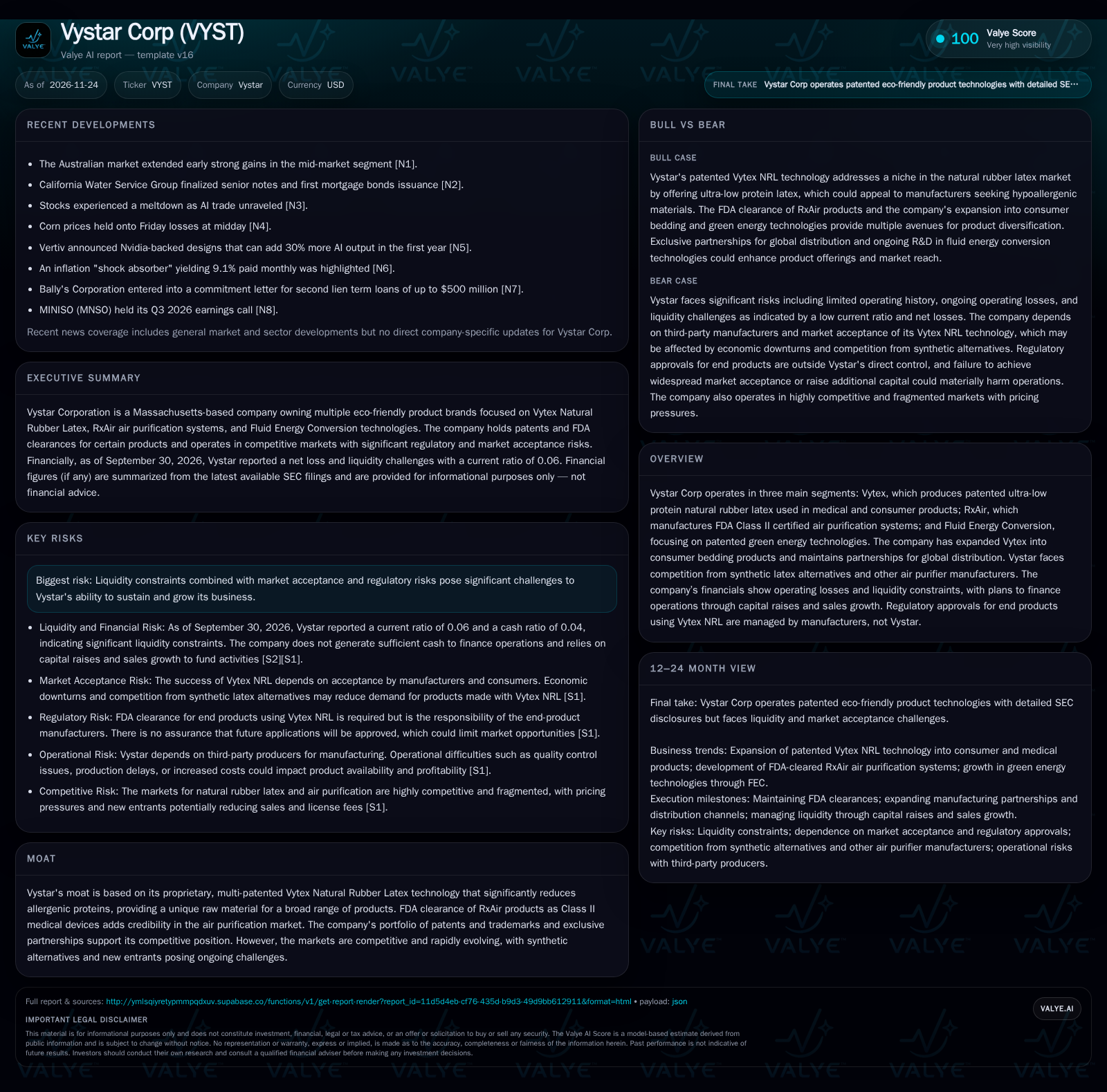
Vystar Corp’s ultra-low protein Vytex latex and FDA-cleared RxAir air purification systems offer differentiated technology, but the company’s critical liquidity shortfall and dependence on external partners raise questions about its ability to execute and scale. Future prospects hinge on market acceptance, regulatory wins by downstream partners, and urgent capital infusion.
Its growth depends on downstream manufacturers securing regulatory clearance, market adoption of eco-friendly latex, and the company’s ability to raise new capital or drive sales traction. Execution risk is high given today’s financial position and single-employee structure. [S1] [S2]
Vystar Corp positions itself as an innovator in sustainable materials and air purification, but its patented Vytex latex and FDA-cleared RxAir products have yet to translate into commercial momentum or financial stability. The company’s acute liquidity crunch, reliance on external capital, and dependence on third-party manufacturers and regulatory outcomes create formidable obstacles to scaling its technology. Investors and partners must weigh the durability of its intellectual property against execution risk and the urgent need for capital, especially as market acceptance and regulatory wins remain largely outside Vystar’s direct control. [S1] [S2]
Acute Liquidity Pressure and Market Adoption Uncertainty Define Vystar’s Present
As of September 30, 2026, Vystar Corp reported current assets of $437,906 against current liabilities of $7,667,172, yielding a current ratio of just 0.06 and a cash ratio of 0.04—signaling a critical liquidity shortfall. The company posted a net loss of $91,532 for the period, and its latest disclosures confirm it does not generate enough cash from operations to fund ongoing activities, instead relying on capital raises and hoped-for sales growth. [S2] [S1]
On the product side, Vystar’s Vytex brand holds patents for an ultra-low protein, fully biodegradable natural rubber latex, used in medical, consumer, and bedding products. However, actual market uptake is dependent on third-party manufacturers, and an American partner with FDA clearance for Vytex-based products is not currently producing them. The RxAir division, built on FDA-cleared air purification devices, has credible technology but operates in a fragmented market with many competitors. [S1]
The company’s operational footprint is minimal; as of December 31, 2025, it had only one employee, raising questions about its ability to execute partnerships, support customers, or drive sales. [S1]
Revenue Potential Hinges on Licensing, Partnerships, and Capital Efficiency
Vystar’s business model appears to be built around licensing and supply of patented Vytex latex to product manufacturers, direct sales of RxAir air purification devices, and potentially monetizing Fluid Energy Conversion (FEC) technology through licensing or joint ventures. If Vytex latex is adopted at scale, the company could benefit from volume-driven royalty or margin streams with relatively low fixed costs, given its lean structure.
However, the economics are heavily contingent on third-party manufacturers’ willingness and ability to secure regulatory approval for Vytex-containing end products—particularly in medical and healthcare applications. Without direct manufacturing or control over the regulatory process, Vystar’s revenue timing is unpredictable and subject to external delays.
In air purification, RxAir’s FDA clearance is a potential differentiator, but competition is fierce and price-sensitive. The company would need to secure robust distribution partnerships or direct-to-consumer traction to achieve meaningful sales. With only one employee, scaling sales, managing customer support, and maintaining regulatory compliance may require additional investment or outsourcing, which could pressure margins.
The company’s severe liquidity constraints mean it must either rapidly secure external funding or achieve a step-change in product sales to cover operating costs. Its cost base is likely low, but the inability to fund even minimal operations raises the risk of business interruption or distressed asset sales. [S2] [S1]
Patented Technology Offers Niche Differentiation, But Scale and Substitution Risks Persist
Vystar’s main competitive advantage lies in its portfolio of patents around Vytex NRL, which offers a hypoallergenic, biodegradable alternative to traditional latex and synthetic substitutes. This could appeal to medical device manufacturers and eco-conscious consumer brands, especially as regulatory and market pressure for sustainable materials increases.
However, the natural rubber latex market is mature, and synthetic alternatives (such as nitrile or neoprene) are entrenched due to cost, supply stability, and established regulatory pathways. Even in the U.S., where the majority of exam and surgical gloves are still latex-based, switching to Vytex would require manufacturers to invest in new regulatory filings and potentially retooling. The question is whether the allergy and sustainability benefits are compelling enough to overcome inertia and cost concerns.
In air purification, RxAir’s FDA Class II clearance provides a mark of credibility, but the market is crowded with both established brands and new entrants, many of whom compete aggressively on price and marketing. Without strong distribution or brand recognition, Vystar’s share could remain marginal.
Exclusive global distribution partnerships (e.g., with Corrie MacColl Limited for Vytex) offer a pathway to broader market access, but the effectiveness of these relationships will depend on the partner’s commercial execution and market demand. [S1]
Breakthrough Adoption of Vytex and RxAir Could Transform Financial Trajectory
The most favorable scenario for Vystar would see one or more major manufacturers successfully launching high-volume products using Vytex latex, supported by clear regulatory wins and demonstrable market demand for hypoallergenic, biodegradable materials. If a medical device or consumer brand achieves commercial success with Vytex-based products, Vystar could benefit from licensing revenue, supply agreements, and increased visibility, potentially attracting further manufacturing partners.
Similarly, if RxAir products gain traction in institutional or residential markets—perhaps leveraging FDA clearance as a differentiator in a post-pandemic environment—sales growth could provide much-needed operating cash and validate the brand.
Evidence supporting this scenario would include public announcements of new Vytex-based product launches by third parties, positive regulatory outcomes for those products, material increases in Vystar’s reported revenue, and successful capital raises that allow for expansion of the team and operational scale. Confirmation would also come from new, multi-year supply or distribution contracts, and improved liquidity metrics in future filings.
Survival Depends on Timely Capital Infusion and Incremental Market Penetration
The most plausible near-term outcome is that Vystar continues to operate under severe financial constraint, seeking additional private placements or bridge financing while pursuing incremental adoption of Vytex and RxAir products. Revenue may remain lumpy and insufficient to cover fixed costs, forcing management to prioritize only the most promising partnerships or licensing opportunities.
Progress in Vytex adoption will likely be slow, dependent on downstream partners’ regulatory efforts and willingness to bear the switching costs from incumbent materials. RxAir may generate modest sales, but without a significant marketing push or channel expansion, growth is likely to be limited by resource constraints.
Evidence that would confirm this scenario includes continued operating losses, further capital raises or debt issuances, and low or stagnant headcount. Conversely, a sudden improvement in liquidity, a significant uptick in sales, or new commercial partnerships would suggest the company is breaking out of this holding pattern.
Liquidity Exhaustion or Commercial Failure Could Force Asset Sales or Restructuring
If Vystar is unable to secure near-term funding or if anticipated product launches by partners fail to materialize, the company could face insolvency, forced asset divestitures, or even liquidation. The single-employee structure and negative cash flow leave little margin for error or operational setbacks.
Adverse regulatory decisions, continued lack of market acceptance for Vytex, or intensified competition in the air purification segment could further erode commercial prospects. In this scenario, patents and other intellectual property might be sold at a discount to competitors or financial buyers, and existing partnerships could dissolve.
Evidence of this downside would include public disclosures of going-concern warnings, inability to meet short-term obligations, fire-sale asset transactions, or legal proceedings related to creditor claims.
Milestones That Will Determine Vystar’s Technology Adoption and Financial Survival
Announcements of new Vytex-based product launches or regulatory approvals by third-party manufacturers—these would directly test market acceptance and the commercial value of Vystar’s IP.
Any significant change in headcount or addition of key management personnel—given the current one-employee structure, this would signal a shift in operational capacity.
Publicly disclosed multi-year licensing, supply, or distribution agreements for Vytex or RxAir products—if disclosed, these would provide evidence of commercial traction.
Revenue growth attributed to specific product lines (if disclosed), which would help distinguish between organic sales improvement and reliance on financing activities.
Updates on the status or outcomes of the Corrie MacColl Limited partnership, as this is a key channel for global Vytex distribution—progress here would validate the partnership strategy.
Any going-concern warnings, default notices, or material weaknesses in internal controls disclosed in future filings would highlight heightened financial distress.
Disclaimer: This is research-only, informational analysis and not investment advice. It may include AI-generated interpretation and general industry context. Always verify important details using primary sources.

Comments