
Digi International: Recurring Revenue Ambitions, Acquisition Integration, and the Challenge of IoT Scale
Digi International’s expanding IoT solutions portfolio, driven by recent acquisitions and a focus on recurring subscription revenues, positions it for growth in a fragmented and competitive market. The company’s ability to manage supply chain complexity, integrate new offerings, and defend margins amid evolving cybersecurity and international risks will determine whether its current momentum translates into durable value.
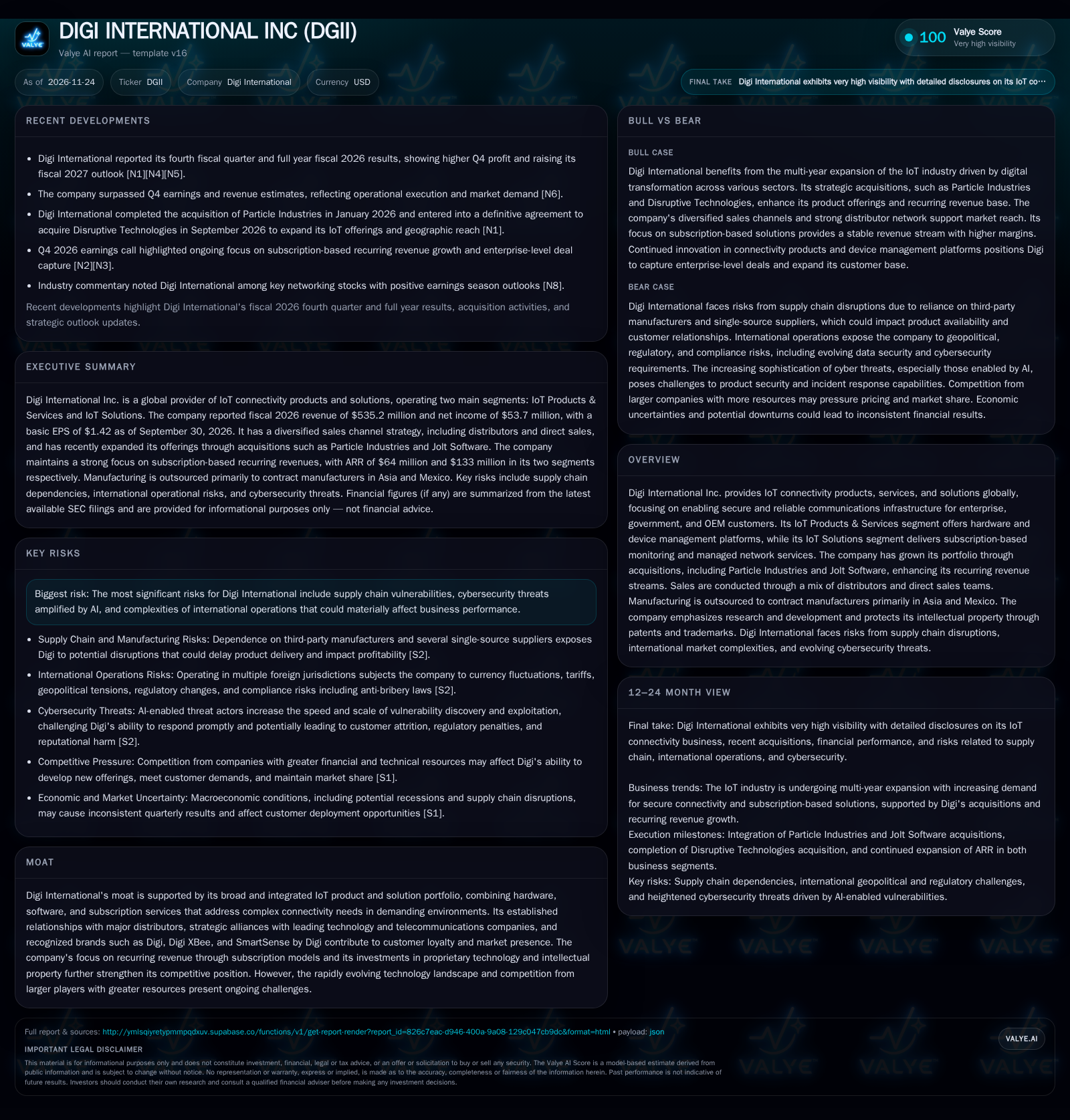
Digi International is deepening its IoT solutions business with recent acquisitions and a growing emphasis on higher-margin, subscription-based recurring revenues. With $197 million in ARR across both segments and a fiscal 2026 revenue of $535 million, Digi faces both opportunity and execution risk as it integrates new technologies, manages supply chain dependencies, and navigates global competition and cybersecurity threats [S1] [N1].
Digi International is at a pivotal juncture, leveraging a string of acquisitions and a sharpened focus on subscription-based IoT solutions to drive growth. As the company’s recurring revenue streams begin to dominate its financial profile, Digi must prove it can integrate disparate platforms, defend margins, and scale globally—while navigating persistent supply chain, cybersecurity, and competitive threats. The next phase will test whether Digi’s evolving business model can deliver sustainable value amid the complexities of the IoT landscape.
Acquisitions, Recurring Revenue, and Financial Profile: The Present Backdrop
Digi International closed fiscal 2026 with $535.2 million in revenue and a net income of $53.7 million. The company’s business is now anchored by two segments: IoT Products & Services, which generated $64 million in annualized recurring revenue (ARR), and IoT Solutions, which reached $133 million in ARR—reflecting an accelerating tilt toward subscription-based, higher-margin revenues [S1].
Recent acquisitions are materially reshaping Digi’s portfolio and market reach. The completed purchase of Particle Industries in January 2026 enhanced Digi’s device management and connectivity software, while Jolt Software (acquired in fiscal 2025) added workforce management capabilities. A definitive agreement to acquire Disruptive Technologies, announced in September 2026, aims to expand Digi’s sensing technology and European footprint [S1] [N1].
The company’s go-to-market structure is hybrid: about 55% of IoT Products & Services revenues move through distributors such as Arrow, Avnet, and Ingram Micro, while IoT Solutions is primarily sold through Digi’s direct sales organization. Manufacturing is outsourced to contract partners in Asia and Mexico, and Digi’s balance sheet showed $29.5 million in cash and a $109 million revolving loan as of June 2026 [S1].
How Digi Monetizes IoT: Subscription Models, Channel Mix, and Operating Leverage
Digi’s economic engine is increasingly driven by predictable, recurring revenue streams. The IoT Solutions segment—featuring platforms like SmartSense and Managed Network-as-a-Service—relies on subscription contracts, which generally offer higher gross margins and cash flow visibility compared to hardware-centric sales. The $133 million in ARR from IoT Solutions now eclipses the $64 million in ARR from IoT Products & Services, signaling a successful transition toward SaaS-like economics [S1].
IoT Products & Services remains rooted in device sales (embedded modules, routers, servers) and associated management platforms. These revenues are more transactional, subject to hardware cycles and customer project timing. Gross margins in this segment are typically lower, given the cost of goods sold and channel discounts to distributors. The distributor-heavy model (55% of revenue) may help scale reach but can dilute margins and slow feedback loops from end customers.
Fixed costs are anchored in R&D investment and the maintenance of proprietary platforms, with variable costs tied to contract manufacturing and logistics. As Digi pushes further into software and managed services, the potential for operating leverage increases—if customer acquisition and retention costs remain controlled. However, integrating new acquisitions and defending price points against larger competitors will define whether Digi can sustainably expand margins.
Defending Share in a Fragmented, Fast-Moving IoT Arena
Digi’s competitive position is built on breadth—its portfolio spans hardware, device management, and subscription-based monitoring—plus recognized brands (Digi, XBee, SmartSense, Particle by Digi) and channel relationships with major distributors and technology partners (e.g., AT&T, AWS, Qualcomm, Verizon, Vodafone) [S1]. This enables Digi to serve OEM, enterprise, and government customers with integrated solutions.
However, the IoT market remains intensely competitive, with pressure from both large, well-capitalized technology companies and nimble vertical specialists. Larger players can undercut pricing, bundle offerings, or outspend Digi on R&D and go-to-market. Meanwhile, pure-play SaaS providers and device manufacturers may compete for niche segments or attempt to leapfrog Digi via cloud-native architectures or AI-powered analytics.
Digi’s channel strategy—distributor-heavy for hardware, direct for solutions—offers reach but also exposes it to channel conflict and margin compression. The company’s ability to cross-sell new acquisitions and defend switching costs through ecosystem integration will be critical to maintaining share. Intellectual property protections and proprietary device management standards may provide some friction, but rapid technology cycles and evolving customer requirements could erode these advantages.
If Integration and Recurring Revenue Scale, Profitable Growth Could Accelerate
The most favorable scenario for Digi International is one in which it successfully integrates recent acquisitions and converts a greater share of its hardware customer base to high-margin, recurring IoT Solutions subscriptions. Cross-selling Particle and Jolt capabilities into the SmartSense platform could deepen wallet share among existing customers, while the addition of Disruptive Technologies opens new European markets and sensing applications [S1] [N1].
If Digi can continue to grow ARR in both segments—especially by upselling managed services to hardware customers—operating leverage may improve, driving both gross and operating margin expansion. Evidence supporting this scenario would include a rising proportion of total revenue from subscriptions, improving customer retention rates (if disclosed), and expanding gross margin. Successful integration of acquired features and increased enterprise deal capture, as highlighted in recent earnings calls, would further validate this trajectory [N2] [N3].
Steady Growth Amid Integration and Supply Chain Complexity
The most plausible outcome is that Digi continues to grow moderately, with IoT Solutions gradually increasing its share of the revenue mix, but integration and execution risks moderate the pace of margin expansion. The company may see steady ARR growth from both organic sales and acquisition synergies, but competitive pricing, channel conflict, and the need to harmonize disparate platforms could constrain profitability gains.
Supply chain and manufacturing risks—including potential disruptions in Asia, single-source dependencies, and logistics volatility—will likely persist, occasionally affecting product availability and delivery timelines [S1] [S2]. Meanwhile, ongoing investment in security, compliance, and R&D will be necessary to keep pace with evolving customer and regulatory demands. Confirmation of this scenario would include consistent but not accelerating ARR growth, stable (but not rapidly improving) gross margins, and periodic supply chain or integration-related headwinds.
How Supply Chain Shocks and Security Breaches Could Disrupt Digi’s Momentum
A less favorable scenario unfolds if Digi encounters severe supply chain disruptions—such as geopolitical flare-ups in Asia, contract manufacturer failures, or component shortages—that materially delay shipments and erode customer trust. As much of Digi’s manufacturing is outsourced to Asia and relies on single-source suppliers, any sustained disruption could lead to lost sales, channel inventory buildup, or the need for costly spot purchases [S1] [S2].
Simultaneously, a major cybersecurity incident—especially one exploiting AI-driven vulnerabilities in Digi’s device management platforms—could trigger regulatory penalties, reputational damage, and customer attrition. In this scenario, ARR growth would stall or reverse, margins would compress due to remediation and lost business, and integration of recent acquisitions could be delayed or derailed. Evidence would include missed revenue targets, spikes in operating costs, public security incidents, or customer churn (if disclosed).
What Will Prove Digi’s Ability to Build a Durable IoT Growth Engine?
Trends in annualized recurring revenue (ARR) for both IoT Products & Services and IoT Solutions, as reported quarterly, to gauge the pace and mix of subscription growth.
Gross and operating margin trajectories, especially as Digi integrates new acquisitions—improving margins would suggest successful cross-selling and cost discipline.
Customer retention and churn rates for IoT Solutions and SmartSense (if disclosed), as higher retention would validate sticky, value-added offerings.
Updates on integration milestones and cross-sell progress for Particle Industries, Jolt Software, and Disruptive Technologies—evidence of platform harmonization and synergy capture.
Supply chain resilience, including any disclosures about diversification of manufacturing partners or mitigation of single-source supplier risks.
Incidence and impact of cybersecurity events, particularly those affecting managed services or device management platforms—public disclosures or regulatory filings could reveal material breaches.
Changes in distributor channel concentration for IoT Products & Services—shifts could indicate evolving go-to-market strategies or margin pressures.
Debt and liquidity management, including changes to the revolving loan balance or working capital metrics, as indicators of potential financial flexibility and risk appetite.
Disclaimer: This is research-only, informational analysis and not investment advice. It may include AI-generated interpretation and general industry context. Always verify important details using primary sources.

Comments